You need a clear way to see where your organization stands with data. This short guide frames the journey across stages, so you can pick practical steps that speed up better decisions and reduce rework.
The path is not perfectly linear. Your team may shine at dashboards while still fixing governance or predictive work. That mix of strengths and gaps is normal and solvable with the right process.
Foundations like data management, governance, and culture unlock the most value as you move from descriptive and diagnostic work to predictive, prescriptive, and even cognitive capabilities.
This introduction sets expectations: you’ll learn how to map your current state, prioritize investments, and tie improvements to business outcomes without overbuying tools.
Key Takeaways
- Map your position to set realistic goals and focus investments.
- Expect uneven progress—teams often mix strengths and gaps.
- Strong data management and culture unlock compound value.
- Align the questions you ask with the quality of your data.
- Use team and process practices to speed analysis and decisions.
Why analytics maturity matters right now for your business
Right now, how you handle signals and privacy changes directly shapes whether your data fuels smart growth or costly guesswork.
Turning “more data” into better decisions, faster
Cookieless tracking is reshaping advertising. If your company lacks the right data access and clean datasets, your targeting will lag. Poor attribution — for example, blaming teens for sneaker buys when parents actually buy them — wastes spend and misguides campaigns.
From cookieless realities to AI: why timing and level matter
Use an analytics maturity lens to pick when to add artificial intelligence or automation. If your processes and data are weak, AI won’t scale and will create more problems than value.
“Most leaders say culture and process block predictive work more than tech does.”
- You’ll link privacy shifts to practical steps that keep marketing running without guesswork.
- You’ll prioritize data quality so your team makes faster, reliable decisions.
- You’ll learn which tools and stakeholder practices to adopt first to get real insights from current capabilities.
What is the analytics maturity model?
Think of this framework as a map that shows how your team turns raw data into decisions over time.
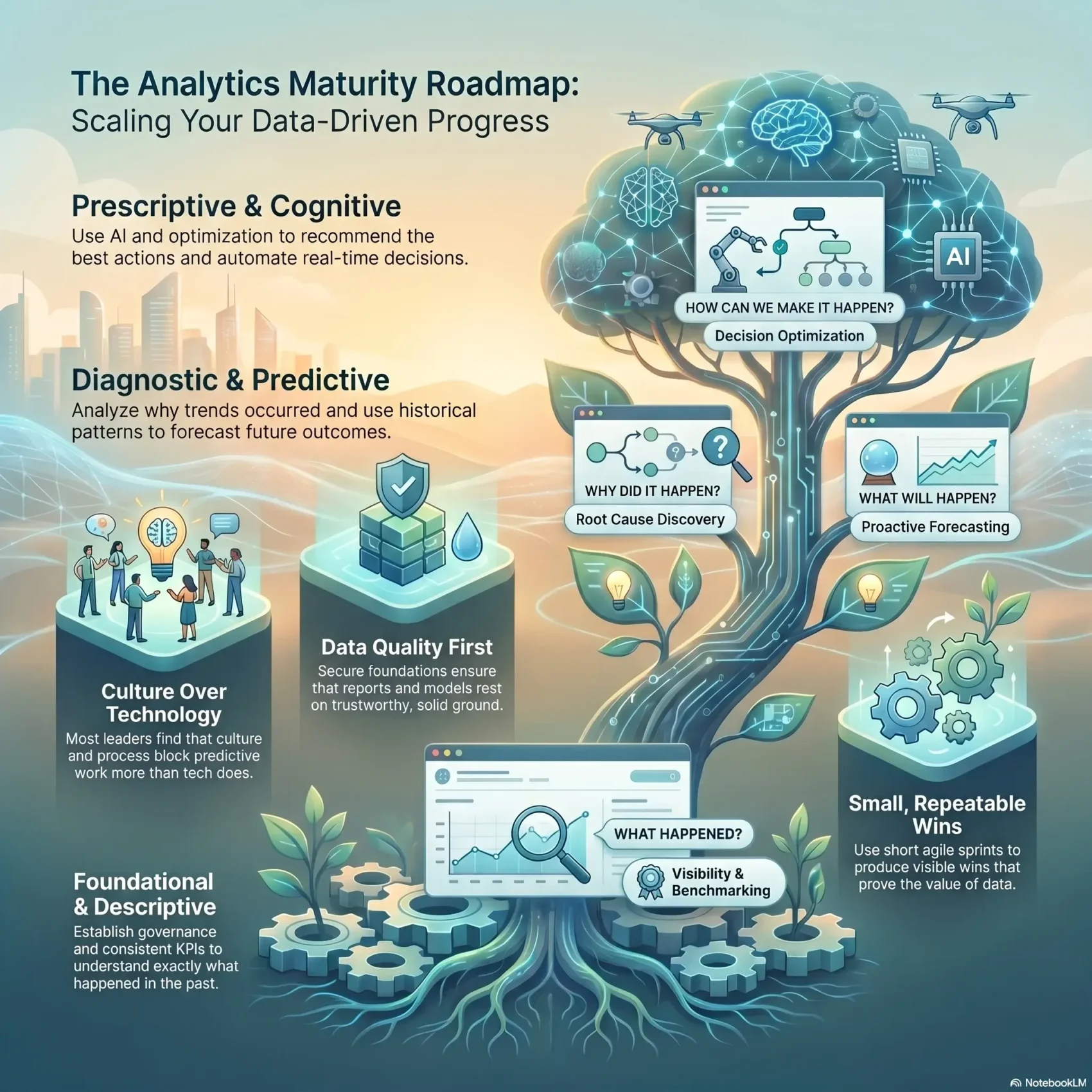
A clear framework defines stages your organization passes through: from foundational readiness through descriptive, diagnostic, predictive, and prescriptive work, up to real-time machine-assisted insight.
A practical framework to understand use and stages
Use the framework to spot strengths and gaps, align your team, and prioritize next steps. Foundations like governance, data quality, and culture are prerequisites for higher-value analysis.
Popular frameworks compared
- Gartner: question-driven and business-focused.
- SAS: scorecards and capability checkpoints.
- OECD & DAMM: governance and association-focused guidance.
Four core questions to map your roadmap
Match the four core questions—descriptive analytics (what happened), diagnostic analytics (why), predictive analytics (what will), and prescriptive analytics (how)—to your priorities and tools.
Tip: Measure progress by capabilities and outcomes, not tool count. As your maturity grows, predictive prescriptive thinking and the right machine techniques become practical and lower risk.
Stages of analytics maturity: from unstructured to cognitive
Progress looks like a ladder: basic reporting, stronger governance, then proactive forecasts and automated recommendations.
Unstructured
Unstructured
No strategy, scattered files, and ad‑hoc analysis leave you guessing. You’ll spot access gaps and short-lived reports that don’t scale.
Foundational
Establish data management, governance, and clear ownership. Trusted pipelines and inventories let your team stop fixing basic issues and start building reliable reports.

Descriptive analytics
Describe what happened with consistent KPIs, trend views, and benchmarking. Reports show where to focus next.
Diagnostic analytics
Compare periods, segments, and regions to find causes. That helps you link changes to specific actions.
Predictive analytics
Use historical patterns to forecast outcomes and prioritize opportunities. Learn when to add machine learning and explore predictive analytics in finance as an example.
Prescriptive analytics
Run what‑if scenarios and optimization to choose the best course under constraints. Align options with business goals and budgets.
Cognitive analytics
Once data is centralized, combine machine learning and NLP for near real‑time insights at scale. This is where automated decisions and fast feedback loops shine.
“Start where you are. Build the basics, then add complexity with confidence.”
- Spot unstructured signals and stop flying blind.
- Secure foundations so reports and models rest on solid ground.
- Move from descriptive to diagnostic to predictive and prescriptive steps, then plan for cognitive capabilities.
How to assess your current analytics maturity level
Begin with a practical audit: list your sources, check who has access, and note gaps in tools or processes. This quick scan shows what you can use today and what needs fixing.
Questions to ask: data sources, access, tools, and governance
Inventory internal sources (CRM, web tracking, customer feedback) and external feeds (ad platforms, public datasets). Ask targeted questions about completeness, latency, and access controls.
Check governance and management: who owns each source, and are there policies that block reuse?
Prioritizing metrics that answer “why” and “how”
Move beyond totals. Track behavior signals that explain why customers convert and how to improve flow. Pick metrics that link to decisions and value.
Stakeholders and collaboration: breaking silos to share insights
Define roles, handoffs, and sprint cadences so your team shares findings with stakeholders fast. Match tools to skills—BI for non‑technical users; warehouses like BigQuery and dbt for SQL work; ML platforms when you run a readiness check for predictive analytics.
- Document capabilities across governance, quality, access, and modeling for a baseline review.
- Prioritize resources to fix blockers and enable wider analysis across your organization.
Roadmap to advance your analytics maturity
Focus on small, repeatable wins that prove the value of better data and faster insights. Start with people and simple processes that remove blockers. Then layer lifecycle habits and the right technology so projects deliver steady value.
People and process: build a lasting team culture
Effective data work is a team sport. Define roles, run regular rituals, and give enablement so your team shares findings beyond the core group. Culture and clear handoffs are often the top barrier to scaling.
Lifecycle and agile coordination
Use a life cycle from framing to deployment and iteration. Break work into short sprints so projects produce visible wins and measurable learning.
Technology stack and tools
Select tools that match your stage: BI for quick views, warehouses for scale, dbt for modeling, and ML platforms when you are ready to productionize learning.
Data quality and management
Strengthen foundation elements. Fix lineage, definitions, and governance first so every model and dashboard reflects consistent truth.
From predictive to prescriptive
Run controlled experiments, build what‑if scenarios, and use optimization to recommend the best next action. That turns forecasts into decisions.
Marketing case: plan campaigns with a clear path
Forecast seasonal demand, test creative for buyers versus end users, and shift budget based on predicted lift. Formal metrics and feedback loops help you retire low‑value work and scale the rest.
- You’ll codify a repeatable approach for cross‑team work.
- You’ll plan resources and solutions so growth is sustainable.
- You’ll deliver incremental projects that compound into capability.
Conclusion
Start small with reliable reports; higher‑value forecasts and recommendations come later. Move step by step through the analytics maturity model: descriptive tells what happened, diagnostic explains why, predictive forecasts what will occur, and prescriptive recommends the next action.
Don’t rush into artificial intelligence. Invest in first‑party data and quality first. Upgrade people, process, and collaboration so your team can turn analysis into clear decisions that deliver business value.
You’ll leave with a simple framework to assess your level and pick one or two pilots to run this month. Track outcomes, communicate progress to leadership, and revisit your roadmap as the organization grows.
Found this useful?
Make SmartKeys a preferred source on Google, and our articles will surface more often in your Top Stories, AI Overviews, and AI Mode.
Add as Preferred Source