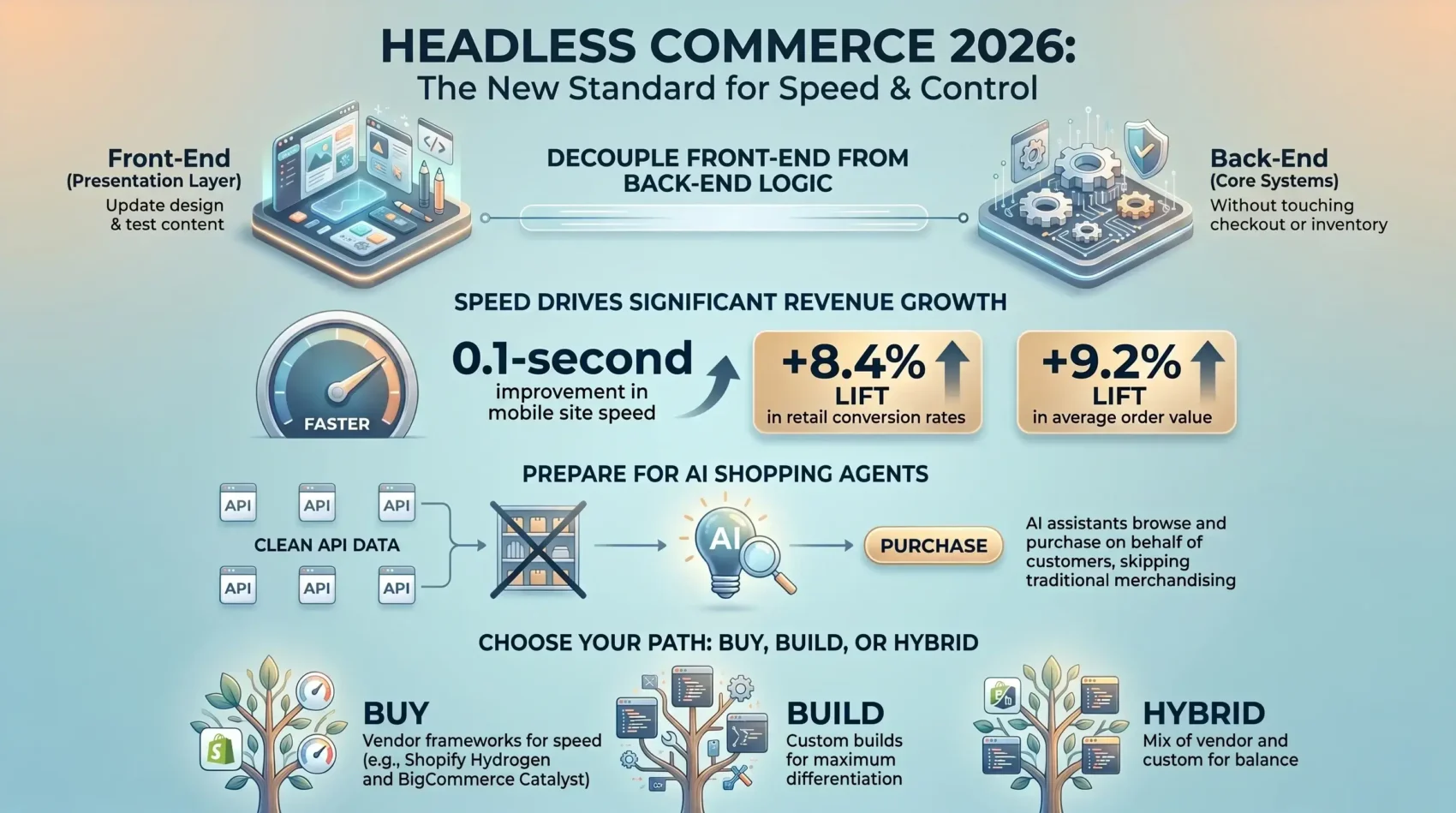
You need speed, control, and the ability to change your storefront without disrupting operations. Headless commerce is one way to get there. It separates the front end, meaning the pages shoppers actually see, from the back end that holds products, prices, stock, and orders. The two halves talk to each other through APIs, the standard interfaces one piece of software uses to request data from another.
The tooling has matured. Shopify’s Storefront API now pairs with the Hydrogen framework and Oxygen hosting, and BigCommerce ships Catalyst, an open-source storefront built on Next.js and released under an MIT license, which means you can use and modify the code freely. What was a custom engineering project five years ago is now a supported product path on both platforms.
Two things changed the calculation in 2026. Core Web Vitals put hard numbers on the page speed you owe shoppers. And AI shopping assistants became a real channel, with open protocols behind them. Both reward stores that expose clean data and ship front-end changes quickly.
This guide weighs the benefits, the real costs, and the practical steps, so you can decide whether the model fits or whether your current platform is still the better answer.
Key Takeaways
- You can update the storefront independently from back-end systems to speed testing and releases.
- APIs, content systems, and developer tools deliver consistent content and commerce across every channel.
- Shopify Hydrogen and BigCommerce Catalyst turn composable builds into a supported product path.
- Expect a trade-off: more flexibility and performance headroom against added development effort.
- Clean product data is what AI shopping agents read, so the architecture decides how ready you are.
- Phased rollouts prove value quickly and keep migration risk contained.
What This Guide Covers
The sections below compare decoupled storefronts with traditional platforms so you can choose deliberately.
- How to scope investment, manage ongoing costs, and ask vendors the right questions
- What Shopify Hydrogen with Oxygen and BigCommerce Catalyst give you out of the box
- Phased rollout plans that prioritize listing pages, product pages, and checkout
How Headless Commerce Works
Separating presentation from business logic lets your team change the shopping experience without touching core systems.
Decoupling the Front End and Back End
When you split the front end from the back end, you reduce risk while iterating on design and content. Teams update layout, copy, and tests without redeploying the commerce engine that processes orders.
Picture a retailer launching a spring campaign. On a coupled platform, the new landing template ships inside a full platform release, scheduled around a quiet week. On a decoupled storefront, the front end deploys on its own and checkout never moves.
This model supports several channels at once: web, mobile, point of sale, and in-store kiosks, all reading from the same product record. It is the same architectural idea behind blending online and in-store journeys, where the customer expects one catalog no matter which screen they touch.
API-First Architecture Across Channels
An API-first design means every function is exposed as a service before any interface is built. APIs standardize access to catalog, pricing, promotions, and inventory, so you build a capability once and deliver it everywhere. That reuse is the core of the API economy.
- You reduce deployment friction with a clear separation of concerns.
- Content systems, CRMs, and a customer data platform connect through the same API layer.
- Gateways, authentication, and caching keep performance and reliability predictable in production.
- Middleware, or an integration platform as a service, handles the plumbing to your finance system (ERP), product data system (PIM), and order management system (OMS).
Headless vs. Traditional Ecommerce: How the Architectures Differ
Your storefront and back-end services can be tightly linked or separated. That choice affects speed, cost, and future growth.
Monolithic Coupling Versus Decoupled Services
Traditional ecommerce ties the presentation layer to back-end logic in one system, often called a monolith. You launch fast with themes, drag-and-drop tools, and built-in features from a single platform, and one vendor owns the upgrade path.
Deep customization gets harder over time. Theme dependencies also raise regression risk, meaning a change in one place quietly breaks something else.
Speed, Flexibility, and Scalability Trade-Offs
A decoupled model separates the layers so your team can innovate on the front end without touching core systems. That shortens the loop for experiments and new channels.
Expect more coordination between teams and more code you own. In return you get stronger scalability and easier cross-channel delivery, which matters when mobile drives the majority of ecommerce sales but still converts below desktop.
Cost Profiles and Resource Requirements
Traditional platforms usually have lower upfront costs and predictable maintenance. That is why small teams and early-stage stores often stay on them.
A decoupled build requires higher initial investment and standing developer capacity. In exchange it removes the release bottleneck for teams shipping constantly. Choose based on team size, roadmap, and tolerance for upfront cost.
The Core Benefits You Can Realize Right Now
You can see tangible wins when you separate the presentation layer from core systems. The clearest one is performance, and performance is now measured against published thresholds.
Performance You Can Measure Against a Public Benchmark
Core Web Vitals are Google’s three published page-experience metrics. Largest Contentful Paint (LCP) measures how long the main content takes to appear and should stay within 2.5 seconds. Interaction to Next Paint (INP) measures how quickly the page responds to a tap or click and should stay within 200 milliseconds. Cumulative Layout Shift (CLS) measures how much the layout jumps while loading and should stay below 0.1. INP replaced First Input Delay in March 2024, which raised the difficulty for storefronts carrying heavy third-party scripts.
Google measures these at the 75th percentile of real visits, so at least three quarters of sessions must clear the threshold.
Speed pays. In research commissioned by Google and carried out by 55 and Deloitte across 37 European and American brand sites and more than 30 million sessions, a 0.1-second improvement in mobile site speed lifted retail conversion rates by 8.4% and average order value by 9.2%.
Decoupling helps because you scale and optimize the front end independently. Edge caching, which serves pages from servers near the shopper, plus framework choice and a budget for third-party scripts, all become your decisions rather than a theme’s.
Faster Time to Market and Safer Front-End Changes
Teams push front-end updates without risking checkout or inventory. The result is fewer rollbacks, shorter release cycles, and campaign pages that go live when marketing needs them.
Cross-Channel Experiences Without Rebuilding the Back End
Progressive web apps, native apps, kiosks, and in-store screens all read from shared services. One catalog can feed an augmented reality try-on, a marketplace listing, or a resale channel without a second integration.
Team Efficiency Without Back-End Bottlenecks
Parallel development speeds delivery. Marketing and design can experiment without waiting in a developer queue, and shared pricing and catalog services keep every channel synchronized.
Costs, ROI, and How to Control Your Investment
Knowing where your money goes helps you choose the right platform and partners. Start by separating one-time build costs from recurring spend so you can plan realistically.
Budgets vary enormously. A single-channel build on a starter framework is a small project. A multi-brand, multi-region replatform is a program with its own maintenance line. Get written estimates rather than working from published benchmarks. Scope, integration count, and content migration drive the number far more than the platform license does.
Upfront Build Versus Ongoing Maintenance
Break costs into clear buckets: design and development, integrations, hosting, content and search subscriptions, and agency fees. That forecast is your total cost of ownership, the full multi-year bill rather than the sticker price.
Front-end hosting and API call volume are variable costs that behave like cloud spend. The same discipline applies, so the habits behind FinOps and cloud cost optimization translate directly to a composable stack.
Vendor Vetting: Questions That Surface Hidden Costs
- Can the vendor deliver your required experience and handle every integration on your list?
- What implementation and post-launch support is included, and for how long?
- How are upgrades, service level agreements, overage on API calls, and account management billed?
Control scope and define success metrics up front. Use a phased implementation to prove value, and build a return model that ties conversion gains and release speed to the investment.
Implementation Paths: Buy, Build, or Go Hybrid
Deciding whether to buy, build, or blend affects speed, cost, and long-term control. Pick the path that matches your timeline and what you must own versus what you can outsource.
Off-the-Shelf Frameworks and Templates
You can accelerate launch with vendor-maintained starters. Shopify Hydrogen with Oxygen hosting and BigCommerce Catalyst both ship reference storefronts, components, and developer kits you can deploy on day one and customize afterwards.
Build Your Own for Maximum Control
When a distinctive experience is your differentiator, a custom build gives you full control. Expect longer timelines, more maintenance, and a permanent line item for developer capacity.
Hybrid: A Best-of-Breed Balance
A hybrid approach lets you own the parts that differentiate and buy the commodity services. That reduces risk while keeping the important surfaces under your control, and it is how most business model changes actually get delivered.
“Start small: validate a proof-of-concept, then scale with governance and versioning in place.”
- Compare buy versus build by return and time-to-market, not by preference.
- Plan proof-of-concept milestones, resourcing, and on-call coverage before you scale.
For extra reading on chat-driven and messaging-led selling, see conversational commerce.
Your Modern Commerce Stack
A modern stack stitches APIs, content systems, and edge delivery into fast, personalized shopping experiences. Map the core layers so each can scale and be replaced independently: API gateway, commerce engine, content management system (CMS) or digital experience platform (DXP), search, payments, and analytics.
Shopify Storefront API, Hydrogen, and Oxygen
The Storefront API exposes cart, product and collection data, search, recommendations, contextual pricing, subscriptions, and B2B features, and it works with any front-end framework. Hydrogen is Shopify’s React storefront toolkit, now built on React Router rather than Remix. Oxygen is the edge hosting Shopify describes as included with the Hydrogen channel, so it does not arrive as a separate hosting contract.
BigCommerce Catalyst and Composable Integrations
Catalyst is BigCommerce’s storefront framework. It is built on Next.js with React server components, which render parts of the page on the server to cut the JavaScript shipped to the browser, and it reads data through the GraphQL Storefront API. The code sits on GitHub under an MIT license with regular versioned releases, so you start from a working B2C funnel rather than an empty repository.
MACH Principles and Composable Patterns
MACH stands for microservices, API-first, cloud-native, and headless. Follow those ideas and you can swap search, personalization, or payments as needs change without rebuilding the core. That flexibility is also where embedded finance and buy now, pay later options plug in.
- Pair a headless CMS or a digital experience platform with your commerce back end.
- Progressive web apps, websites that install and behave like native apps, give app-like speed on mobile.
- Secure and govern the API layer with caching, rate limits, and monitoring.
- Decide early where the stack runs; a hybrid cloud strategy often outlives the storefront itself.
Getting Agent-Ready: Selling Through AI Assistants
A new buyer arrived: software. AI assistants now browse, compare, and in some flows complete checkout on a shopper’s behalf. They read structured data rather than your design, so your merchandising never reaches them.
Open standards appeared quickly, and 2026 brought consolidation. Stripe and OpenAI published the Agentic Commerce Protocol (ACP) on 29 September 2025, letting merchants expose products, pricing, and checkout to AI agents through one integration while keeping their own payment provider, tax handling, and fulfillment. The specification is still maintained by both companies.
Google announced the Universal Commerce Protocol (UCP) on 11 January 2026, developed with Shopify, Etsy, Wayfair, Target, and Walmart, and endorsed by more than 20 partners. In April 2026 Google donated its Agent Payments Protocol (AP2), which handles payment authorization, to the FIDO Alliance, the industry body behind passkeys, putting a competing standard under neutral governance.
Platforms are wiring this in. Shopify’s Winter 26 Hydrogen update added Storefront MCP, so a headless store can run its own AI assistant on live product and customer data, and Shopify Catalog, which makes headless storefronts discoverable by assistants such as ChatGPT and Perplexity.
Headless architecture helps here for a structural reason. If your catalog, pricing, and inventory already sit behind clean APIs, exposing them to an agent is an integration, not a rebuild. Stores whose product data only exists inside a theme have more work to do.
- Keep product, price, and availability data accurate at the API level, not just on the page.
- Expect agent traffic to skip your merchandising, so put the value in the data.
- Watch where agent workflows touch service and returns, not only the purchase, and give agent-driven orders their own attribution.
The standards have not settled, so treat this as a channel to prepare for rather than a finished platform. Work also shifts toward post-purchase service and voice of customer analysis, because a shopper who never saw your storefront still forms an opinion of your brand.
Phased Rollouts: Reduce Risk and Prove Value
Start small with targeted releases so you can prove value fast and limit disruption.
Prioritize high-impact journeys such as product listing pages, product detail pages, and checkout. Those pages drive the most immediate conversion and give you measurable wins early.
Prioritize Listing Pages, Product Pages, and Checkout
Scope a pilot that targets those pages first, focused on Core Web Vitals and clean product data.
- Define your success metrics before you build: LCP and INP, conversion rate, and error rate.
- Coordinate content and product changes with front-end releases.
- Use feature flags, switches that turn a new page on for a slice of traffic, so you can roll back in minutes.
Measure, Learn, and Iterate
Run staged deployments and use A/B tests, which show two versions to comparable groups of shoppers, to validate changes without disrupting the store. Compare field data from real visits rather than lab scores from a test tool.
Manage dependencies across APIs, search, and payment services so development keeps flowing. Brief the commercial side too, because your sales and account teams need to know what changed and when.
“A phased approach reduces risk and accelerates time-to-value while keeping teams aligned.”
Is Headless a Fit for Your Business Today?
Replatforming is a practical choice, not a trend chase. Match technical signals to business goals so you pick a path that supports growth instead of creating a maintenance burden.
Signals You Are Ready
Look for clear blockers. Slow pages you cannot fix inside the theme, repeated integration failures, or personalization limits usually mean the platform is constraining growth.
- You fail Core Web Vitals on key templates and the theme gives you no room to fix it.
- Multiple channels need tailored experiences you cannot deliver today.
- Your release queue is the reason campaigns ship late.
- You want to expose your catalog to marketplaces, agents, or partners.
Proceed With Caution: Capacity and Opportunity Cost
Balance ambition with reality. Without developers, governance, or partner bandwidth, a large replatform will stall your other priorities.
- Weigh hiring plans and partner availability against scope and timelines.
- Estimate the opportunity cost if replatforming delays near-term growth.
- Reduce risk with a narrow pilot or a single-channel rollout first.
Decision framework: define thresholds for traffic, revenue, and channel complexity, then use a short proof-of-concept to validate the gains before you commit. The economics resemble any platform business decision. The value shows up once volume and channel count are high enough to pay for the flexibility.
Conclusion
An API-first storefront lets you ship richer experiences while core systems stay stable. Your team gains the flexibility to iterate on product pages and checkout without long waits, and performance becomes something you can engineer rather than inherit.
The supporting products are real now: Shopify’s Storefront API with Hydrogen and Oxygen, and BigCommerce Catalyst on Next.js. Phased rollouts focused on listing pages, product pages, and checkout prove the value quickly, and clean APIs leave you ready for the agent-driven channel taking shape.
Your playbook: align goals, vet vendors on total cost, choose buy, build, or hybrid, and measure outcomes against Core Web Vitals and conversion. For more context on where the market is heading, see e-commerce trends.
Found this useful?
Make SmartKeys a preferred source on Google, and our articles will surface more often in your Top Stories, AI Overviews, and AI Mode.
Add as Preferred Source