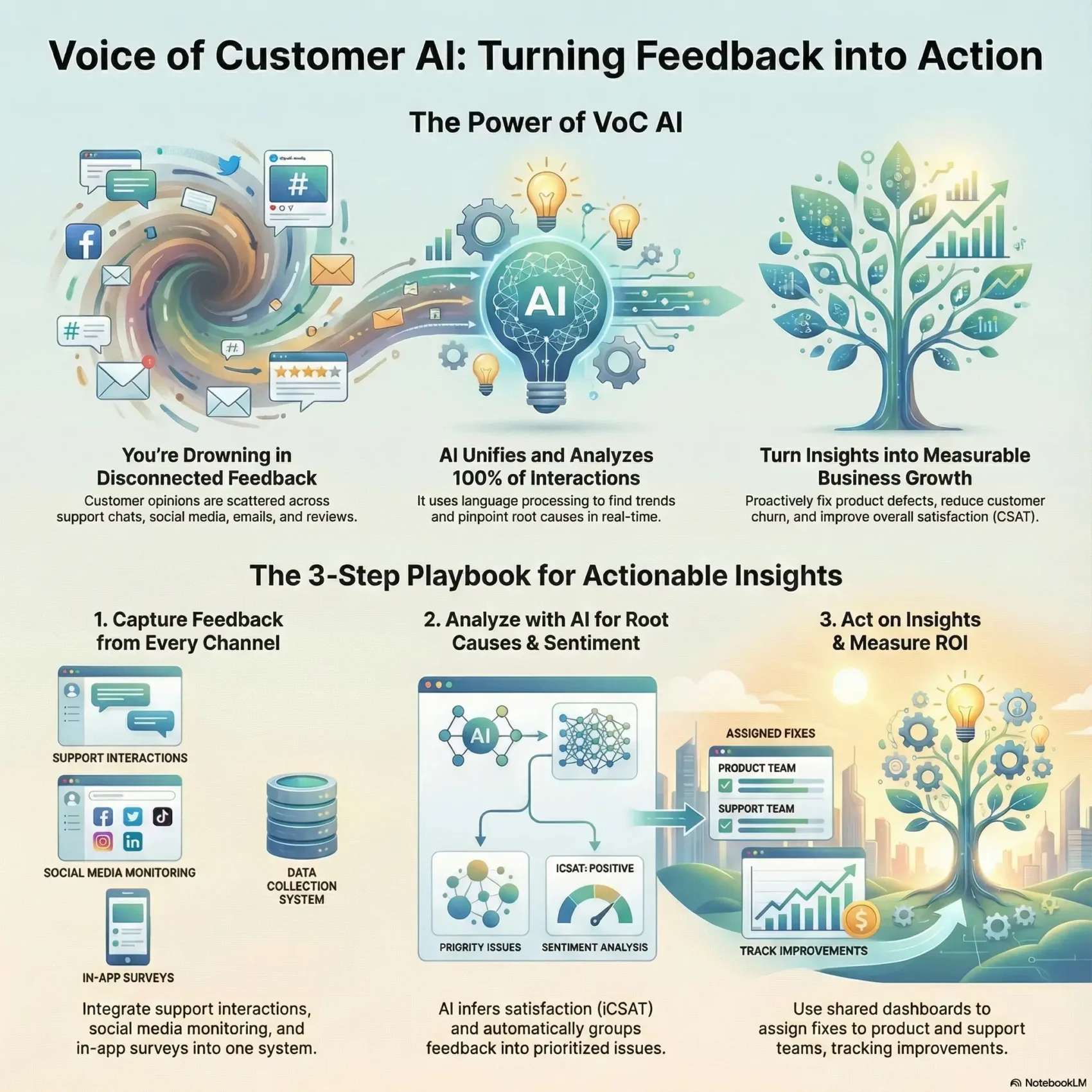
Voice of the customer, usually shortened to VoC, means everything your customers tell you about their experience. Support chats, emails, recorded calls, survey answers, app store reviews, social posts. Most companies collect all of it and read almost none of it.
Voice of customer AI is software that reads the whole pile for you. It sorts messages into themes, scores how satisfied each person sounded, and points at the step that caused the complaint. Instead of a spreadsheet of survey scores, you get a ranked list of problems with a customer count next to each one.
A concrete example. A subscription business handles 4,000 support contacts a month and gets survey answers from roughly one in twenty. A VoC system reads all 4,000, finds that 300 of them describe a failed card update, and traces those to a single broken screen in the billing flow. That is a product ticket, not a staffing problem, and nobody would have seen it in the survey sample.
This guide is written for the person who has to buy one of these tools. It covers what the software really does, how the vendor market shifted in 2026, how to run a pilot that proves something, and the EU rules that began applying in August 2026.
Key Takeaways
- VoC AI reads every customer message, not just the small share who answer surveys.
- Inferred satisfaction scores fill the gap where no survey exists, so coverage stops being the limit.
- The core decision is built-in versus standalone: speed of setup against breadth of coverage.
- 2026 brought heavy consolidation, so check who owns a vendor before you sign.
- Emotion analysis carries disclosure duties in the EU and is banned outright for employees.
Why voice of customer AI matters right now
Two things changed. Complaints travel faster than they used to, because a bad experience becomes a public post within minutes. And the volume of written customer contact keeps rising as chat and messaging replace phone calls.
That combination breaks the old method. Surveys reach a small, self-selecting group: people who are delighted or furious. Everyone in between goes unrecorded, and the problems that quietly cost you money never make the report.
The practical question is not whether to listen, but what you do with what you hear. A VoC program earns its budget when it produces a short list of fixable causes, each with an owner and a deadline. If it produces another dashboard nobody opens, it has failed.
“Tie the budget to outcomes you can measure: higher satisfaction, shorter handling times, fewer repeat contacts, better retention.”
Start by deciding scope. Will you use the reporting already built into your help desk, or add a separate platform that also watches social media, review sites and your website? That single choice drives cost, setup time and who ends up owning the program. The sections below work through both options.
From VoC to CXM: grounding the program in experience management
Customer experience management (CXM) is the wider practice of designing and improving every step a customer goes through, from first advert to renewal. VoC is the listening part of it. Keeping the two connected is what stops analysis from ending in a report nobody acts on.
Core components: journey mapping, feedback loops and consistency
Start with a customer journey map, which is simply a written list of the steps a customer takes with you: finding you, signing up, paying, getting help, renewing. Mark the steps that matter most and the handoffs where things break, such as a chat that gets passed to a phone team with no context.
Then put a feedback loop at each of those steps. An in-app prompt after setup, a short survey after a support case is closed, a follow-up call for cancelled accounts. The point is to capture the reaction while the experience is fresh, not three months later in an annual study. A culture that treats those signals as normal input matters more than the software you buy.
Customer insights versus customer sentiment
These two words get used interchangeably, and they should not be. Sentiment is how a customer sounded: positive, negative, frustrated, relieved. An insight is a finding you can act on, such as “customers who change payment method fail at the confirmation step, and 300 of them contacted us last month”.
Sentiment is an input. Insight is the output. Teams that report sentiment alone end up arguing about whether the score went up, instead of fixing anything.
- Governance: agree one list of topic names so results from different regions and channels can be compared.
- Consistency: make sure what marketing promises, what the product does and what support says all match.
What voice of customer AI actually does
Underneath the marketing, these products do three jobs: they read text, they group it, and they score it. Everything else, including the way results get presented to executives, sits on top of those three.

Natural language processing and emotion detection
Natural language processing (NLP) is the technique that lets software read ordinary sentences rather than fixed form fields. A basic system tags a message as positive or negative. A good one reads the whole exchange, so it understands that “great, another failed payment” is sarcasm and not praise.
Emotion detection goes one step further and labels the feeling: disappointment, confusion, relief. That extra detail is useful for coaching and for spotting a design problem, since confusion and anger point at different fixes. It also carries legal duties in the EU, which the compliance section covers.
Inferred CSAT and root cause detection
CSAT means customer satisfaction, normally measured by asking people to rate an interaction. The problem is response rate: most interactions never get rated at all.
Inferred CSAT, often written iCSAT, is the model’s own estimate of how satisfied the customer was, produced from the conversation itself and expressed on a 0 to 10 scale. It is an estimate, not a survey answer, so treat it as a trend line rather than a precise figure. Its value is coverage: every interaction gets a score, so a problem affecting a quiet, non-responding group finally becomes visible.
Root cause detection is the grouping step. The system clusters messages that describe the same underlying issue, such as a broken payment step, a confusing refund policy or a defect in one product line, and shows how many customers each cluster represents. That is what makes prioritisation possible: you fix the cluster with the most people behind it, not the one that generated the loudest email.
- Score sentiment across chat, email and voice transcripts in one place.
- Use the customer counts to build a business case product teams can act on.
Channels your VoC program should cover
Map the places customers actually talk to you, then start where problems surface first. Trying to cover everything in month one is the most common way these programs stall.
Customer support: chat, email and the contact centre
This is usually the richest source and the best place to begin, because the customer is already describing a problem in detail. Capture the full transcript rather than a disposition code chosen by a rushed agent. Complete capture is also what makes inferred satisfaction meaningful, and it links directly to the themes in how service teams are being reorganised around AI.
Social media and review sites
Social listening tools such as Brandwatch, Sprinklr or Mention watch public posts and reviews for mentions of your brand. They are an early-warning system rather than a diagnostic one: they tell you something is spreading, and support transcripts tell you why.
On-site and in-app feedback
Website and app tools combine short surveys, exit prompts and session replay, which records what a user did on screen. Pair the two and you can see the drop-off and read the explanation next to it, which is exactly the gap that pure behavioural analytics leaves open.
- Mix asked-for and volunteered feedback. Surveys tell you about the moments you chose; tickets and reviews tell you about the ones you missed.
- Set access rules early. Transcripts contain personal data, so decide who can see raw records before you switch anything on.
Market landscape in 2026: the categories you will compare
Four categories cover almost every shortlist, and 2026 was an unusually eventful year for all of them.
Built-in VoC inside support suites
Help desk platforms such as Zendesk and Intercom now analyse ticket and chat content natively. The appeal is speed: the data is already in the system, so there is no integration project, and the reporting sits where agents and team leads already work. Our reviews of Zendesk against Freshdesk and Intercom against Help Scout go through those plans in detail.
Enterprise experience platforms
Sprinklr and comparable platforms unify social, review, messaging and support channels in one place, with alerting and cross-channel trend detection. They suit organisations where brand, product and service teams need to look at the same data.
Survey and experience management specialists
This is where the market moved most. Qualtrics completed a $6.75 billion acquisition of Press Ganey Forsta on 18 May 2026, folding a large healthcare experience business and a survey research business into one vendor.
Medallia went the other way. In June 2026, Thoma Bravo handed the company to its lenders in a restructuring led by Blackstone, with Apollo and KKR taking part; the lender group injected $150 million of new capital and cut the debt. The product continues, but ownership changed hands entirely, and that is worth asking about in a procurement conversation.
Digital experience analytics
Hotjar is now part of Contentsquare, and hotjar.com redirects there. What used to be a single product is sold as three separately priced lines: Experience Analytics, Voice of Customer, and Product Analytics, each with its own free tier and its own subscription. If you assumed one Hotjar plan still covers heatmaps and surveys together, price it again.
“Consolidation is not automatically bad, but it changes roadmaps and renewal terms. Ask who owns the vendor and what the support commitment looks like after the deal.”
How to choose: evaluation criteria that separate the tools
Judge these systems on how reliably they turn raw messages into a next step. Vendor demos use clean sample data, so insist on yours.
Reading quality
Send a set of your own transcripts, including the messy ones. Check how the system handles negation (“the refund did not arrive”), sarcasm, industry jargon and any language other than English that your customers use. Ask to see the topic groups it produces and whether a human can rename or merge them.
Scoring quality
Compare inferred satisfaction against real survey answers for the same interactions. A useful system tracks the survey trend closely even if individual scores differ. Ask how the vendor tests for bias across accents, dialects and customer segments, and how often models are retrained.
Reporting and drill-down
You should be able to move from a trend line to the individual transcript behind it in a couple of clicks. If a finding cannot be traced back to real customer words, nobody in product will act on it.
Integrations and access control
Check the connections to your help desk, your CRM and your warehouse, because feedback becomes far more useful once it sits beside your other business data. Confirm export options, audit logs and role-based permissions before you commit. Weak input data quality will undermine even a strong model.
- Test with your own transcripts, never the vendor’s samples.
- Ask for a written accuracy comparison against your existing survey scores.
Built-in VoC versus standalone platforms
If your goal is a faster, better support operation, the reporting inside your existing help desk usually gets you there sooner and cheaper. There is no integration work, no second contract and no separate login, and team leads adopt it because it is already in front of them.
Standalone platforms buy you breadth. Social listening, survey research, panel management and predictive modelling are rarely strong inside a help desk. Expect a longer implementation, real data engineering work and an internal owner whose job this is.
Where the built-in option runs out
Built-in tools tend to stop at your own channels. They will not tell you what people are saying on a review site, they rarely support serious survey research, and their models are usually tuned for support conversations rather than for the whole customer relationship.
- Choose built-in when the mandate is support quality and satisfaction.
- Choose standalone when brand, product and research teams all need the same data.
- Consider a split: daily operational reporting in the help desk, plus a research platform for company-wide programs.
“Compare total cost honestly: licences, implementation, data engineering and the internal time to run it.”
Designing your data and feedback architecture
Map how each interaction reaches a single, queryable place. Without that, you get several tools each holding a slice of the truth, which is how two teams end up presenting different numbers for the same month.
Unifying transcripts, surveys, reviews and social data
Agree one taxonomy first. A taxonomy here is just the agreed list of topic and intent names, such as “billing: card decline”. If support calls it one thing and product calls it another, no comparison works.
Enrich each record with a little context: product, plan tier, region, tenure. That is what turns “customers are unhappy about onboarding” into “customers on the entry plan in Germany are unhappy about onboarding”, which someone can actually own. A customer data platform is one common way to hold that context, and it pairs naturally with a first-party data strategy.
Survey design without bias
Keep surveys short and neutrally worded. Avoid leading questions, randomise answer order where the tool allows it, and watch who is not responding: if only English-speaking desktop users answer, your results describe them and nobody else. Feedback people volunteer without being asked, sometimes called zero-party data, is often more honest than a rating scale.
Finally, write a retention policy for transcripts and recordings, and enforce it.
Implementation roadmap: from pilot to scale
Run a narrow pilot that proves one thing, then expand. Programs that launch across every channel at once usually spend six months on plumbing and produce nothing anyone remembers.
Choosing pilot channels and measures
Pick one or two channels, normally chat and email, and set a fixed window of six to eight weeks. Choose a small set of measures: satisfaction, resolution time, repeat contact rate and the movement in your top three topic clusters.
Stand up one working view that lets a team lead go from topic to transcript. Use it in the weekly team meeting from day one, because a report that is not part of a routine gets ignored no matter how good it is.
Closing the loop and getting other teams involved
Route negative signals to a named owner with a response deadline. “Closing the loop” simply means someone follows up with the customer and the underlying cause gets logged, rather than the ticket being closed and forgotten.
Make the rituals real. A short weekly session between support, product and operations, where the top three clusters become backlog items, does more than any amount of alerting. This is the same discipline that makes retention work pay off.
- Feed recurring questions into help content and bot answers.
- Compare inferred scores against surveys each month to keep the model honest.
Measuring return: tying VoC to product and growth
Every insight needs an owner and a release date, otherwise there is nothing to measure. Track satisfaction, inferred satisfaction and the size of each topic cluster before and after a fix.
From root cause to roadmap. Link the big clusters, such as duplicate accounts, payment failures or a defect in one product line, to a cause and an owner. Then check the cluster shrinks after the release. A cluster that does not shrink means you fixed the wrong thing, which is useful to know early.
Where the money shows up. Savings come from fewer repeat contacts, shorter handling times and fewer escalations. Growth shows up as retention by cohort after a fix ships. Report both, and use the reporting stack you already have rather than building a parallel one.
- Show the cluster shrinking, not just the satisfaction score rising.
- Keep one living scorecard of issue, action, owner and result.
Rules, ethics and compliance
This section changed materially in 2026, and it is the part most buyers underestimate.
What the EU AI Act now requires
Two provisions apply directly to VoC work. Since 2 August 2026, Article 50 of the EU AI Act has required deployers of emotion recognition systems to inform the people exposed to them, and requires that anyone interacting with an AI system is told so, unless it is obvious. The information has to be given at the latest at the first interaction and in a clear, distinguishable way.
The stricter rule is older. Article 5 has prohibited emotion recognition in the workplace and in education since 2 February 2025, with narrow exceptions for safety and medical reasons. In practice that means you can analyse how a customer sounded, with disclosure, but you cannot run emotion analysis on your own agents. Scoring an agent’s tone in a coaching tool is exactly the use the prohibition targets. Our guide to EU AI Act compliance sets out the wider timeline, and the broader privacy picture is moving in the same direction.
Privacy and consent in practice
Say how feedback will be used and offer an opt-out. Connect to social accounts through authenticated connections rather than scraping public handles. Mask personal data in transcripts, store the minimum you need, and audit exports.
Reducing model bias
Ask vendors how they test performance across languages, dialects and customer groups, and what training data they used. Require human review before any model output affects a person, whether that is a customer decision or an internal score. Spot-check outputs monthly; a model that quietly drifts will keep producing confident, wrong labels.
- Write down who may see raw transcripts and log every export.
- Keep a short acceptable-use policy for AI summaries and recommendations.
Conclusion
Voice of customer AI is worth buying when you have more customer feedback than anyone can read, and a team ready to act on what it finds. It is not worth buying as a reporting layer nobody owns.
Start narrow. Prove that inferred satisfaction tracks your real survey results, fix one cluster, and show the cluster shrinking. Then extend to voice, social and website feedback.
Anchor the program in journey mapping, feedback loops and one agreed taxonomy, and check the compliance duties before you switch emotion analysis on rather than after. For the next step in joining up conversational channels, see our guide to conversational commerce.
Found this useful?
Make SmartKeys a preferred source on Google, and our articles will surface more often in your Top Stories, AI Overviews, and AI Mode.
Add as Preferred Source