The planning fallacy is the habit of expecting work to take less time than it actually does. Daniel Kahneman and Amos Tversky named it in 1979, and researchers have found the same pattern ever since. You know that a report like this one took two weeks last time. You promise it in one anyway.
The strange part is that other people see your timeline more clearly than you do. Ask someone outside the project how long it will take and you usually get a longer answer. That answer is usually closer to the truth. The gap between the two is where missed deadlines, budget overruns and ruined weekends come from.
This article explains why the bias happens, what it costs a business, and which guardrails actually make estimates more honest. The methods scale down to a personal to-do list and up to a project with five teams and a vendor.
Key Takeaways
- Schedules are optimistic by default, and experience alone does not fix that.
- Knowing about the bias is not enough. A process that forces a reality check is.
- How similar work actually finished is the best single input for a new estimate.
- Ranges, buffers sized by risk and one skeptical reviewer beat a single confident date.
- Logging predicted against actual durations turns every project into data for the next one.
What the planning fallacy is, in plain terms
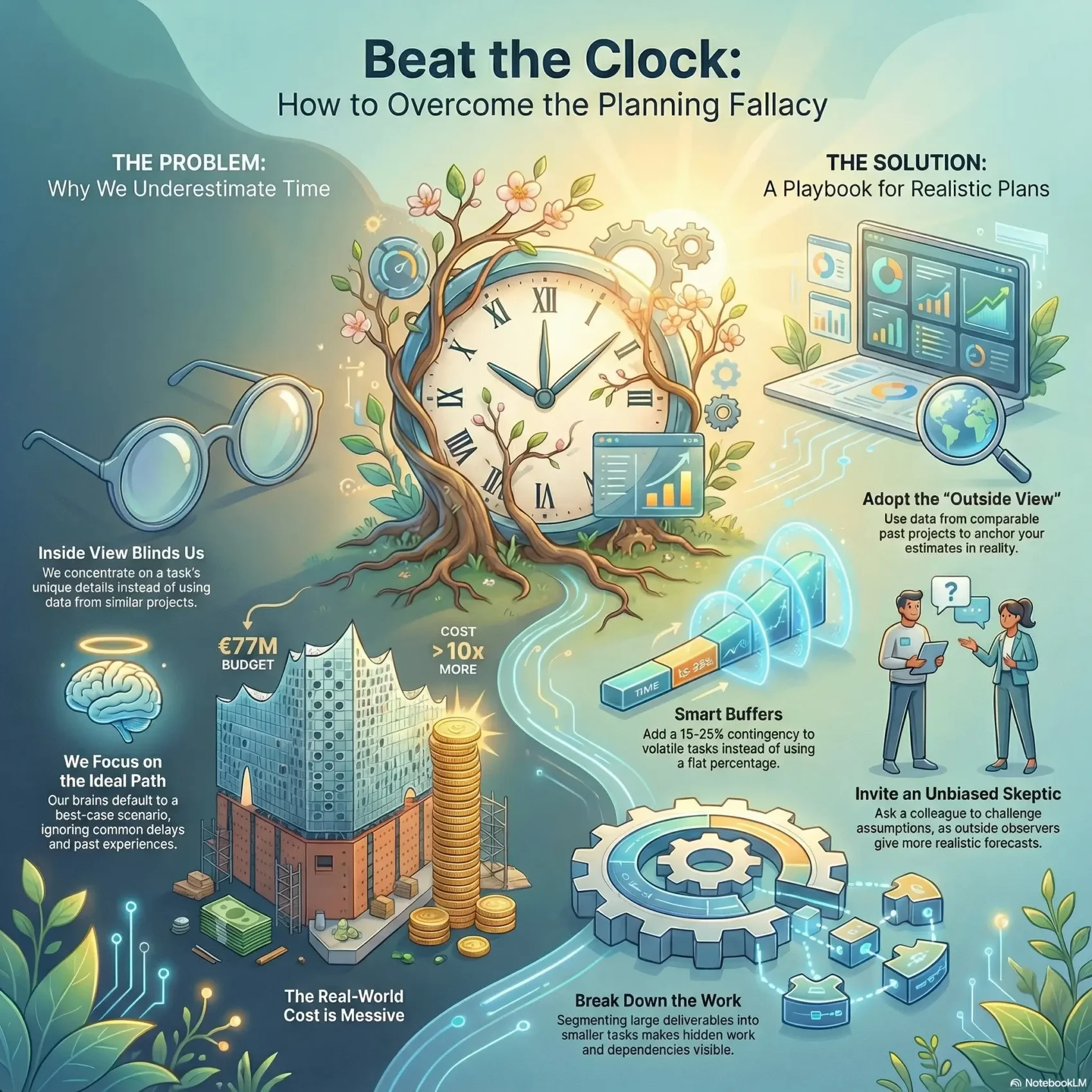
When you plan a task, your mind runs the ideal version of it. You picture the work itself, not the day you spend waiting for someone to reply, or the review round that sends you back a step. Kahneman and Tversky described this as a clash between the story you tell about this particular job and the boring statistics of similar jobs.
The classic demonstration comes from Roger Buehler, Dale Griffin and Michael Ross, published in the Journal of Personality and Social Psychology in 1994. They asked final-year students when they would finish their thesis. The average prediction was 33.9 days. The average reality was 55.5 days. Only about 30 percent finished inside their own estimate.
The same line of research showed how little confidence helps. When students named a date they were 99 percent sure they could hit, fewer than half made it.
The inside view and the outside view
Two ways of estimating sit behind almost everything in this article.
The inside view looks at the task in front of you. You break it into steps, add up the hours, and get a number. It feels rigorous. It quietly assumes nothing goes wrong.
The outside view ignores the details and asks a different question: how long did work like this take before? That question feels lazy and produces better numbers, because past results already contain all the interruptions you are about to forget.
Why knowing about the bias does not cure it
People stay optimistic even after being shown their own track record. Part of that is optimism bias, the general tendency to expect better outcomes than the base rate supports. Part of it is memory. You remember the projects that went well more vividly than the ones that dragged, so your mental sample is already skewed.
Anchoring adds another layer. Once a date is spoken out loud, every later estimate drifts toward it, even when the first number was a guess. This is a close cousin of the sunk cost trap, where past investment keeps a plan alive that the evidence no longer supports.
Where you meet it in ordinary work
A student swears the paper will take three days, although the last three papers each took a week. That is the textbook case, and every workplace has its own version.
Software teams commit to a clean sprint, then lose days to integration problems, a slow code review and a test suite that fails on the build server. Marketing teams schedule a campaign around a launch date that legal has not confirmed. Anyone who has renovated a kitchen knows the pattern outside work too.
Three blockers show up again and again:
- Waiting. Feedback, approvals and vendor replies rarely arrive on the day you assumed.
- Switching. Every jump between tasks costs a few minutes of refocus, and those minutes are never in the estimate. If you lose track of where your hours go, time blindness is worth understanding on its own.
- Hidden work. Setup, data cleanup, handover notes and the second round of edits are real tasks that nobody writes down.
Treat the words “quick win” and “just a tweak” as alarms. They almost always mean the speaker has not looked at the steps.
What it costs a business
An optimistic date is not a harmless date. It sets budgets, staffing and customer promises that then have to be walked back.
At project scale the numbers are stark. Bent Flyvbjerg, who has built a database of more than 16,000 large projects at Oxford, reports that 47.9 percent come in on budget, 8.5 percent come in on budget and on time, and just 0.5 percent hit budget, schedule and the benefits that were promised. His book with Dan Gardner, How Big Things Get Done (2023), sets out the method behind those figures.
Two public examples make the pattern concrete. The Sydney Opera House was meant to open in 1963 for about 7 million Australian dollars. It opened in 1973 and cost 102 million. Hamburg’s Elbphilharmonie was scheduled in 2007 to be finished by 2010 at an estimated 241 million euros. It opened in January 2017 at 866 million.
White space risk: the work nobody put on the plan
White space risk is the gap left by items that are not on the timeline at all. Permits, licences, security reviews, a third-party approval, a data migration nobody owns.
These gaps hurt more than a bad estimate does, because they stop the line rather than slowing it. A task you underestimated by 40 percent still moves. A permit you never applied for does not. Running the plan past a simple risk management framework is usually enough to surface them.
Firefighting crowds out the review that would have helped
When schedules slip, teams spend the week on whatever is loudest. Vendor lead times and design reviews get pushed, which creates the next slip. The Eisenhower Matrix is a useful sorting tool here, and a habit of deciding what genuinely matters protects the work that prevents future emergencies.
How to tell your own estimate is too optimistic
You can usually spot a soft estimate by the language around it. Look for these signs before the plan is signed off:
- The estimate has one number and no range.
- The buffer is unnamed, or labelled “just in case”, which usually hides tasks without owners.
- Steps that historically took longer have been compressed, without any change to how the work is done.
- The plan depends on someone working late or on an unusually good week.
- Review cycles, stakeholder availability and vendor lead times are missing or set to their best case.
- Risks are listed, but none of them has an owner or a date.
A quick test: ask what happened the last three times your team did something similar. If nobody knows, you are estimating from feeling. A short time audit on your own week gives you the same reality check at a personal scale.
Five methods that make estimates more honest
Start by replacing hopeful guesses with evidence. None of these methods is complicated, and you do not need all five at once.
1. Use reference class forecasting
Reference class forecasting means finding a group of comparable finished projects, checking how long they really took, and using that spread as your starting point. You adjust for what makes your case different, but you start from reality rather than from zero.
This is not a fringe technique. The UK Treasury’s Green Book, the standard guidance for appraising public spending, requires explicit adjustments for optimism bias in business cases, based on how similar projects have performed.
2. Estimate in ranges, not dates
Give a best case, a likely case and a worst case. A range communicates uncertainty honestly and gives stakeholders something to plan around.
Where you have your own history, use the median duration as the likely case and roughly the 80th percentile as the worst case. Update the range at agreed checkpoints as real progress data comes in, rather than defending the original number.
3. Size buffers by volatility, not habit
A flat 10 percent added to everything is decoration. Put the contingency where the uncertainty actually sits: new technology, a first-time vendor, anything that depends on a party you do not control.
Write down what each buffer is for and what event would consume it. That turns buffer time into a documented decision instead of quiet padding.
4. Give the deadline a shape
Work expands to fill the time available, an observation known as Parkinson’s Law. Generous deadlines are not automatically safer, because slack with no structure gets absorbed. Pair a realistic end date with interim milestones and time blocking for the work that matters most.
5. Bring in one skeptic and run a pre-mortem
Ask a colleague who is not invested in the outcome to challenge the timeline. Because they hold the outside view by default, their estimate is usually longer and usually closer.
A pre-mortem sharpens this. Gather the team, state that the project failed and shipped three months late, and ask everyone to write down why. People raise concerns in that framing that they would never volunteer in a status meeting.
Break the work down, then commit to the first step
Smaller pieces are easier to estimate because they contain fewer unknowns. Splitting a deliverable into named steps also drags hidden work into the open, which is where most of the missing time was hiding.
There is a caveat worth knowing. Listing subtasks tends to raise the total estimate, which is usually a correction rather than an error. But if you only list the obvious steps, you can end up confidently wrong. Keep a slot for integration, review and rework in every breakdown. Guidance on breaking big goals into achievable steps and on starting a large project covers the mechanics.
Give every segment an owner and a definition of done
A step without an owner is a step nobody schedules. A step without a definition of done is a step that gets reopened. Both are common sources of drift, and both are cheap to fix during planning. Checklists keep recurring steps consistent, which also reduces how much your estimates vary from run to run.
Close the gap between intending and starting
An implementation intention is a plan in the form “if situation X happens, then I will do Y”. Psychologist Peter Gollwitzer’s research shows these if-then plans raise follow-through, because the trigger does the remembering for you.
In practice: “When the standup ends, I open the migration script.” That is more useful than “I should get to the migration this week”. Naming the next concrete action works the same way at task level, and pairs well with ordinary task management habits.
Let finished projects teach the next one
The most useful estimating tool most teams already own is their own history. It is just not written down anywhere.
Build a light reference library. For each finished project, record start and finish dates, a one-line scope note, what blocked it and by how long. Ten entries are enough to be useful.
Then keep two habits going:
- Record the gap between predicted and actual duration, every time, without judgement. The point is calibration, not blame.
- Write your assumptions next to each estimate, so you can check later which ones were wrong.
Normalise scope before you compare, so you are not measuring a three-week feature against a three-month platform change. Where your own history is thin, industry benchmarks or predictive analytics can fill the gap until your data grows. A short weekly review is a natural place to log this without adding a new meeting.
Making it stick across a team
Individual discipline fades. Structure lasts. If estimate quality is nobody’s job, it goes back to guesswork within a quarter.
Three things carry most of the weight:
- Named owners for milestones and decision points, so slippage has an address.
- An agreed standard for estimates, buffers and change control, so teams are not each inventing one.
- A visible record of variance and predictability, reviewed on a regular cadence.
The cultural half matters as much. If a realistic estimate is treated as a lack of ambition, people will keep quoting dates they do not believe. Reward accurate forecasting rather than aggressive targets, and the numbers improve on their own. Delegating clearly helps here too, because a task handed over without its constraints tends to come back late.
Plan for the dependencies you do not control
Some delays have nothing to do with your estimate. A supplier misses a shipment, a certification body takes six weeks instead of two, a strike closes an airport during your migration window.
You cannot forecast these individually. You can plan for the category:
- Map the dependencies that would stop work entirely: access, equipment, approvals, travel, key people.
- Stage the plan so that everything critical does not land in the same fragile week.
- Define a trigger and a response in advance. For example, if capacity drops for a full week, the fallback option starts automatically.
Working through this once, as part of contingency planning, gives you a plan you can reuse rather than a scramble each time.
Conclusion
Treat every timeline as a hypothesis you intend to test. The planning fallacy is stubborn precisely because the optimistic version of a plan feels more accurate than the historical one.
The counter is not more willpower. It is a short set of habits: take the outside view, quote ranges, put buffers where the risk is, let one skeptic pick the plan apart, and write down what actually happened.
Pick one project starting soon. Ask how three comparable projects really went, turn your single date into a range, and start a log of predicted against actual durations. Within a few projects you will have something most teams never build: an estimate you can defend with evidence. Pairing that with clear goal setting is what turns better forecasts into better delivery.
Found this useful?
Make SmartKeys a preferred source on Google, and our articles will surface more often in your Top Stories, AI Overviews, and AI Mode.
Add as Preferred Source