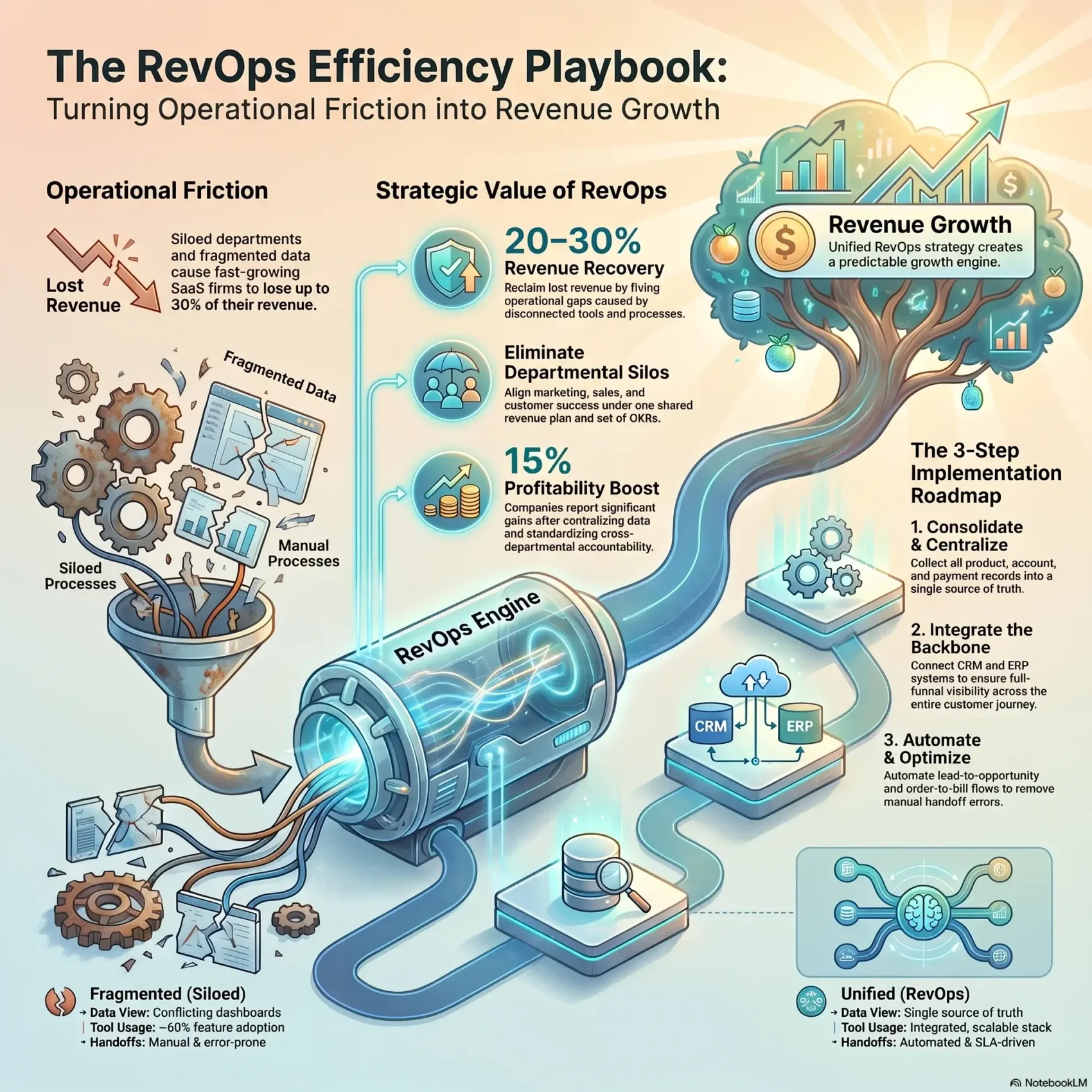
Your revenue engine is probably leaking money in the gaps between teams, not inside them. Forrester has long put that leak at 20–30% of revenue for fast-growing companies — lost to disconnected tools, broken handoffs, and numbers nobody trusts.
Revenue operations (RevOps) is how you close those gaps. And in 2026 it is no longer optional: roughly 78% of B2B companies with 50+ employees now run a dedicated RevOps function, up from 48% in 2023. Gartner expects 75% of the world’s highest-growth companies to operate a formal RevOps model this year.
The payoff is well documented. Forrester research on companies that align people, process, and technology across the full revenue engine points to roughly 36% more revenue growth and up to 28% higher profitability. Even conservative estimates land at 19% faster growth and 15% better margins.
This playbook gives you the practical path: map the end-to-end journey, consolidate product-to-cash data, integrate CRM and ERP, automate lead-to-opportunity and order-to-bill, and run a 90-day plan that proves lift before you ask for budget.
Key Takeaways
- Operational gaps — not weak selling — cost fast-growing firms 20–30% of revenue. That money is recoverable.
- RevOps has crossed into the mainstream: ~78% of mid-sized B2B companies now have the function, and the VP RevOps title has grown sharply.
- The 2026 priority is subtraction, not addition: 67% of RevOps leaders plan to reduce their tool count this year.
- AI belongs in forecasting, scoring, and enrichment today — not in end-to-end autonomous execution.
- Staff to a ratio, not a hunch: about 1 RevOps person per 25–30 revenue team members, or 1:15–20 for top performers.
- Align OKRs, build full-funnel visibility, and create one source of truth so decisions move fast and stay consistent.
What RevOps Is and Why 2026 Raised the Stakes
Think of revenue operations as the single thread that ties marketing, sales, customer success, and finance into one growth engine. That thread removes duplicate work and gives every customer a consistent experience.
From fragmented functions to a unified revenue engine
Revenue operations aligns departments so everyone chases the same goals with shared metrics and shared language. When you centralize data, processes, and tooling, decisions speed up and accountability improves.
The market conditions of 2026 make this urgent rather than nice-to-have. B2B sales cycles have stretched roughly 22% since 2022, median win rates have slipped, and a majority of enterprises missed their revenue targets last year. None of that is fixed by hiring more reps. It is fixed by removing friction from the motion you already run — the same logic behind a well-run go-to-market strategy.
RevOps vs. sales operations: scope, impact, and ownership
Sales operations optimizes the mid-funnel. Revenue operations spans the full journey — from product and pricing through billing and cash collection.
The practical result: fewer handoff errors, better forecasting, and clear ownership of the customer lifecycle. Executive sponsorship and a defined role for the operations lead keep the organization moving toward one plan. For the wider strategic context, see our overview of the role of RevOps in modern sales and marketing.
- Unified metrics reduce rework and help you prioritize customer impact.
- Coordinated planning prevents conflicting priorities across teams.
- Clear ownership models show who leads and how teams partner on goals.
The Cost of Inefficiency: Where Revenue Actually Leaks
Siloed systems turn good work into wasted effort. The leak is rarely one dramatic failure. It is dozens of small ones: a lead that sits unrouted for two days, a quote rebuilt by hand, a renewal nobody flagged until week 51.
How silos distort metrics and morale
When marketing celebrates MQLs while sales misses closed-won, misreported numbers produce bad decisions. Conflicting dashboards make it hard to trust any single view.
Data quality is the root cause more often than teams admit. Salesforce research has found the vast majority of CRM records are incomplete in some way, and Gartner reports that only about 7% of companies achieve 90%+ forecast accuracy. You cannot forecast your way out of dirty data — which is why a deliberate data governance strategy is the unglamorous foundation of everything else here.
Tool sprawl compounds it. The average B2B revenue team now pulls from roughly 23 separate vendors, and most teams use only a fraction of the features they pay for. That partial adoption raises cost without lifting performance — a pattern we unpack in work tech overload.
What to watch for and how to act
- Early signs: rework, conflicting dashboards, and open disagreement about what a metric means.
- Fixes: create a single source of data, standardize handoffs, and align incentives across departments.
- Result: clearer forecasts, faster conversions, and better customer outcomes.
Start this quarter: map handoffs, cut redundant tools, and set shared KPIs so your teams stop optimizing locally and your company recovers lost revenue.
When to Introduce RevOps: Start Early, Scale Smarter
Begin with the customer’s worst friction and design processes that solve it end to end. Doing this up front keeps product and go-to-market aligned as you scale.
Step-zero thinking means reverse-engineering your strategy from real customer pain. Introduce RevOps late and you risk building a mess on top of a mess — patchwork integrations layered over processes nobody documented.
The trigger point is usually structural, not numerical: the moment a single owner can no longer see the whole funnel, or the first time a handoff between two teams costs you a deal you should have won.
How to get started
- Design around the customer’s top pain and map a minimal viable journey.
- Set clear goals and operating rhythms that tie first touch to renewal.
- Assign ownership for core workflows so the company knows who fixes what.
- Right-size tooling to avoid overlap and future tech debt.
Start early, keep the scope tight, and scale processes as your growth milestones arrive. If you are still choosing between motions, our comparison of PLG vs. sales-led growth is a useful companion read.
RevOps Efficiency: The Core Principles You’ll Operate By
Set a practical operating model that turns data into faster, aligned decisions. Agree on a few guiding principles first so your teams move in the same direction.
Alignment on OKRs, targets, and a common language
Align on OKRs, definitions, and targets so teams speak the same language and chase shared outcomes. Establish governance to keep data definitions and dashboards consistent across groups. The mechanics of getting two historically separate functions to agree are covered in our framework for aligning sales and marketing.
Full-funnel visibility across the customer journey
Build a single view so marketing, sales, and post-sale motions are visible end to end. Full-funnel visibility reveals which levers actually move revenue — and, more usefully, which ones you have been over-investing in.
Usability over visibility
A dashboard nobody opens is not visibility. The 2026 edge goes to teams whose managers and sellers can interpret data in the moment and act on it, without filing a request with an analyst. Make insight the default setting, not a ticket.
Proactivity over firefighting
Use forecasting to shift from reactive fire drills to proactive planning, and embed those insights into weekly cadences so decisions stay tied to reality.
- Metrics hierarchy: balance leading indicators with lagging revenue metrics.
- Enablement loop: connect playbooks, training, and retros to continuous improvement — see current sales enablement trends.
- Prioritization: focus on the few metrics that drive real performance and customer success.
Designing Your RevOps Team Structure for Your Stage
A stage-aware team model saves hiring mistakes and keeps your organization focused on measurable outcomes. Start by defining who owns outcomes, how data flows, and what success looks like this quarter.
Staff to a ratio, not a hunch
Current benchmarks put a healthy RevOps team at roughly one team member per 25–30 revenue-facing employees across sales, marketing, and customer success. High performers invest more heavily, at 1:15–20. Teams stretched to 1:40 or worse consistently report weaker CRM data quality, longer cycles, and more pipeline leakage.
Leadership and executive sponsorship
Begin with a clear lead who sets SMART KPIs and reporting lines. Secure executive sponsorship so the team has the budget and authority to change cross-departmental workflows — without it, RevOps becomes a reporting desk.
Analytics pods and focused insights
Build small analytics pods aligned to marketing, sales, and customer domains. These pods deliver domain metrics, fast experiments, and the insights leaders need to act. Pair them with the right business intelligence tools so reporting does not depend on one person’s spreadsheet.
Operations management and enablement
Assign operations managers to own processes, tech administration, and training. Strong enablement turns policy into daily habit and improves adoption across departments.
SMB vs. enterprise: practical org patterns
- SMBs: start lean with a cross-functional manager or a consultant before hiring a dedicated RevOps team.
- Mid-market: form domain pods for analytics, operations, and enablement.
- Enterprises: centralize under a CRO with specialized analysts and full-time operations roles for scale.
- Engagement: set intake SLAs and rituals so departments know how to prioritize requests.
Measure success by adoption rates, SLA adherence, and clear business impact. Define role competencies and growth paths to keep talent and improve long-term performance.
Aligning Sales, Marketing, and Customer Success Around One Revenue Plan
Aligning your go-to-market functions around one plan removes churn between handoffs and makes targets simple to track.
Sales operations builds repeatable processes, manages CRM hygiene, and runs enablement and territory planning. Clean CRM data fixes forecasting gaps and lets your sales teams operate predictably — the direction of travel is clear in the evolution of CRM.
Marketing operations owns the lead lifecycle, measurement, and attribution. When marketing focuses on the campaigns that move pipeline rather than volume, you get better conversion and clearer ROI. For high-value segments, pair this with an account-based strategy.
Customer success operations drives retention, expansion, and a consistent experience. Net revenue retention has become a board-level metric, with 120%+ marking top performers and 100% the floor. Operationalized health scores and expansion plays protect that number — our guides to customer success tools and customer retention strategies go deeper.
Finance collaboration ties billing and revenue integrity together. Connected billing and contract systems give you faster collections and cleaner cash flow visibility, and modern finance automation removes most of the manual reconciliation.
- Agree on shared definitions — SQL, SAL, opportunity stages, health scores — to improve conversion and forecasting.
- Tighten cadences so teams resolve issues fast and avoid finger-pointing.
- Align incentives and dashboards so data stays clean as it moves from marketing to sales to post-sale.
The outcome: unified teams that reduce friction, protect revenue, and deliver a consistent customer experience no matter which group is leading the moment.
Process Mapping: Visualizing the End-to-End Revenue Journey
Map every customer touchpoint so you can see where work stalls and why. Start with a simple visual that traces activity from first contact through cash collection. Keep it focused enough that your teams can use it this week, not next quarter.
Finding overlaps, gaps, and bottlenecks
Mapping sales, marketing, and customer success processes reveals overlaps that waste effort and gaps that cause rework. Document each step, owner, input, and output so the customer journey is consistent and measurable.
“When you can point to an exact handoff that fails, you can fix it.”
- Visualize flow: see how work moves from first touch through cash and identify where teams get stuck.
- Standardize stages: set entry/exit criteria so reporting and forecasting stay accurate.
- Define SLAs: assign owners and measurable SLAs to make handoffs reliable.
- Time each stage: time-in-stage analytics turn vague complaints into a ranked bottleneck list.
Automated data-sharing to reduce handoff friction
Automated data sharing removes manual handoffs and gives everyone the same context at transfer: intent, history, and next best actions. Align processes to customer milestones so internal actions match external value. The same discipline applied outside the revenue org is covered in our operations team efficiency playbook.
Data as Your Single Source of Truth
Treat your data layer as the backbone that keeps forecasts honest and teams aligned. When you centralize records, you remove guesswork and speed up smart decisions.
Who owns the truth: CRM, finance, or customer success?
Teams often call the CRM the “truth,” yet finance and customer success hold critical records too. Decide explicitly where the source of truth lives and how those systems reconcile, so reports match reality instead of arguing with each other. Many teams now centralize behavioral and account data in a customer data platform and keep the CRM as the system of record for deals.
Data governance to standardize metrics across departments
Set a governance plan so metrics and definitions stay consistent across departments.
- Implement data quality controls and assign ownership to reduce conflicting dashboards.
- Harmonize account, product, contract, invoice, and payment records across systems.
- Centralize critical revenue metrics so trends are easier to spot and act on.
- Add auditing, lineage, and documented data contracts so decisions stay reliable — and so AI outputs have something trustworthy to learn from.
Result: aligned lifecycle metrics mean customer-facing teams stop chasing separate targets that undermine revenue.
The 2026 RevOps Tech Stack: Consolidate Before You Add
The biggest RevOps priority this year is subtraction. Roughly two-thirds of RevOps leaders plan to reduce their tool count in 2026 — the “more is better” era of go-to-market tooling is over.
What gets cut first
The usual candidates: standalone enrichment tools replaced by waterfall platforms, legacy sales engagement tools absorbed into all-in-one GTM suites, and one-off analytics dashboards replaced by CRM-native reporting or a proper BI layer. Audit by job-to-be-done, not by logo.
Choosing tools to fix top inefficiencies
Start by inventorying pain points, then choose tools that close those specific gaps. Set feature-adoption targets during procurement so you actually use what you buy. Our roundup of RevOps automation tools is a good starting shortlist.
Integrations that connect CRM, ERP, and customer data in real time
Connect CRM, ERP, and customer platforms with standardized data models and resilient pipelines. Real-time flows prevent duplicate work and keep reports aligned across teams. Every territory change that needs a two-week engineering cycle is a governance failure, not a technology limit.
Automating repetitive tasks to unlock strategic work
Automate quoting, order-to-bill, enrichment, and routine handoffs so your team focuses on higher-value strategy. Low-code automation reduces errors and speeds time to cash — see where the wider market is heading in business automation trends.
Security, compliance, and total cost of ownership
Evaluate TCO, admin overhead, and adoption costs, not just license price. Blended overhead — the hours your ops team spends maintaining integrations and chasing data discrepancies — often exceeds the license line. Layer security and compliance checks into procurement and pick integrations that scale.
AI in RevOps: What Actually Works in 2026
AI adoption in RevOps roughly doubled year over year, reaching about 61% of teams using it in at least one workflow. But the adoption curve is lopsided, and the gap is instructive.
Around half of teams now use AI for forecasting, lead scoring, and data enrichment. Fully autonomous workflow execution sits in the single digits. That gap tells you where the technology genuinely is versus where the marketing is.
The honest read: AI is excellent as an augmentation layer — scoring thousands of leads, spotting patterns in buyer behavior, predicting which deals slip. It is not yet reliable for end-to-end execution of complex revenue processes without a human correction layer.
The direction of travel is clear, though. Gartner projects that by 2028 the majority of RevOps tasks in workflow, data, analytics, and tech administration will be executed by AI agents. Build now for that: clean data contracts, documented processes, and clear escalation paths give agents something safe to act on later. Our guide to predictive analytics for business growth covers the modeling side in more depth.
- Start here: forecast scoring, enrichment, deal-risk flags, and call summarization.
- Wait on: autonomous multi-step execution across billing or contracting.
- Non-negotiable: a human review layer wherever an AI output touches a customer or an invoice.
Metrics That Matter: Measuring Revenue, Efficiency, and Experience
Measure the few signals that connect pipeline health to cash and customer outcomes. A tight scorecard helps you act before small problems become big ones.
Pipeline and revenue
Track ARR, TCV, win rates, and ARPU so you can see which deals move the needle. Benchmark honestly: median B2B win rates have declined over the past few years, so a flat win rate may actually be a relative gain.
Efficiency and cash
Monitor DSO, revenue backlog, and cycle times to spot cash delays and process bottlenecks quickly. With median cycles now materially longer than in 2022, time-in-stage is one of the highest-leverage numbers you own.
Retention and growth
Churn, renewal rate, NRR, CLV, and product adoption are your signals for customer health. NRR above 100% means your installed base grows without new logos; 120%+ puts you with top performers.
Funnel health and strategic reviews
Measure MQL→SQL conversion and qualification trends to guide enablement and fixes. Run regular pricing, competitor, and funnel reviews so your pricing strategy framework keeps pace with the market.
“Tie leading indicators to goals so forecasting becomes proactive, not reactive.”
- Track a complete revenue scorecard linking pipeline quality to closed-won, cash, and retention.
- Define metric formulas and ownership so reporting stays consistent over time.
- Embed forecasting discipline so you move from firefighting to proactive execution.
For the full metric definitions and formulas, see our companion guide to RevOps productivity metrics, and for forecasting specifically, how RevOps tools are changing business forecasting.
Your 90-Day RevOps Implementation Plan
Focus first on the data paths that touch a deal from quote to payment. Small wins build trust and clear the path for bigger changes.
Days 1–30 — Consolidate revenue records
Collect product, account, quote, order, contract, invoice, and payment data into one model. Centralized records mean fewer disputes and faster closing. Run a tool audit in parallel and mark every overlap.
Days 31–60 — Integrate into a product-to-cash backbone
Connect your product catalog, forecasting, CRM, and ERP so finance, sales, marketing, and CS see the same view. Cross-functional access is what turns a data project into an operations improvement.
Days 61–75 — Automate key handoffs
Automate lead-to-opportunity routing, quote generation, and order-to-bill steps. Automation removes error-prone work and frees your team for high-impact tasks. Measure hours saved and error rates before and after — that delta is your business case.
Days 76–90 — Learn from revenue in real time
Use live analytics to get timely insights, predict needs, and time cross-sell and upsell offers. Dashboards should tie directly to actions: who does what next, and by when.
“Make the data actionable and your team will act faster.”
- Centralize revenue-critical data so everyone uses the same accurate records.
- Establish a governance committee to keep integrations stable as you scale.
- Define change management steps and publish the 90-day results — measured lift is how you fund the next phase.
Conclusion
Close the loop between data, tools, and people so your company scales without chaos.
RevOps turns fragmented work into a cohesive revenue engine that is easier to run and easier to scale. The 2026 evidence is consistent: aligned revenue engines grow faster and hold better margins, and the teams pulling ahead are the ones consolidating their stack rather than expanding it.
Use the playbook — consolidate records, integrate systems, automate the handoffs that break most often, and run a 90-day plan to prove lift. Align sales, marketing, and customer success so the customer experience stays consistent from first touch to renewal.
Measure the lift, iterate fast, and keep decisions tied to clear metrics so growth compounds instead of stalling.