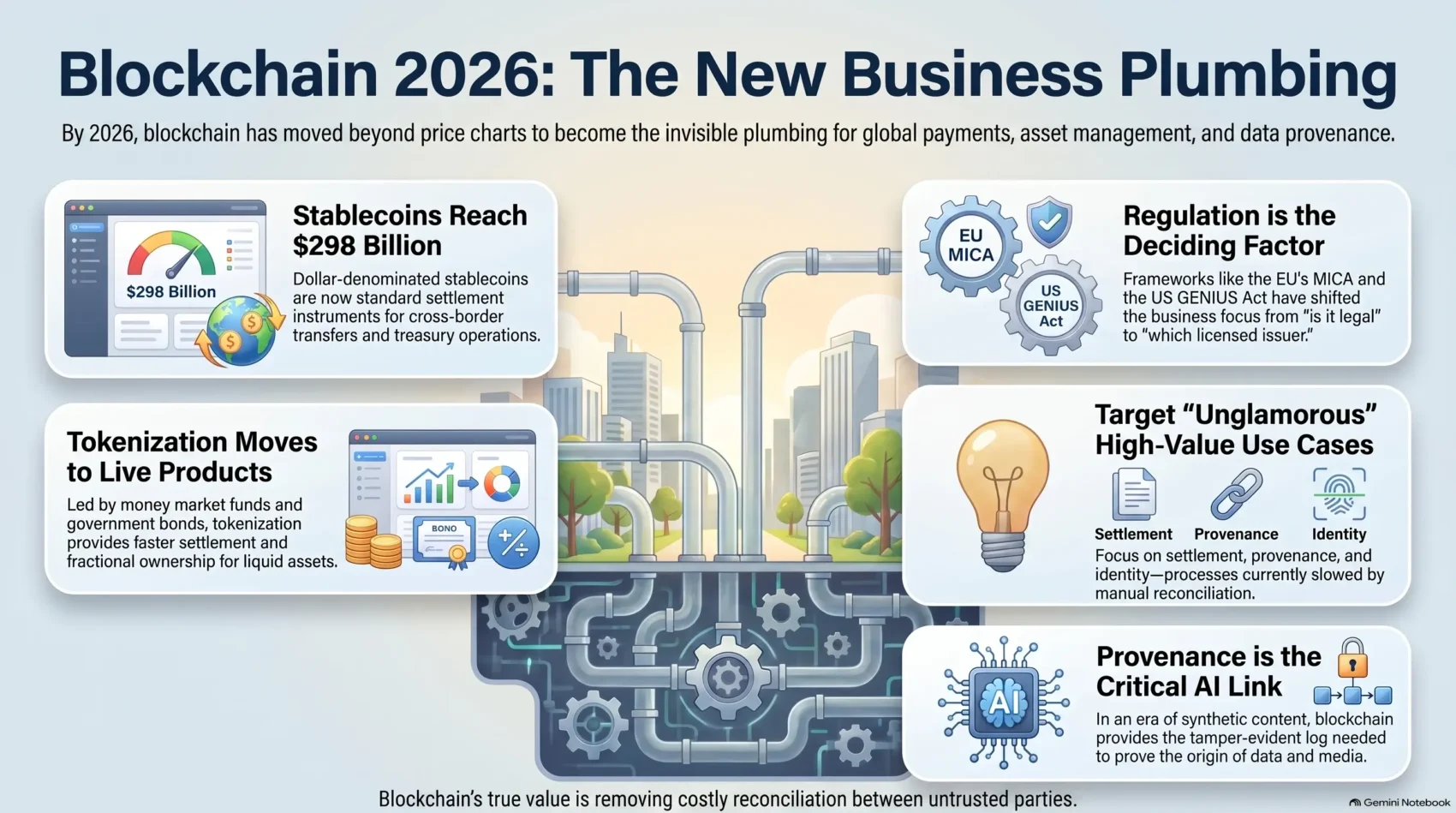
Blockchain has stopped being a story about price charts and become a story about plumbing. In 2026 the technology mostly shows up inside payment rails, fund administration, trade documents and identity systems, often without the word “blockchain” appearing anywhere in the product name. Two figures frame the shift: roughly $298 billion in stablecoins were circulating on public chains in mid-August 2026, alongside about $38 billion in other tokenized real-world assets, according to the analytics platform RWA.xyz. This article looks at where blockchain trends genuinely stand for businesses, what quietly failed along the way, and which developments deserve your attention next.
Key Insights
- Stablecoins are the largest working use case, and regulation now decides who may issue them.
- Tokenization has moved from pilots to live products, led by money market funds and government bonds.
- Central bank digital currencies are widely explored and rarely launched.
- Several flagship bank and insurance consortia collapsed; open-source foundations carried the work forward.
- Blockchain as a Service consolidated sharply after Microsoft retired its Azure offering.
- Fraud remains a material cost and a governance problem for anyone holding digital assets.
- The strongest business cases are unglamorous: settlement, provenance and identity.
Understanding Blockchain Technology
A blockchain is a shared ledger maintained by many computers at once, which allows peer-to-peer transactions to settle without a central operator. Instead of one institution holding the authoritative copy of the records, every participant holds one, and the network agrees on what is true.
Three properties do most of the work. Decentralized networks spread verification across participants rather than a single gatekeeper. Immutability means an entry cannot be quietly rewritten once the network has accepted it, which is why blockchains suit audit trails and provenance. Cryptographic security links each block to the one before it, so tampering with an old record invalidates everything after it.
Those properties come with costs: throughput limits, key management risk, and the fact that a shared ledger only helps when several parties genuinely need one. Since Bitcoin launched in 2009 the technology has spread well beyond cryptocurrencies into smart contracts, tokenized securities and decentralized identity, but the useful question is never “can this run on a blockchain” — it is “does anyone here distrust the middleman enough to pay for removing them”.
Blockchain Trends in 2026: Where Adoption Is Real
Payments are the clearest case. Dollar-denominated stablecoins now function as settlement instruments for cross-border business transfers, exchange collateral and treasury operations, which is why cryptocurrencies in global business transactions and crypto treasury management have become finance-team topics rather than IT experiments. The pattern echoes what happened with open banking and embedded finance: the rail matters less than who is licensed to run it.
Regulation is now the deciding factor. The EU’s Markets in Crypto-Assets Regulation has applied in full since the end of December 2024, and in the United States the GENIUS Act created a federal framework for payment stablecoins after being signed into law in July 2025, with implementing rules from banking regulators following through 2026. For businesses this changes the practical question from “is this legal” to “which licensed issuer and which jurisdiction”, and it puts RegTech tooling squarely in scope.
Central bank digital currencies tell a more cautious story. The Atlantic Council’s CBDC Tracker reported in May 2026 that 146 countries and currency unions, representing more than 98% of global GDP, are exploring a CBDC, with 77 in an advanced phase and 41 running pilots — but only three retail launches so far, in the Bahamas, Jamaica and Nigeria. Exploration is near-universal; deployment is not.
Fraud remains the counterweight. The FBI’s Internet Crime Complaint Center recorded 181,565 cryptocurrency-related complaints in its 2025 Internet Crime Report, published in April 2026, accounting for more than $11 billion of roughly $21 billion in total reported losses. Any treasury or custody decision has to start from that number, not from a technology roadmap.
Decentralization in Non-Financial Sectors
Outside finance, the value of a shared ledger is usually provenance rather than payment. In healthcare, distributed records can make patient data portable between providers without one organization owning the index, which is the same interoperability problem that connected medical devices keep running into.
Supply chains are the most mature non-financial use case. A shared record of custody lets each party verify where a batch came from without trusting a single vendor’s database, which is why blockchain in logistics keeps resurfacing as regulators tighten traceability and due-diligence requirements. Blockchain is one option here, not the only one — a well-governed central registry often works just as well when the participants already trust an operator.
Real estate is moving more slowly than the early promises suggested, because deeds, escrow and title insurance are legal constructs before they are data problems. The tokenization work happening in PropTech is real, but it sits alongside conventional registries rather than replacing them.
Governance is the quiet win. Distributing a record across counterparties removes reconciliation work, and reconciliation is where a surprising share of back-office cost lives.

Tokenization of Assets
Tokenization means representing ownership of an asset as a transferable digital record, so that it can be divided, transferred and settled programmatically. The appeal is faster settlement, fractional ownership and fewer intermediaries between buyer and seller.

The market has concentrated where the underlying asset is already standardized and liquid. Tokenized money market funds and short-term government debt dominate: RWA.xyz put tokenized real-world assets excluding stablecoins at about $38 billion in August 2026, with the largest individual Treasury products each holding roughly $2–3 billion. Private credit and commodities follow at a distance; tokenized real estate and art remain small.
- Tokenization can improve liquidity for assets that are otherwise slow to trade.
- It shortens settlement cycles and reduces reconciliation between counterparties.
- It opens smaller ticket sizes to investors who were previously priced out.
Be careful with the headline forecasts. Multi-trillion-dollar projections circulate widely, but they describe an addressable market rather than assets actually on-chain today, and the gap between the two is roughly three orders of magnitude. A more useful test for your own business: does tokenizing this asset remove a specific intermediary, a specific delay or a specific reconciliation cost? If the answer is no, a database will do.
Blockchain as a Service (BaaS)
Blockchain as a Service lets a company run ledger infrastructure without operating nodes itself. The category has narrowed considerably: Microsoft retired Azure Blockchain Service in 2021, and much of the demand shifted to managed node and API providers rather than full-stack consortium platforms. Amazon Managed Blockchain, IBM and Google Cloud’s node services remain the mainstream enterprise options, alongside specialist infrastructure vendors.
The case for BaaS is the same as for any managed service: you rent operational expertise instead of hiring it, and you can decommission the project cheaply if it does not work. That last point matters more than vendors like to admit, given how many blockchain pilots end quietly. Treat it as you would any other cloud-native infrastructure decision, with the same exit questions.
- Managed nodes and APIs instead of in-house infrastructure.
- Scaling that follows usage rather than upfront capacity planning.
- A cheap off-ramp if the use case does not survive contact with production.
Integration with Other Emerging Technologies
Blockchain rarely stands alone. Its most credible pairing is with sensor data: IoT deployments generate readings that several parties need to trust, and anchoring those readings to a tamper-evident ledger makes disputes easier to settle. Cold-chain monitoring and emissions reporting are typical examples, the latter increasingly tied to carbon accounting and green finance requirements.
The honest caveat is that a ledger cannot verify that a sensor told the truth. It guarantees the record was not altered after the fact, not that the reading was correct in the first place — which is why device security and distributed security architectures matter at least as much as the chain itself.
- Tamper-evident records for data that crosses organizational boundaries.
- Automated settlement through smart contracts once conditions are met.
- Shared audit trails that reduce dispute resolution time.
- Clear provenance for real-time operational data.
Cross-Industry Collaboration
Shared infrastructure only pays off when enough competitors join, and the record here is mixed. Two of the most-cited consortia are gone: the bank-backed trade finance platform we.trade filed for insolvency in 2022, and the insurance consortium B3i ceased operations the same year. Both had blue-chip backers and neither found enough transaction volume to cover its costs.
What survived was open-source rather than joint-venture. The Hyperledger projects were folded into Linux Foundation Decentralized Trust, which launched in 2024 with 17 projects and more than 100 founding members, and R3’s Corda remains in use across regulated financial infrastructure. Industry bodies such as the Global Blockchain Business Council continue to work between the sector and regulators.
The lesson for anyone evaluating a consortium is straightforward: ask who pays for the network once the pilot budget runs out, and what happens to your data if the entity dissolves. Governance and exit terms have killed more of these projects than technology ever did. Sector-specific efforts in InsurTech and finance automation face the same test.
Artificial Intelligence (AI) Integration with Blockchain
The overlap between AI and blockchain has narrowed to something more concrete than the early hype suggested: provenance. As generative models flood channels with synthetic content, being able to prove where a document, dataset or media file came from has real commercial value, and cryptographic signing is the mechanism most content-authenticity efforts rely on.

The second use case is auditability. Regulated organizations deploying AI in business operations increasingly need to show which model version produced which decision on which data. An append-only log is a reasonable way to make that record hard to revise after the fact, and it complements rather than replaces model governance.
What has not materialized is the “decentralized AI” narrative in which model training moves on-chain. Training remains compute-bound and centralized; the blockchain layer, where it appears at all, handles attribution, licensing and payment rather than computation.
Conclusion
The future of blockchain in business looks less like disruption and more like infrastructure. Stablecoins and tokenized funds are working at meaningful scale, regulation has made the operating environment clearer, and the failures of the consortium era have left a more realistic picture of what shared ledgers can do.
The cautionary tales are worth keeping in view. The Central African Republic adopted Bitcoin as legal tender in 2022 and repealed the law the following year. Flagship consortia dissolved. Several cloud providers retired their blockchain platforms. None of that invalidates the technology, but it does argue for narrow, well-scoped projects over strategic transformation programmes.
For most organizations the practical next step is small: work out whether any process you run today is slowed by reconciliation between parties who do not fully trust each other. That is where blockchain earns its keep — and where Web3 business models and digital wallets are most likely to touch your operations first.