Generative engine optimization (GEO) makes your content easy for AI systems to find, understand, and cite when they write an answer. It matters because people increasingly start a search inside an assistant such as ChatGPT or Perplexity, rather than on a results page, then ask follow-up questions about products, providers, and sources.
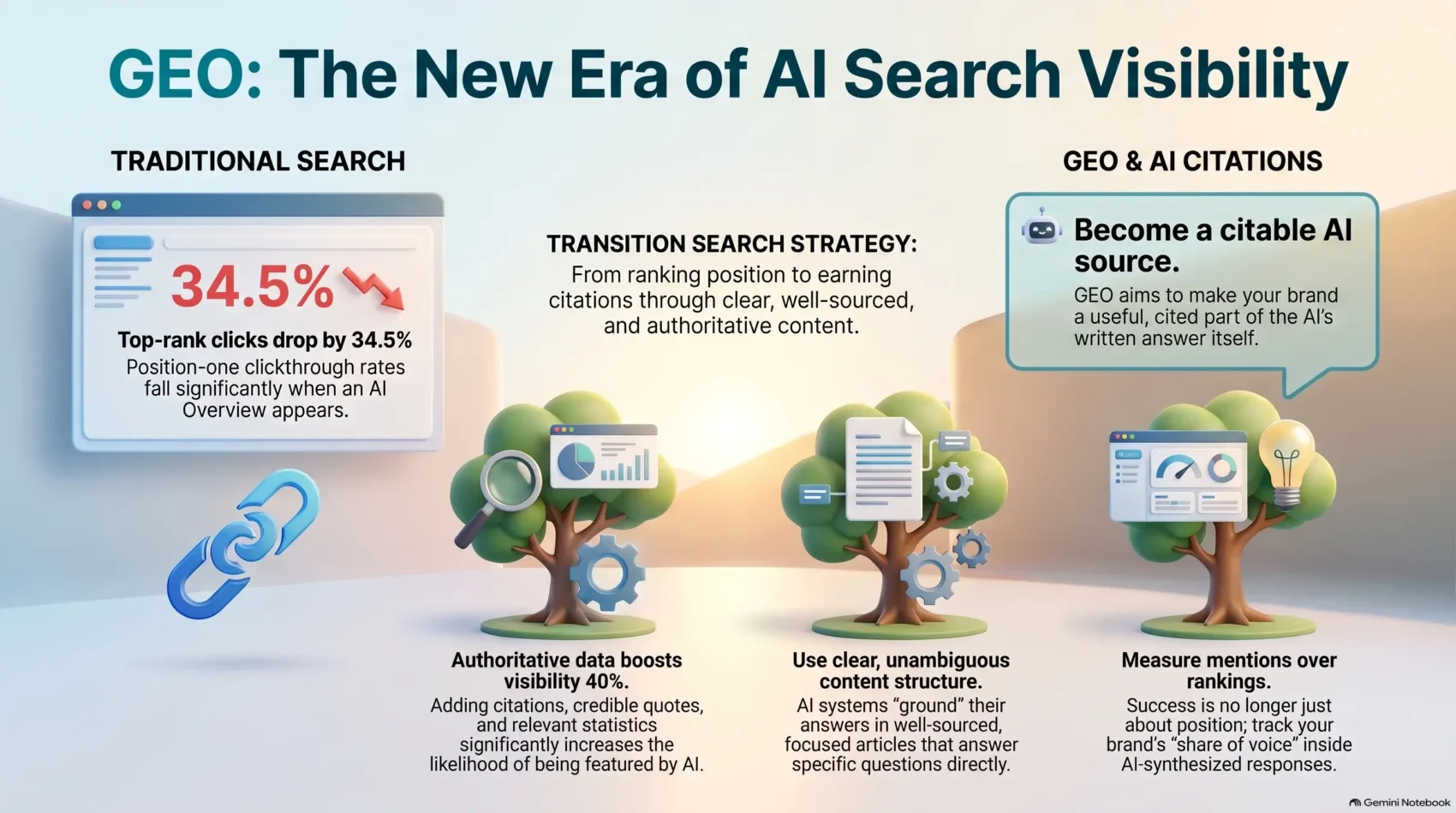
The scale is no longer speculative. OpenAI COO Brad Lightcap said in February 2026 that ChatGPT had passed 900 million weekly active users. Google announced at I/O 2026 that AI Overviews, the AI-written summaries that now sit above the classic blue links, reach more than 2.5 billion people a month. An Ahrefs study of 300,000 keywords, published in April 2025, estimated that position-one clickthrough rates fell about 34.5% on searches where an AI Overview appeared.
Your goal is not to replace SEO. Search engine optimization, the work of getting pages to rank in ordinary results, stays the foundation. Google’s documentation on AI features says the pages that show up in AI Overviews and AI Mode are simply pages that are indexed and eligible for a normal Search snippet. This guide covers the content, technical, citation, and measurement work that actually supports GEO.
Key Takeaways
- AI answers now shape much of search visibility.
- Eligibility for AI features starts with ordinary indexing and snippets.
- Citable, well-sourced information earns mentions more reliably than volume, and GEO extends SEO instead of replacing it.
- Measure impressions, mentions, and referrals; treat vendor scores as estimates.
What Is Generative Engine Optimization?
Generative engine optimization is the practice of making your content part of an AI-written answer, not just another blue link below it. The term comes from a 2023 research paper by teams at Princeton and IIT Delhi. They built a benchmark of real user queries, then tested which content changes actually moved the needle.
How GEO Helps Your Content Appear in AI-Generated Responses
ChatGPT, Google, Perplexity, and Claude handle search differently. They may retrieve live sources, summarize facts, cite pages, or recommend options. Perplexity, for example, merges several sources into a comparison table and suggests follow-up questions. The reader’s next move is then a narrower question, not a click back to the results page.
That has a practical consequence for anyone planning digital marketing strategies: a page that only ranks may never be read, while a page quoted inside the answer reaches the reader as the decision is being framed.
AI Search and Agentic Experiences
Some systems now do more than answer questions. Agentic tools act on the user’s behalf: they browse, compare options, fill in forms, and in some cases complete a purchase. A browser agent reads a page much as a screen reader does, working from screenshots, the underlying HTML, and the labels a site gives its buttons and fields. Readable structure therefore becomes a functional requirement, not a nicety. Google’s Universal Commerce Protocol, developed with Shopify and other partners, standardizes how agents read catalogs and complete purchases. The clarity that makes conversational commerce work also helps an agent represent your products correctly.
How AI Search Systems Retrieve and Cite Content
AI search systems do not rely only on what a model memorized during training. They routinely retrieve fresh web pages, compare them, and build a response from that evidence. This is why a generative engine can answer a question about a price that changed last week.
Retrieval-Augmented Generation and Grounded Responses
Google uses retrieval-augmented generation, often called grounding: it pulls relevant pages from its index and uses them to support the answer it writes. Well-sourced, unambiguous pages are easier to ground. Copy that hedges every claim gives a system nothing specific to attach a citation to. A page that states a plan costs $29 per user per month can be quoted directly. A page that says pricing “varies by need” cannot.
Query Fan-Out and Related Search Questions
Google describes query fan-out as issuing multiple related searches across subtopics before composing an answer. One lawn-care question may become separate searches for herbicides, chemical-free weed removal, and seasonal prevention. That widens the pool of citable pages, which favors focused articles over sprawling ones.
Why Crawlable, Current Sources Matter
Use clear structure, accessible pages, and facts you have checked this year. Grounded responses can show prominent, clickable citations that send qualified visitors to your pages. Meeting the technical requirements guarantees nothing, though: treat eligibility as a floor, not a promise.
Generative Engine Optimization vs. Traditional SEO
Your search strategy now has to serve both people and answer systems. Traditional SEO aims for a higher position in organic results. GEO aims to make your brand a useful, citable part of the response itself.
The two share most of their foundations. Crawlable pages, clear intent matching, and trusted links still support rankings. Fresh, well-structured content adds a second advantage, because a system can extract a specific fact from it with less risk of error.

“You don’t need to create new machine readable files, AI text files, or markup to appear in these features.”
That settles a lot of noise: there is no secret file to publish. What changes is the scoreboard. Alongside position and clicks, track whether your pages earn mentions, citations, and share of voice, meaning how often you appear inside AI answers compared with your competitors.
- SEO: rankings, clicks, crawlability, and links.
- GEO: clarity, freshness, citations, and visibility inside answers.
- Shared goal: results that meet the need behind the query.
Because AI Overviews are associated with a meaningful drop in clicks for top-ranking pages, appearing inside the answer can matter as much as ranking beneath it.
Why AI Search Visibility Matters for Your Brand
Brand discovery now often starts with a question rather than a visit. At the audience sizes above, generative engine optimization has earned a place beside traditional SEO in most marketing plans.
When an answer cites your site or mentions you favorably, your brand enters the consideration set before the reader has compared alternatives. That is the same shift reshaping AI in marketing strategies more broadly: influence moves upstream, to the moment the question is asked.
Turn Qualified Discovery Into Brand Trust
Broad traffic looks impressive in a dashboard, but qualified visibility usually creates more value. Someone arriving from a cited answer has already read an accurate summary of what you do. Consistent facts across your site, your profiles, and third-party coverage also help systems describe your business correctly. If your pricing page, your LinkedIn profile, and a review site each name a different plan tier, an assistant will pick one of them, and it may not be the current one.
- Visibility: appear while the reader is framing the problem.
- Mentions: earn recognition inside relevant responses, linked or not.
- Performance: reach prospects who are closer to a decision.
A machine-readable presence therefore becomes part of the agentic buying journey described above. The same applies to mobile commerce, where the screen shrinks and the summary carries more weight.
Create Content That Generative Engines Can Understand
Useful pages begin with the questions your audience actually asks. Write for people first, then make the information easy for a system to follow. Clear structure, plain language, and concrete examples do that without making the page mechanical.
Answer Real Questions With Clear, Conversational Writing
Use descriptive headings and answer the question in the first sentence beneath each one. A worked example explains a complex idea faster than jargon, and it gives a retrieval system a self-contained passage it can quote. Techniques from brand storytelling still apply; they simply have to survive being summarized.
Build Helpful, Reliable, Non-Commodity Content
Google recommends unique, helpful, reliable, people-first content with a distinct point of view. A firsthand account of buying a first home beats a recycled “7 tips for first-time homebuyers” list, because the specifics cannot be found in fifty other articles. Teams that already practice agile marketing can treat each page as a testable hypothesis rather than a finished asset.
Use Data, Quotes, Examples, and Multimedia to Add Value
The Princeton and IIT Delhi GEO paper reported that content changes could lift visibility in generative responses by up to 40%. The strongest gains came from adding citations, quotations from credible sources, and relevant statistics. Effects varied a lot by topic, so treat that as direction rather than a guaranteed number. Turning your own figures into a clear narrative, as in data storytelling, tends to produce exactly the passage a system can lift and attribute.
There is no ideal word count. Build each page around the reader’s need, include the detail that answers it, and stop. Padding makes the useful part harder to retrieve.
Strengthen Your Website’s Technical Accessibility
A technically sound site gives search tools a clean path to your best answers. Before Google can use your content in AI features, the relevant pages must be indexed and eligible to show a Search snippet. Technical SEO therefore supports GEO directly, not as a separate discipline.

Improve Crawling, Indexing, and Page Experience
Use Google Search Console, the free reporting tool for your own site in Google Search, to find crawl errors, indexing gaps, and visibility trends. Keep important content publicly accessible. Google can process JavaScript when you do not block it, but pages that build themselves in the browser usually need more work before their main content is reliably available.
Responsive layouts, lower latency, and a clearly marked main content area help visitors and systems alike. To control how your content is used, the standard robots directives and snippet controls, including nosnippet, data-nosnippet, max-snippet, and noindex, are the supported levers.
Use Clear Structure, Semantic HTML, and Accessible Content
Organize each page with descriptive headings, meaningful link text, and semantic HTML, meaning tags that describe what a block of content is rather than how it looks. That structure helps screen readers and gives retrieval systems obvious boundaries between ideas. Google does not require perfectly valid code, but accessible pages are easier for everything to parse, including the browser agents described earlier. This is part of the broader digital literacy a marketing team needs now.
- Review indexing and crawl reports monthly.
- Keep key content visible without a click, tab, or accordion.
Earn Trust, Mentions, and Citations Across the Web
Your brand gains strength when trusted sites connect it to the topics you serve. Recognition should follow value, not substitute for it.
Build Credible Brand Presence on Relevant Platforms
Reddit, YouTube, LinkedIn, and industry forums expose your ideas to communities that ask hard questions. Helpful answers and honest comparisons create unlinked mentions, where someone names your brand without linking to you. Those mentions help a generative engine build a picture of who you are. That picture is not a ranking factor you can point to, so treat it as reputation work. The dynamics resemble B2B influencer marketing and community-led growth more than link building.
Focus on honest participation instead of manufacturing mentions. Google’s systems reward quality and actively fight spam, so purchased praise wastes budget. Sustained presence across social media beats a campaign burst.
Develop Expertise Through Fresh, Well-Sourced Information
Publish current content with named sources, original examples, and input from people who do the work. An accurate Wikipedia entry may improve discoverability, but it is not a tactic you control. Treat it as one part of a wider plan, alongside the positioning work in your go-to-market strategy.
- Publish insight on sites your buyers already read.
- Refresh facts and replace sources that have gone stale.
Optimize Product and Local Business Information
Accurate business details give AI systems dependable facts to work from. Keeping product names, prices, availability, services, hours, and locations current is what stops an assistant from quoting a price you retired last spring.
For online stores, Google recommends keeping Merchant Center feeds current. Merchant Center is the free tool that supplies your product data to Google’s shopping and search surfaces, and a current feed makes each product easier to interpret. Match feed data to your product pages, images, stock levels, and shipping terms. A well-governed customer data platform, a single system that holds your customer and product records, makes that consistency easier to maintain than spreadsheets do.
Local companies should maintain a complete Google Business Profile and use the same name, address, phone number, and hours everywhere. Google’s Business Agent, available through Merchant Center and business profiles, adds a conversational path between customers and brands and draws on exactly this information. Feeding it stale data is worse than feeding it nothing.
- Align feeds, profiles, and website pages after every change.
- Keep contact details identical across every surface.
Measure Performance and Refine Your GEO Strategy
Measurement turns engine optimization from an opinion into a plan. Tracking real-time data matters less here than tracking the right data consistently over months.
Track Mentions, Citations, and Share of Voice
Google added generative AI performance reporting to Search Console in June 2026. It covers impressions where your URL appears inside an AI Overview or AI Mode response. Know its limits before you build a dashboard on it. It reports impressions rather than clicks or clickthrough rate, queries stay anonymized, and classic position data does not apply to a synthesized answer.
Third-party platforms fill part of the gap. Semrush tracks share of voice, brand mentions, and sentiment across AI platforms; our Semrush review covers what it costs. SE Ranking is a lighter visibility monitor, and the Surfer SEO and Ahrefs comparison helps if content analysis is your bottleneck.
Choose Tools With Realistic Expectations
No third-party tool can see Google’s ranking systems, and none can query every assistant at scale without sampling. Treat reported visibility scores as estimates built on a sample of prompts. Check whether the vendor discloses how that sample is drawn, with the skepticism you would apply to any explainable AI claim.
Google’s documentation is explicit that you do not need new machine-readable files or special markup to appear in AI features. Structured data remains useful for rich results, but it is not an entry ticket. If a vendor’s method depends on a file Google says it does not read, keep looking. Teams running their own assistants will recognize the governance questions in an LLM ops strategy.
Conclusion
The next phase of discovery rewards useful answers, not shortcuts. Your SEO plan should keep producing valuable content, accessible pages, and credible sources, so AI systems can use them with confidence and readers still have a reason to click through.
Google’s guidance confirms that ordinary foundations decide whether your pages can appear in AI features: indexing and snippet eligibility. Because AI Overviews are associated with a roughly one-third drop in clicks for top-ranking pages, visibility inside the answer now matters alongside the ranking beneath it. Pair clear, current content with technical access, honest citations, accurate business details, and regular measurement. Read behavioral analytics alongside visibility scores to see what readers do after the answer.
People-first quality still compounds. Building trust instead of chasing unsupported hacks has survived every previous shift in how AI is transforming business operations, and it is the approach worth defending now.
Found this useful?
Make SmartKeys a preferred source on Google, and our articles will surface more often in your Top Stories, AI Overviews, and AI Mode.
Add as Preferred Source