
Some employees leave loudly. Most drift away quietly first. They still hit their deadlines and still show up to meetings, but they no longer ask questions, volunteer ideas or talk about next year. Workplace researchers now have a name for this slow slide: quiet cracking.
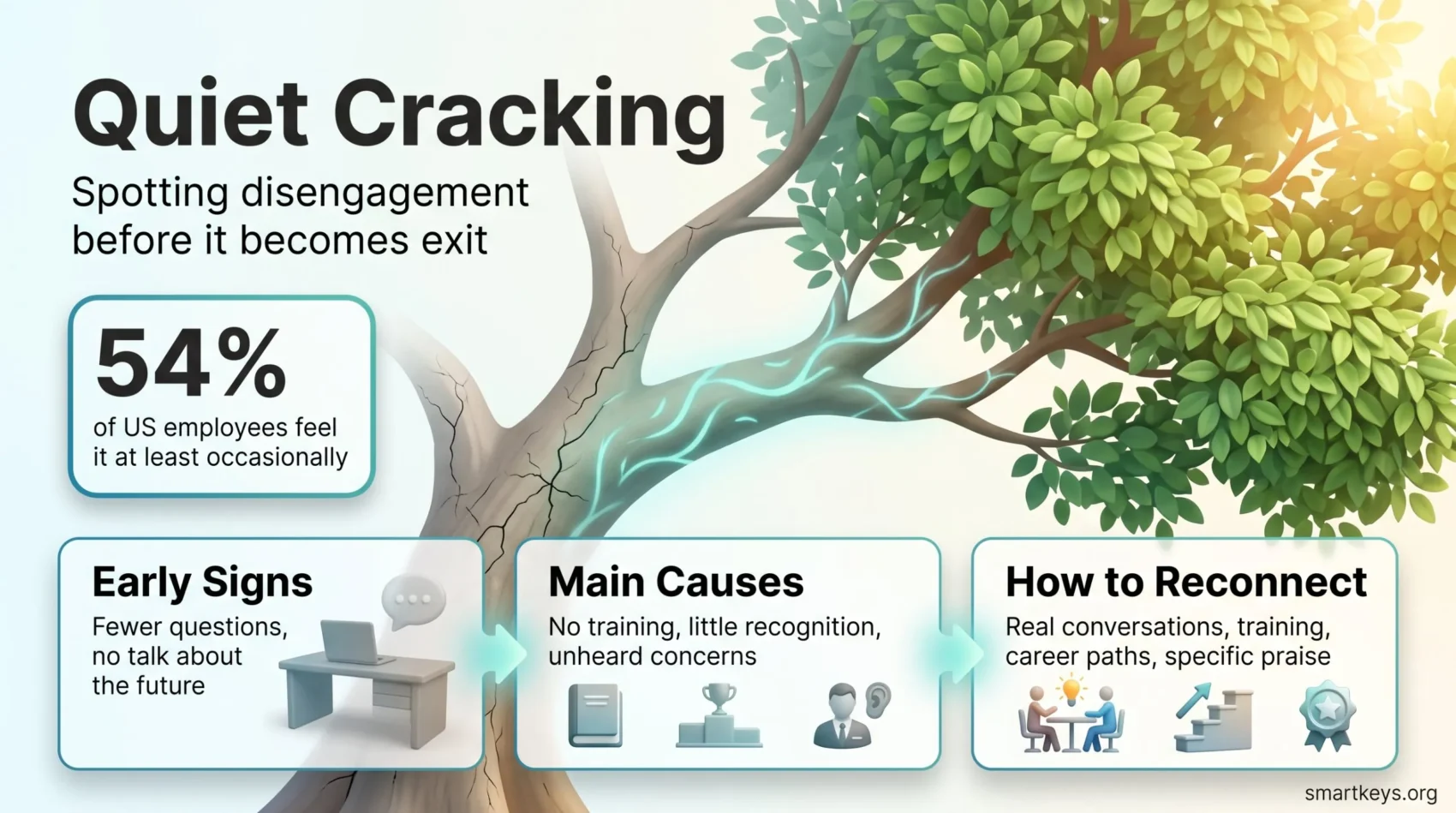
The term comes from a 2025 survey by the learning platform TalentLMS. It defines quiet cracking as “a persistent feeling of workplace unhappiness that leads to disengagement, poor performance, and an increased desire to quit.” Among 1,000 US employees, 54% said they experience it at least occasionally. One in five (20%) feel it frequently or constantly.
The business stakes are large. Gallup’s State of the Global Workplace 2026 report found that only 20% of employees worldwide were engaged in 2025, meaning involved in and enthusiastic about their work. Gallup estimates that low engagement costs the global economy about $10 trillion in lost productivity, roughly 9% of global GDP.
Key Takeaways
- Quiet cracking is ongoing, often hidden unhappiness at work that erodes motivation and raises the wish to quit.
- 54% of US employees report it at least occasionally; one in five feel it frequently or constantly.
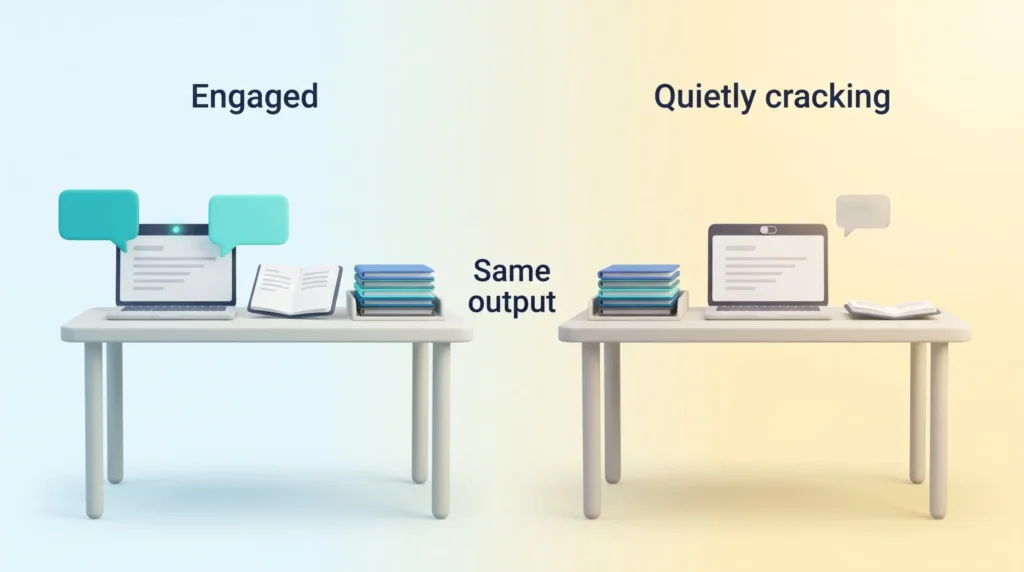
- It is hard to spot because output often stays stable while curiosity and plans for the future fade.
- Missing training, weak recognition, managers who don’t listen and unclear career paths are the main drivers.
What Is Quiet Cracking?
Quiet cracking describes a gradual loss of connection to your job. People affected by it are not openly rebelling or refusing work. They are slowly losing confidence that their effort matters and that the company has a future for them.
The word “quiet” is the key. Because the decline happens inside people’s heads, it rarely shows up in productivity dashboards. A developer might still close every ticket on time while browsing job listings every evening.
The phrase spread quickly after TalentLMS published its quiet cracking research. It is often confused with two older terms, so a direct comparison helps.
Quiet Cracking vs. Burnout vs. Quiet Quitting
| Quiet cracking | Burnout | Quiet quitting | |
|---|---|---|---|
| What it is | Persistent unhappiness and a fading connection to the job | Exhaustion from chronic workplace stress that has not been managed | A deliberate choice to do only what the job requires |
| Main driver | Feeling unsupported, unrecognized or stuck | Overload and sustained pressure | Protecting personal time and energy |
| Is it a choice? | No, it builds gradually | No | Yes, it is a conscious boundary |
| Typical signs | Less curiosity, fewer questions, no talk about the future | Fatigue, cynicism, falling performance | Stable minimum output, no extra effort |
The World Health Organization lists burnout in the ICD-11, its international classification of diseases, as an “occupational phenomenon” caused by chronic workplace stress. It is not classified as a medical condition. Burnout is mainly about too much pressure. Quiet cracking can happen even when the workload is fine, because its core is a lack of support, growth and recognition.
In practice the three often overlap. An employee who cracks quietly for months may eventually burn out or start quiet quitting to protect themselves. That is why early detection matters.
Early Warning Signs of Quiet Cracking
Because output often stays stable, look at behavior and mood rather than results alone. These signals are worth noticing, especially when several appear together:
- Fewer questions and ideas. Someone who used to challenge plans in meetings now simply nods.
- No interest in growth. They skip optional training and avoid career conversations.
- Silence about the future. They no longer mention goals for next quarter or next year.
- More absences at key moments. Sick days cluster around high-pressure periods.
- Less social contact. Cameras stay off and informal conversations disappear.
One sign alone proves nothing. A quiet week can simply mean a busy week. The pattern over time is what counts, and the right response is a curious conversation, not a diagnosis.
Read Your Survey Data Between the Lines
Engagement surveys can reveal quiet cracking if you compare the right numbers. The employee listening company Perceptyx analyzed its 2025 benchmark data for exactly this. 75% of employees said they have the resources to do their jobs well. But only 68% felt valued, and just 64% saw career opportunities. Many people have the tools to work, but not the reasons to stay.
Look for this gap in your own results, broken down by team. If “I have what I need” scores high while “I feel valued” lags behind, good operational scores are hiding an emotional decline. AI-powered engagement surveys or a regular employee Net Promoter Score (one question: how likely staff are to recommend you as an employer) reveal these trends faster than a once-a-year survey. Some companies also use AI attrition models to flag teams at risk, but treat their output as a prompt for a conversation, not a verdict.
What Causes Quiet Cracking?
Quiet cracking rarely has a single cause. It builds from many small signals that tell employees their future at the company is uncertain. The TalentLMS data points to four main drivers.
Uncertainty About the Future
82% of employees felt secure in their current role, but only 62% felt secure about their future with the company. That 20-point gap is where quiet cracking grows. Stalled promotions, frozen development budgets and restructuring rumors all widen it.
Missing Training and Development
42% of respondents had received no employer-provided training in the previous 12 months. Employees without training were 140% more likely to feel insecure about their jobs. Those who experience quiet cracking frequently were also less likely to have been trained: 44% compared with 62% of their colleagues.
Training signals that the company is investing in someone’s future. When that signal disappears, people draw their own conclusions. If you need to justify the budget, here is how to measure the ROI of upskilling programs.
Too Little Recognition
Recognition shows the sharpest divide. 80% of employees who don’t experience quiet cracking feel valued at work. Among those who experience it frequently, only 26% say the same.
Managers Who Don’t Listen
Only 62% of respondents said their manager listens to their concerns. Among employees experiencing quiet cracking, 47% said their manager does not listen. Role creep, the slow growth of duties beyond the original job, adds to the problem. When responsibilities keep growing without extra support, people feel used rather than trusted.
How Leadership Gaps Make It Worse
Managers are usually the first to notice quiet cracking and the best placed to fix it. They can also cause it without realizing it. Clarity from the top matters too. In the Perceptyx benchmark, only 66% of employees were confident that senior leaders communicate a clear vision. When people cannot see where the company is heading, they cannot see where they fit.
There is also a pressure chain. Gallup reports that manager engagement fell to 22% in 2025, down nine percentage points since 2022. Disengaged managers struggle to energize their teams, so support your managers first.
Three habits make the biggest difference:
- Hold regular one-on-ones. Short, predictable check-ins build the trust people need to speak up. A simple one-on-one meeting template keeps them focused.
- Explain decisions openly. A culture of transparent communication reduces the rumors that feed uncertainty.
- Make it safe to raise concerns. Teams with strong psychological safety surface problems early instead of cracking in silence.
Strategies to Reconnect and Retain Your Employees
Once you spot signs of quiet cracking, the goal is to rebuild the link between the person and their future at the company. These steps target the drivers above.
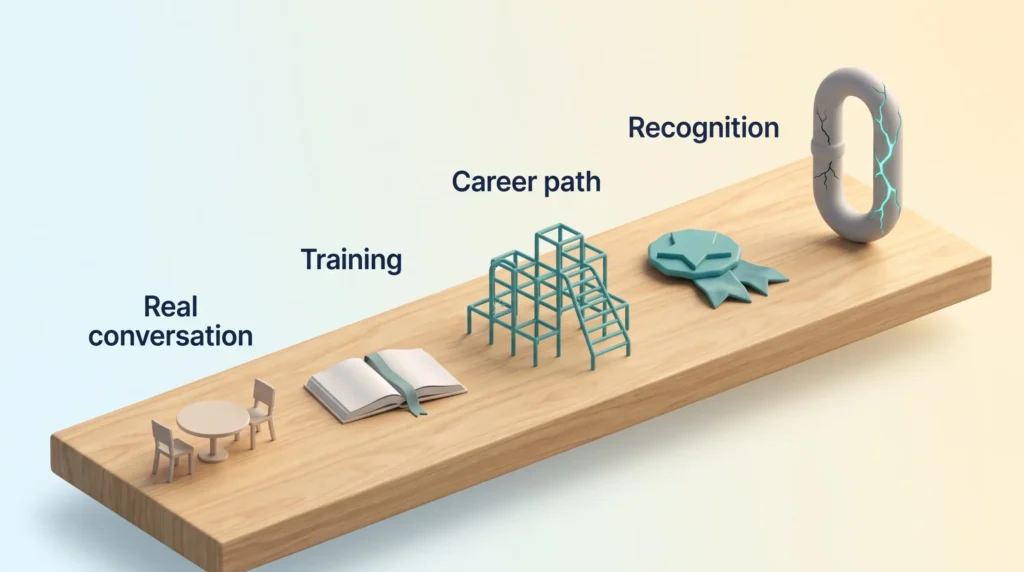
- Start with a real conversation. Ask open questions such as “Where do you want to be in two years?” Then follow up with visible action. Feedback without follow-through makes things worse.
- Make training the default. Offer everyone at least one meaningful learning opportunity per year, linked to a goal they care about.
- Show a career path. Perceptyx found that employees with high intent to stay are three times more likely to believe they can reach their career goals internally. A career lattice or an internal talent marketplace opens options when promotions are scarce.
- Recognize specific contributions. Generic praise fades fast. Name what the person did and why it mattered.
- Let people shape their role. Job crafting, where employees adjust their tasks within a role, can restore a sense of ownership.
- Replace annual reviews with ongoing feedback. Continuous performance management catches frustration months earlier than a yearly appraisal.
For a broader view, see our guide to talent retention strategies and the evidence on what actually drives employee engagement.
Balancing Workload and Expectations in a Changing Environment
Overwork is not the main cause of quiet cracking, but an unfair or unclear workload speeds it up. In the Perceptyx benchmark, 70% of employees considered their workload reasonable. That means 30% did not agree, and company-wide averages can hide the teams where pressure is concentrated.
Audit Team Capacity Regularly
Compare workload scores across teams at least twice a year. Having enough resources does not mean a team can sustain its pace. Watch for teams whose duties grew after a reorganization or hiring freeze while headcount stayed the same.
Clarify Roles, Responsibilities and Expectations
Update role descriptions when duties change, and agree on what good performance looks like. Clear priorities stop role creep and give people permission to say no. If stress is already high, practical stress management techniques and proven burnout prevention habits help before quiet cracking tips into exhaustion.
Introducing AI Without Overburdening Employees
AI tools can remove repetitive work. Badly managed rollouts, however, can also trigger quiet cracking, because they change daily tasks and raise questions about which roles will remain.
Perceptyx surveyed more than 3,600 employees worldwide about generative AI, the type of AI that writes text, code or images on request. 73% were using it or wanted to. Three in four said their workload had changed, and 80% said they needed new skills. Managers felt it most: 81% reported a changed workload. Yet only 64% of employees understood how their company chooses its AI tools.
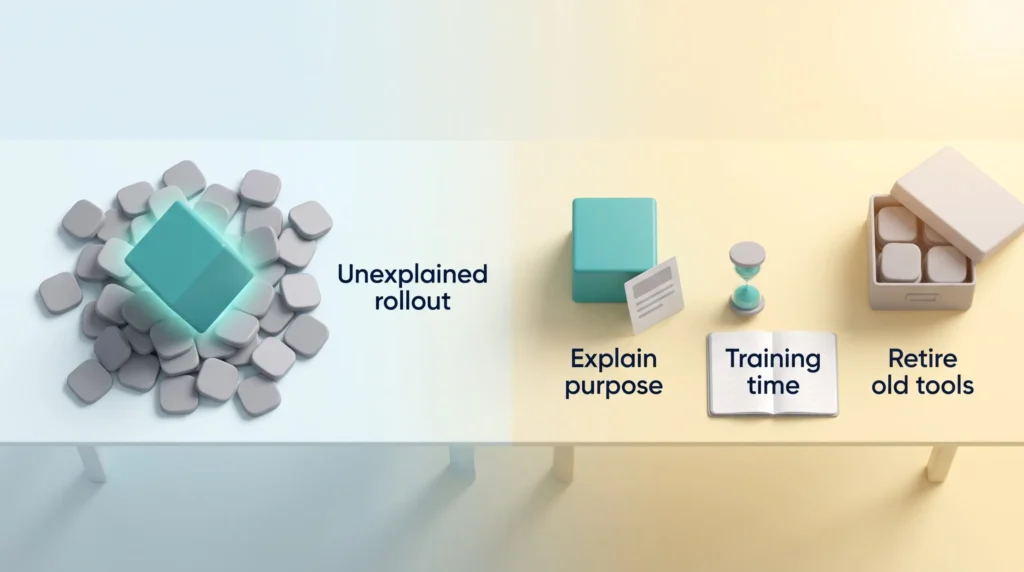
That last number is the risk. When people don’t understand why tools arrive or how their role will change, uncertainty grows. Three steps reduce it:
- Explain the purpose of each new tool and what it means for specific roles. A simple change management plan helps you do this consistently.
- Pair every rollout with training time, not just a login. Our overview of AI in the workplace shows how other companies handle this.
- Retire old tools when you add new ones. Work tech overload is a stress factor of its own.
What to Do If You Feel Quiet Cracking Yourself
If you recognize the pattern in yourself, these steps help you regain control:
- Name what is missing. Is it recognition, growth, clarity or trust in your manager?
- Ask for a career conversation. Many managers don’t notice a quiet decline. Bring concrete goals and ask what it would take to reach them.
- Rebuild connections. Isolation feeds disengagement. Our guide to workplace loneliness covers practical ways to reconnect.
- Decide consciously. If nothing changes after honest conversations, planning a move on your own terms is healthier than cracking for years.
If the feeling affects your sleep or health, talk to a doctor or counselor. Many employers also offer confidential support through an employee assistance program.
Conclusion
Quiet cracking is easy to miss because the work keeps getting done. Underneath, people are losing confidence that their effort is seen and that they have a future at the company.
The fixes are not exotic. Listen regularly, invest in training, recognize specific contributions, keep workloads fair and explain changes such as AI rollouts openly. Start with an audit of your listening channels, manager support and learning access, then act before a quiet slide becomes a resignation.
Found this useful?
Make SmartKeys a preferred source on Google, and our articles will surface more often in your Top Stories, AI Overviews, and AI Mode.
Add as Preferred SourceFAQ
What is quiet cracking in the workplace?
Quiet cracking is a persistent feeling of unhappiness at work that slowly erodes an employee’s motivation and wish to stay. The term was popularized by a 2025 TalentLMS survey, in which 54% of US employees reported experiencing it at least occasionally. Affected people often keep delivering their work. The decline shows up as fewer questions, less curiosity and no talk about the future rather than as missed deadlines.
How is quiet cracking different from quiet quitting?
Quiet quitting is a deliberate choice, while quiet cracking happens without anyone choosing it. Someone who quietly quits decides to do only what the job requires to protect their time and energy. Someone who is quietly cracking may still want to do well but is losing faith that their effort is valued. The two are linked: months of quiet cracking can end in quiet quitting as self-protection.
How can I tell if my team is experiencing quiet cracking?
Watch for changes in behavior rather than drops in output. Typical signs are fewer questions in meetings, no interest in training, silence about future goals and more absences during busy periods. In survey data, look for high scores on resources combined with lower scores on feeling valued or seeing career opportunities. One sign alone means little. A pattern over several weeks is worth an open, curious conversation.
What are the most common causes of quiet cracking?
The main causes are uncertainty about the future, missing training, too little recognition and managers who don’t listen. In the TalentLMS survey, 42% of employees had received no employer training in the past year. Only 26% of employees who frequently experience quiet cracking felt valued, compared with 80% of those who don’t. Role creep, where duties grow without extra support, adds further pressure.
What role do managers play in preventing quiet cracking?
Managers are the most important lever because they notice changes first and control many of the fixes. Regular one-on-ones, open explanations of decisions and specific recognition all reduce uncertainty. In the TalentLMS data, 47% of employees experiencing quiet cracking said their manager does not listen. Managers need support too: Gallup reports that manager engagement fell to 22% in 2025, so companies should back them first.
How can I reconnect with an employee who is quietly cracking?
Start with a private, open conversation about what would make their work more satisfying and where they want to go next. Then act visibly on what you hear, because feedback without follow-through deepens the problem. Useful steps include a concrete learning opportunity, a realistic career path, specific recognition and a workload review. Check in again within a few weeks so the person sees real change.
Can AI tools make quiet cracking worse?
Yes, if they are rolled out without explanation or training. AI can remove repetitive tasks, but it also changes what people do and raises questions about the future of their roles. In a Perceptyx study of more than 3,600 employees, 80% said they needed new skills. Only 64% understood how their company chose its AI tools. Clear explanations and dedicated training time keep AI from adding uncertainty.