A job description does two simple things. It says what a role is responsible for, and it says what someone needs to do it. Artificial intelligence has rewritten both halves.
Two shifts drive this. Software now absorbs tasks that once filled a junior colleague’s week. And roles far outside the tech department have started asking for AI skills of their own.
That leaves managers describing work that is still changing shape, and candidates reading titles that barely existed three years ago. This guide covers what actually changed by 2026, and how to write or read a job description now.
Key Takeaways
- Most job postings that ask for AI skills are no longer tech jobs.
- Postings that require AI skills advertise noticeably higher pay.
- Roughly two in five core skills are expected to change by 2030.
- New titles cluster into two groups: people who build AI systems and people who govern them.
- In the EU, AI used for hiring or performance reviews now carries legal duties that belong in the job description.
- Employers say they hire for skills rather than degrees. The hiring data says otherwise.
What Actually Changed in the Job Description
Job descriptions did not simply gain a line about AI. Their centre of gravity moved.
The old structure listed tasks. Draft the report, clean the data, answer the ticket, build the deck. Many are now partly automated, so listing them describes a job that no longer exists in that form.
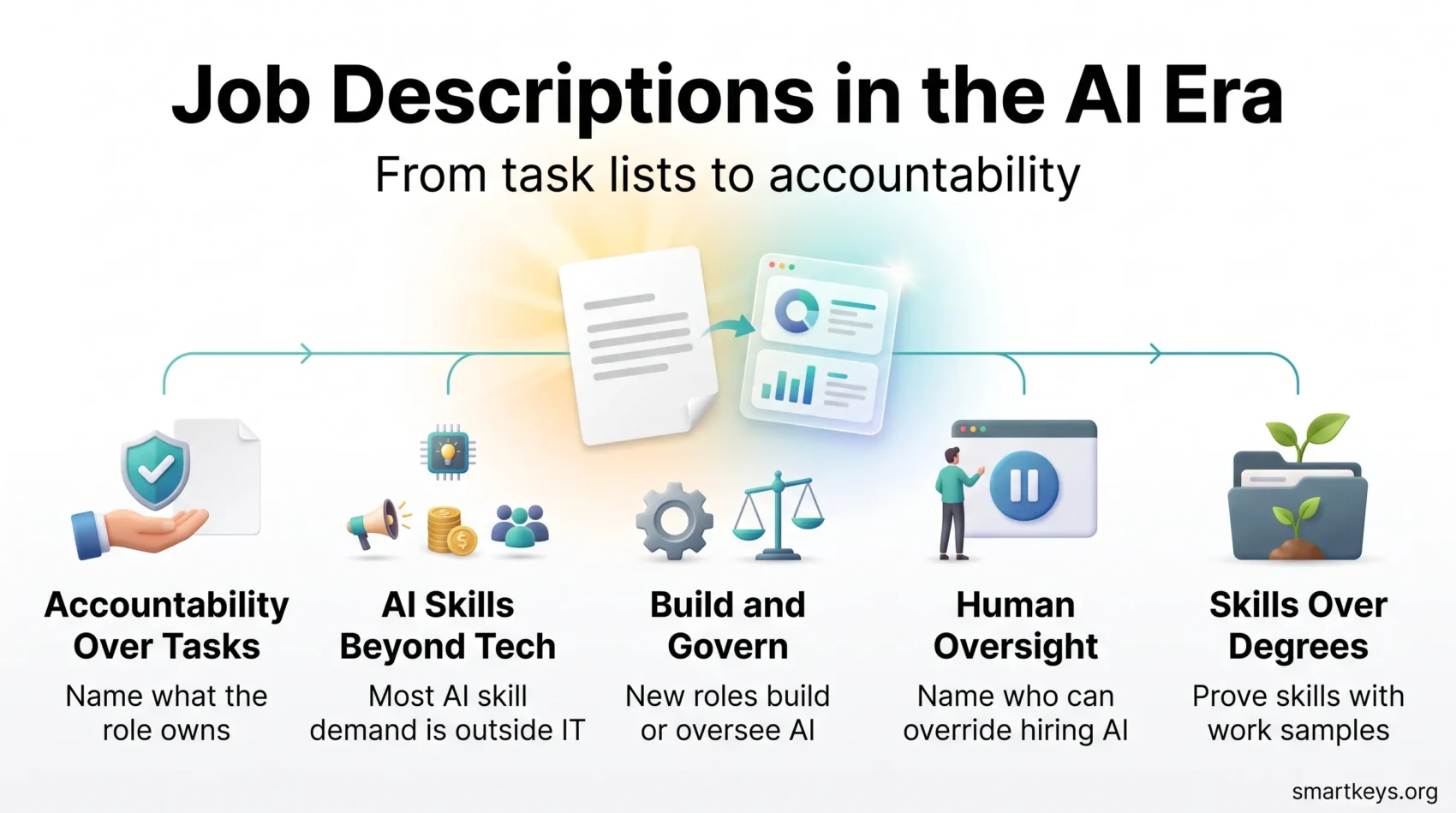
What replaced them is harder to write down. Roles increasingly describe judgment: deciding what the tool should be asked to do, checking whether the output is right, and owning the result when it is wrong. A marketing coordinator no longer writes forty product descriptions by hand. They now brief a model, check the claims against the spec sheet, and take responsibility for what ships.
This is why many 2026 descriptions read as vaguer than their 2022 versions. The concrete tasks moved into the software. What remains is supervision, and supervision is harder to put in a bullet point.
So candidates should read a description for what the role is accountable for, not just its task list. Managers should write that accountability down, because it is now the job.
AI Skills Left the Tech Department
The single clearest data point on this comes from Lightcast, a labour market analytics firm that reads job postings at scale. In a July 2025 report drawing on more than 1.3 billion postings, Lightcast found that 51% of jobs requiring AI skills sat outside IT and computer science occupations.
That is the headline: a majority of AI skill demand is now in marketing, finance, HR, operations and healthcare rather than engineering. The same analysis found postings requiring AI skills advertised salaries about 28% higher, close to $18,000 more per year, than comparable roles without them.
Read that number carefully. It is a premium on advertised pay, not proof that a course certificate raises your salary by a quarter. Employers asking for AI skills tend to be filling senior or hybrid roles, and those paid more already.
Still, the direction is not in doubt. If your work involves data, customers or documents, an AI line has probably already reached the descriptions for jobs like yours. Our guide to which skills are most in demand in 2026 covers where that demand is concentrated.
The Skills That Moved to the Front
The World Economic Forum’s Future of Jobs Report 2025 gives the clearest picture here. It surveys employers, so it reflects what companies expect rather than what has already happened.
Its central finding: employers expect 39% of workers’ core skills to change by 2030. That is lower than the 44% the same survey reported in 2023. Expectations of upheaval cooled slightly rather than rose.
The skills employers named as growing fastest were AI and big data, networks and cybersecurity, technological literacy, creative thinking, and resilience with flexibility and agility.
Notice the shape of that list. Two entries are technical. Three are not. Job descriptions now routinely pair a tool requirement with a judgment requirement, because using the tool well is mostly a judgment problem.
The report also puts numbers on who gets trained. Of every 100 workers, employers expect 29 to be upskilled inside their current role and 19 to be reskilled and moved to a different one. Another 11 will need training but will not get access to it. That last group is the quiet risk in most workforce plans.
What This Means for a Real Job
Take an accounts payable clerk. Invoice matching is increasingly automated. What remains is exception handling: spotting the invoice the system flagged wrongly, and knowing the supplier well enough to tell which answer is right. If the description still leads with “process invoices”, it is describing 2019.

The New Job Titles, in Plain English
New titles arrive faster than shared definitions. Two people can hold the same title and do completely different work. It helps to sort them into two groups.
Roles That Build the Systems
These are technical roles with reasonably stable titles.
Machine learning engineer. Builds and maintains the models, and the pipelines that feed them data. Closer to software engineering than to research.
AI product manager. Decides what an AI feature should do and how success is measured. The hard part is scoping, because AI features fail differently from ordinary ones.
LLM ops or AI platform engineer. Keeps deployed large language models running in production: cost, latency, versioning and monitoring. Our overview of an LLM ops strategy explains what the function covers day to day.
Data steward. Owns the quality and provenance of a data set. An unglamorous role that quietly determines whether anything above it works.
Roles That Govern the Systems
This group grew because of regulation and risk, not because of technical need.
AI ethics or responsible AI lead. Reviews systems before deployment for bias, privacy and safety problems. See our profile of the AI ethics officer role for what the job involves.
AI governance manager. Maintains the inventory of AI systems in use, their risk classification and their documentation. Dull, and increasingly mandatory.
Model risk or assurance reviewer. Tests whether a model does what it claims. Common in banking and insurance, now spreading. Related reading: explainable AI and bias in algorithmic recruitment tools.
One caution here. These titles are often bolted onto an existing job as a part-time duty. Before accepting one, ask how much of the week it should occupy and who the role can overrule.
Compliance Is Now Part of the Description
If your organisation operates in the EU, some of this stopped being optional.
The EU AI Act classifies several common HR uses of AI as high risk. That list includes automated candidate selection, performance evaluation, workplace monitoring, and systems that inform promotion or termination decisions. High risk does not mean banned. It means the system carries documentation, oversight and transparency duties.
For an employer using such a system, rather than building it, the core duties are concrete. A named person must oversee the system, be trained for it, and have real authority to override it. Workers and their representatives must be told clearly, before deployment, that the system is in use.
The timing is unsettled. These obligations were set to apply from 2 August 2026. The European Commission’s Digital Omnibus proposal would tie them instead to harmonised technical standards, potentially pushing them into 2027 or 2028. That proposal was still under negotiation through 2026, so legal advisers have told employers to prepare for the earlier date.
The job description consequence is simple. If a role involves running a hiring or performance AI system, the oversight duty belongs in the description, with a name attached. Our guides to AI hiring tools and what the law requires, EU AI Act compliance and AI in employee monitoring go through the detail.
Skills over Degrees: Talk and Practice
Removing degree requirements has been the most visible change to job postings in recent years, and the one with the widest gap between announcement and reality.
Researchers at Harvard Business School and the Burning Glass Institute examined more than 11,000 US job postings from 2014 to 2023. Companies did drop the requirements. Actual hiring barely moved. Once the analysis accounted for how few roles were affected, fewer than 1 in 700 new hires benefited.
A minority of employers did follow through. The study identified eight large companies averaging 18% more hires without degrees, and at those firms the non-degree hires stayed longer than their degreed colleagues.
So treat a dropped degree requirement as an invitation rather than a guarantee, and expect to prove the skill another way. Portfolios, work samples and micro-credentials carry more weight here than the posting suggests. For employers, the posting is the easy part: if screening still filters on degree, only the wording changed.
How to Write One That Holds Up
A short checklist for anyone rewriting a role this year.
- Name the accountability, not the task. “Owns the accuracy of published pricing” beats “updates the pricing sheet”.
- Say which tools the role uses, and to what depth. “Comfortable prompting and checking a drafting assistant” is a different job from “builds retrieval pipelines”. Both get called AI skills.
- Separate must-have from nice-to-have honestly. Long AI requirement lists mostly deter good candidates who lack one item.
- Write the oversight duty explicitly if the role supervises an AI system that affects people.
- Drop the requirements you do not screen on. A requirement you ignore is noise for everyone.
- Revisit it in twelve months. Roles touching generative AI have been changing faster than annual review cycles.
Rewriting several roles at once? Our guide to digital skills gap analysis helps decide what to ask for.
If You Are the Candidate
The advice that survives contact with the evidence is narrower than most career content suggests.
Learn the tools your own field actually uses, not AI in the abstract. A finance analyst gains more from fluency in the tools on their desk than from a general machine learning course.
Build something small and keep the record of it. Given how weakly degree reforms translated into hires, demonstrated work is the more reliable signal.
Keep the judgment skills sharp. Employers ranked creative thinking and resilience alongside technical literacy for a reason: the automatable parts of the job are the ones already leaving.
Many employers fund training on request, and low-cost courses are widely available. Our guides to upskilling and reskilling, mid-career retraining and remote corporate training cover how to choose.
The Short Version
Job descriptions changed because the work changed. Routine execution moved into software, and what remains is judgment, supervision and accountability.
Demand for AI skills has spread well beyond technical teams, with a visible pay premium in postings. In the EU, roles overseeing hiring or performance AI now carry legal duties, whatever the final compliance date turns out to be.
None of this requires reinventing your career. It does require reading job descriptions, and writing them, as statements of responsibility rather than lists of tasks. For the wider picture, see our overviews of AI and automation at work, how workers are adapting to job automation and what the evidence says about work in 2030. As AI becomes more integrated, it is changing work norms and expectations across the board, and HR practice alongside them. The ethical questions travel with it.
Found this useful?
Make SmartKeys a preferred source on Google, and our articles will surface more often in your Top Stories, AI Overviews, and AI Mode.
Add as Preferred Source