
Many companies now ask staff to be in the office on set days. In the Fortune 100, three days a week is by far the most common hybrid rule, according to a July 2025 Flex Index analysis. Once a rule like that exists, someone has to answer a simple question: are people actually coming in?
The most common answer is badge data. Every time an employee taps a keycard, fob or phone at a reader, the access control system logs who entered, where and when. That log is cheap to collect and hard to argue with. It is also easy to misread.
This guide explains how badge data becomes attendance records, how to calculate fair compliance metrics and where the data stops being reliable. It is written for HR leads, managers and workplace planners who need numbers they can defend.
Key Takeaways
- Badge data shows that someone entered a building. It does not show how long they stayed or what they did.
- Set the attendance rules, exceptions and reporting period before you look at any data.
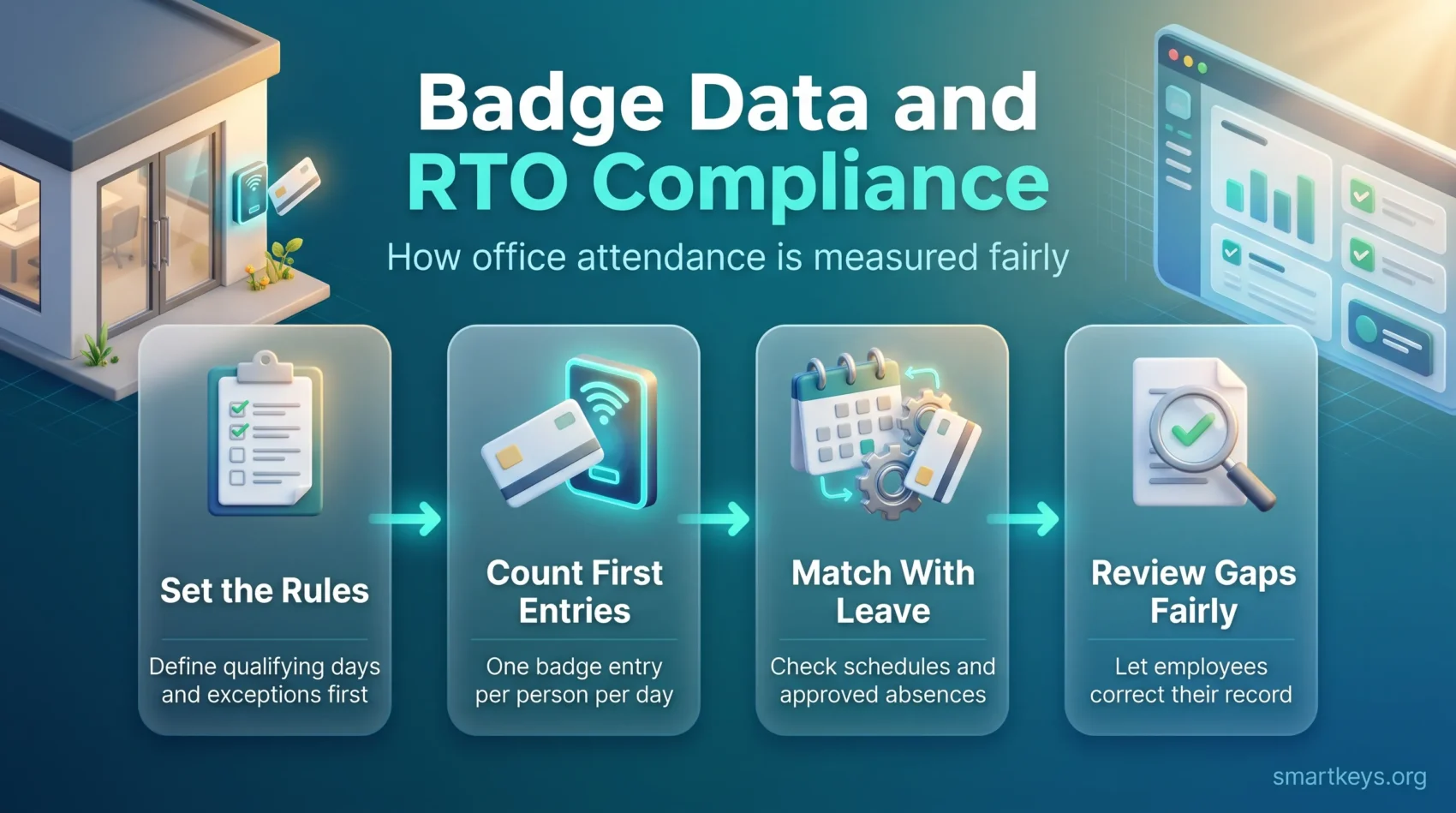
- Count one qualifying entry per person per day, then compare it with the schedule and approved absences.
- Treat gaps as questions to clarify, not as violations, until a person has had a chance to correct the record.
- Tell employees what you collect, why, who sees it and how long you keep it.
What RTO Compliance Actually Means
RTO, short for return to office, describes a policy that sets how many days staff must work on site. RTO compliance is the share of those required days that a person or team actually met. That sounds simple, but it depends entirely on definitions you set in advance.
Take a three-day rule. Does a half day count? What about a day at a client site, a sick day or a public holiday? If those answers are missing, two managers will read the same badge log in two different ways. That is how disputes start.
Attendance data can show whether people followed the location rule. It cannot tell you whether they did good work, so keep those two questions apart from the start. Our guide to return-to-office mandates covers why that distinction matters for retention.
The gap between rules and reality is real. In the same July 2025 analysis, Flex Index reported that the average number of office days required by U.S. company policy had risen 10% in a year, while actual office usage rose only 2% to 3%. Measuring compliance well helps you see which side of that gap your organization is on.
How Badge Data Becomes a Daily Attendance Record
An access control system records an event each time a credential is used. A typical event contains five fields: who (employee ID), where (building and reader), when (date and timestamp), what (entry, exit or denied) and how (card, fob or mobile credential).
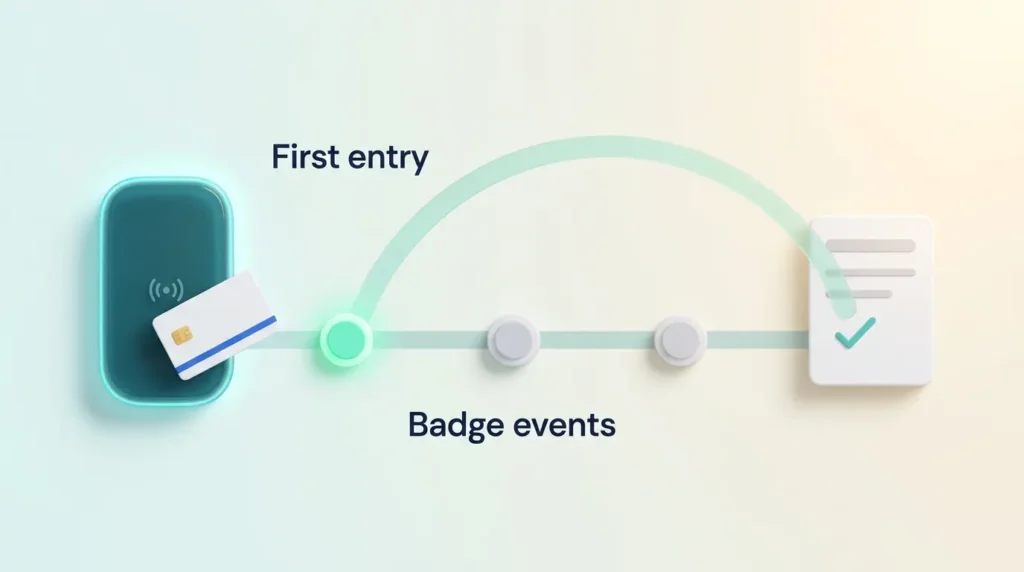
One person can create many events a day: entering in the morning, leaving for lunch, badging into a secure floor. To turn that noise into attendance, you need a counting rule.
The simplest and most common rule is to count only the first entry per person per day. Kastle Systems, whose Back to Work Barometer tracks office occupancy from access data in 10 major U.S. cities, uses exactly this approach to avoid overcounting repeat swipes. In the week ending October 21, 2026, its 10-city average stood at 56.1% of the pre-pandemic baseline. Tuesday was the busiest day, at 66.1%.
For your own records, the first-entry rule gives a clean list of days each person was on site. Add detail only if your policy needs it:
- Exit events show when someone left, but only if your readers log exits. Many do not.
- Multiple sites need a shared employee ID, so a visit to a second office still counts.
- Mobile credentials and cards should map to the same person, or you will see duplicates.
What Badge Data Can and Cannot Prove
Badge data is good evidence of one thing: a credential belonging to this person opened this door at this time. Everything beyond that is an inference.
It cannot prove the person stayed. Someone who badges in at 9 a.m. and leaves at 10:30 looks the same as someone who stays until 6 p.m., unless you also log exits. This is the loophole behind “coffee badging,” the habit of tapping in, being seen and leaving soon after. Some employers have added tools to spot it. In 2025, Samsung introduced attendance tracking for some U.S. semiconductor staff with exactly this goal.
It also cannot prove the person was the cardholder. Shared or borrowed badges happen. And it says nothing about whether the visit was useful. A day of video calls at a desk counts the same as a day of workshops.
So use careful language in reports. Call badge events “presence signals,” not proof of work. If you add Wi-Fi logins or desk bookings to estimate how long people stay, say so, and explain the limits of each source.
Set Clear Attendance Rules Before You Track
The most common mistake is to start with the data and invent the rules afterward. Do it the other way round. Write down what counts before anyone opens a dashboard.
A workable rule set answers these questions:
- Required days: How many days per week or month, and are they fixed (for example Tuesday to Thursday) or flexible?
- Qualifying day: Does any entry count, or must the person stay a minimum time?
- Exceptions: How do holidays, vacation, sick leave, parental leave, business travel and client-site days count?
- Role differences: Do field staff, customer-facing roles or people with approved adjustments follow a different rule?
- Reporting period: Is compliance measured weekly, monthly or per quarter?
A monthly or quarterly period is usually fairer than a weekly one. It absorbs a sick day or a trip without flagging someone who otherwise meets the rule. Our hybrid work policy template covers the clauses most rollouts forget. Our guide to flexible work schedules shows how other employers set them.
Make Sure the Data Collection Is Reliable
Bad inputs produce unfair outcomes. Before you rely on badge data for compliance, check the basics of how it is collected.
- Reader coverage: Every entrance people use should have a reader that logs entries. Side doors and garage entrances are common blind spots.
- Clock sync: Readers and servers should share the same time source. A clock that drifts by an hour can move an entry to the wrong day.
- Identity mapping: Each credential should link to one current employee ID. Former staff and visitor cards should be cleared.
- Outage log: Record when readers or the system were down, so missing events can be explained later.
Biometric readers, such as fingerprint or face scanners, need extra care. In the UK, the data protection regulator says employers using biometrics for time and attendance should consider whether a less intrusive alternative would work. Our guide to biometric authentication at work explains the trade-offs.
Connect Badge Events With HR and Leave Data
Badge data alone tells you who came in. To judge compliance, you also need to know who was supposed to come in. That information lives in other systems: the HR system for roles and work locations, the leave system for approved absences, and sometimes a desk booking tool for planned office days.
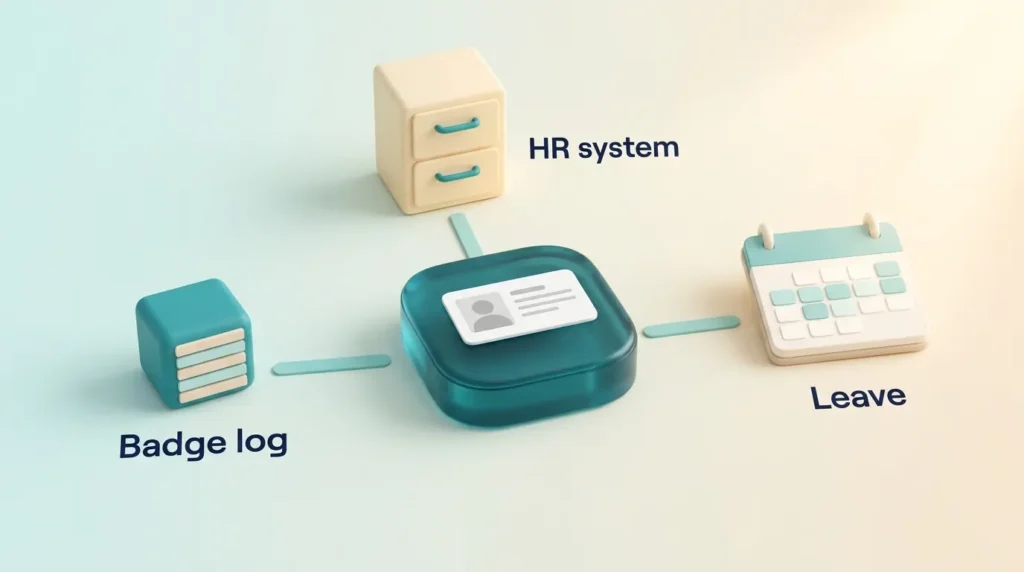
Most access control platforms can export events or connect to HR software through an API, a standard way for two systems to exchange data. Before you buy anything, check three points:
- Can the system match badge events to employees using a shared ID?
- Does it pull approved leave and holidays automatically, or does someone have to enter them by hand?
- How does it handle duplicate swipes and missing entries?
Many tools here overlap with hybrid workforce tools and workforce analytics tools. Pick the simplest setup that answers your policy questions.
Calculate the Core Compliance Metrics
With rules and clean data in place, the math is simple. Three metrics cover most needs.
Attendance Rate
Divide the number of qualifying office days by the number of required office days in the reporting period. Required days should already exclude approved leave and holidays.
Example: a policy requires 12 office days in a month. An employee took three days of approved vacation, so 9 days remain required. The badge log shows 8 qualifying days. The attendance rate is 8 / 9, or about 89%.
Compliance Status
Compare each attendance rate with a threshold, such as “meets policy” at 100% of required days. Some employers use a small tolerance, for example one missed day per quarter, to allow for life’s surprises. Whatever you choose, apply it to everyone.
Team and Site Patterns
Aggregate the data by team, location and weekday. This view is often more useful than individual scores. If a whole team has drifted from the rule, that points to a management or workload issue, not individual behavior. Keep productivity metrics in a separate report and never mix the two in one score.
Compare Records With Schedules and Exceptions
Before you flag anyone, match every missing day against the schedule. A missing badge event can have several explanations:
- Approved leave that was not synced in time
- A client visit, conference or other off-site assignment
- A schedule change agreed with the manager
- A forgotten badge and a temporary visitor pass
- A reader outage or a door with no reader
Only a day that remains unexplained after this check is a real gap. This step prevents the most damaging error: telling someone they broke a rule while they were on approved leave.
Read Attendance Patterns Without Confusing Presence With Productivity
Once the records are clean, patterns become visible. You might see that Tuesday and Wednesday are crowded while Friday is empty. You might see that one department comes in together on the same days and another is scattered across the week.
These patterns are useful for planning. They are not evidence of how hard anyone works.
Watch for proximity bias, the habit of rewarding people managers see most often. Attendance reports can make that bias worse if they are shared casually or used in reviews without context. The fear behind heavy tracking often has a name, productivity paranoia, and more data rarely cures it.
Choose Tracking Methods for Hybrid and Field Teams
Not everyone works behind a badge reader. Hybrid and field teams may need different evidence for the same rule.
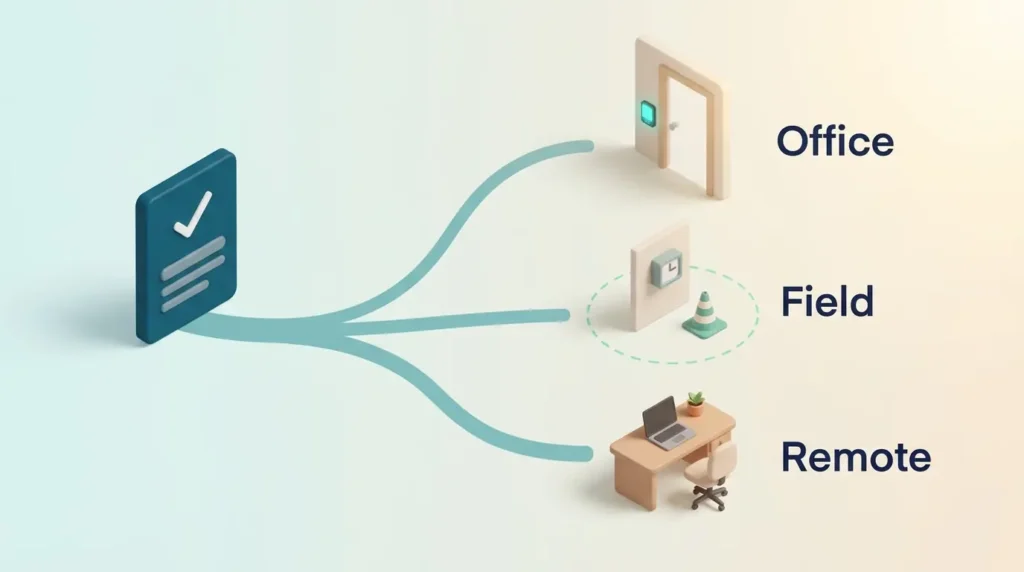
- Office staff: badge entries, sometimes combined with desk bookings.
- Field and multi-site staff: time clocks or mobile clock-ins, sometimes with a geofence, which is a virtual boundary around a job site.
- Remote days: no location data needed. The policy simply records them as remote.
Keep the definitions the same across groups, even if the evidence differs. A “required office day” should mean the same thing whether it is confirmed by a badge reader or a site clock-in. Our overview of making office and remote days productive shows how teams structure the mix.
Build Audit-Ready Attendance Reports
If attendance data can affect pay, promotion or discipline, it needs to hold up to review. An audit-ready report has a few clear features:
- Original timestamps are kept, and every correction is logged with a reason and an approver.
- Reports can be filtered by person, team, site and period.
- Records for a closed period are locked, so they cannot change after the fact.
- The employee can see their own record and understand how it was calculated.
This level of care matters most when results feed into payroll or formal HR decisions. Otherwise, a monthly summary per team is usually enough.
Protect Employee Privacy and Explain Your Policy
Badge data is personal data. In the EU and UK, that means GDPR applies, and employers need a lawful basis, a clear purpose and proportionate collection. In October 2023, the UK Information Commissioner’s Office published guidance on monitoring workers. It says monitoring must respect workers’ expectations, must not be excessive and should be transparent. It also encourages a DPIA, a data protection impact assessment, even where one is not strictly required, and asks employers to consult staff or their representatives.
In practice, a short written notice should answer five questions:
- What data do we collect (badge entries, exits, desk bookings)?
- Why do we collect it (policy compliance, space planning, security)?
- Who can see individual records (for example HR and the direct manager only)?
- How long do we keep it?
- How can an employee check or correct their record?
Rules differ by country, state and works council or union agreement, so check local requirements before rollout. Our guides to employee data privacy and AI employee monitoring go deeper. A broader privacy compliance framework helps you keep retention and access rules consistent.
Use Attendance Insights to Plan Office Space
The least controversial use of badge data is also one of the most valuable: planning space. Aggregated data shows which days are busy, which floors stay empty and whether meeting rooms run out on peak days.

Those answers support concrete decisions:
- Add bookable desks or rooms for peak days instead of assigning a desk to everyone.
- Consolidate floors that stay mostly empty.
- Align cleaning, catering and security staffing with real occupancy.
- Coordinate team days so people who need to meet are in on the same day.
Team-level or site-level data is enough for these decisions. Nobody needs individual records to plan a floor. For the wider picture, see our look at the future of office design and the cost trade-offs between remote and office work.
Fix Data Gaps and Common Tracking Errors
Every badge system has errors. The usual suspects are:
- Tailgating: someone walks in behind a colleague without tapping.
- Forgotten badges: the person enters with a visitor pass that is not linked to their ID.
- Duplicate swipes: repeated taps inflate counts if you do not use a first-entry rule.
- Reader outages: events are simply missing for a period.
Give employees a simple way to correct their record. They should be able to add context, attach evidence such as a calendar entry or visitor log, and receive a documented decision from an authorized reviewer. A fair correction process stops technical errors from turning into unfair absence findings.
Turn Findings Into Fair, Consistent Actions
Data should start a conversation, not end it. When someone repeatedly misses required days, the first step is to ask why. Common reasons include a long commute, caregiving duties, a team that never meets in person anyway, or a workload that makes office days feel pointless.
- Use findings for clarification and coaching first, not automatic discipline.
- Consider role, approved exceptions, technical errors and workload before drawing conclusions.
- Apply the same thresholds and steps across teams so outcomes are comparable.
- Review whether the policy itself still fits the work, especially if many people miss it.
If whole teams fall short, the problem is often the rule or how it was introduced. Practices like a flexible PTO policy or clearer norms for trust in remote teams may solve more than stricter tracking. If you plan to automate decisions from this data, read up on algorithmic management first.
Conclusion
Badge data is a useful presence signal. It tells you who entered and when, which is enough to check a location rule and plan office space. It does not tell you how long people stayed or how well they worked.
The value comes from the process around the data. Set clear rules in advance, count first entries, match records with leave and schedules, and offer a fair way to correct mistakes. Add transparent notice and limited access, and tracking supports the policy without eroding trust.
Keep presence and productivity apart, and use the insights to make office days worth the trip.
Found this useful?
Make SmartKeys a preferred source on Google, and our articles will surface more often in your Top Stories, AI Overviews, and AI Mode.
Add as Preferred SourceFAQ
Does a badge swipe prove an employee worked a full day in the office?
No. A badge swipe only proves that a credential opened a door at a certain time. Unless your readers also log exits, you cannot tell whether the person stayed for an hour or the whole day. You also cannot be sure the cardholder was the person who used the badge. Treat badge entries as presence signals and define in your policy what counts as a qualifying office day, for example any entry or a minimum time on site.
What is coffee badging, and can badge data detect it?
Coffee badging means tapping into the office, being seen for a short time and leaving soon after, so the visit counts toward an attendance rule. Entry-only badge data cannot detect it, because a short visit looks the same as a full day. Systems that also log exits can show how long someone stayed, and a few employers have added tools for this purpose. Coffee badging often signals that office days lack a clear purpose, and more tracking rarely fixes that.
What features should I look for in attendance tracking systems?
Look first at whether the system can link badge events to the right employee and to approved leave without manual work. After that, check how it handles duplicate swipes and missing entries, whether it keeps original timestamps alongside corrections, and whether reports can be filtered by person, team, site and period. Role-based access, which limits who can see individual records, is important for privacy. Pick the simplest system that answers your policy questions rather than the one with the most features.
Can attendance tracking software help with remote work?
Yes, but in a limited way. For hybrid teams, the software mainly records which days are office days and which are remote, so compliance with a location rule can be checked. Field and multi-site staff may use time clocks or mobile clock-ins instead of badges. Remote days themselves usually need no location data at all. The key is to keep one definition of a required office day for everyone, even when the evidence differs. Tracking activity on remote days is a separate, more intrusive practice.
How do I ensure employee privacy while using attendance monitoring tools?
Start by collecting only what your policy needs and telling employees about it before you begin. A short notice should explain what data you collect, why, who can see individual records, how long you keep it and how people can correct mistakes. Limit access to HR and direct managers, and use team-level data for space planning. In the EU and UK, badge data is personal data under GDPR, and the UK regulator encourages a data protection impact assessment and staff consultation. Local laws and works council or union agreements may add further rules, so check them first.
What should I do if there are discrepancies in attendance records?
First check whether the gap has a simple explanation, such as approved leave, a client visit, a forgotten badge or a reader outage. Only a day that remains unexplained is a real gap. Then let the employee respond with context and evidence, such as a calendar entry, and give a documented decision. Keep the original record and log every correction with a reason, so the history stays clear if the case is reviewed later.
How can I use attendance insights to improve workplace efficiency?
Use aggregated data to plan space and services, not to rank individuals. Badge patterns show which weekdays are busiest, which floors stay empty and whether meeting rooms run out on peak days. That lets you add bookable desks for busy days, consolidate unused areas and align cleaning, catering and security with real occupancy. Team-level or site-level data is enough for all of these decisions, which keeps privacy risks low.