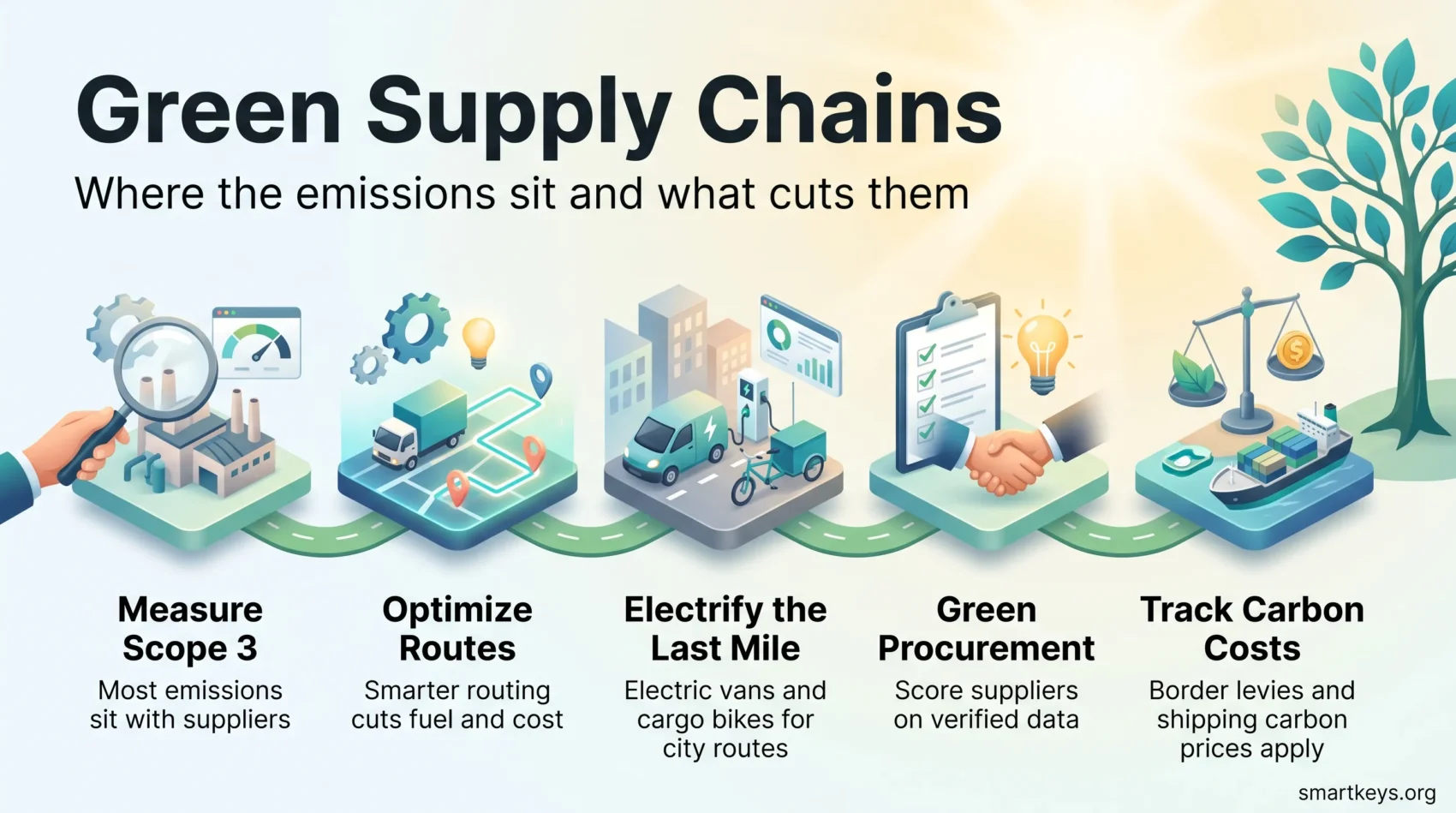
Most of a company’s carbon footprint sits outside its own walls. It sits in the factories of its suppliers, in the trucks that move its goods and in the ships that cross the ocean. That is the simple reason green supply chains moved from marketing brochures into finance meetings.
The scale is easy to underestimate. Companies that disclose through CDP, the environmental reporting platform used by thousands of large firms, reported in 2024 that their supply chain emissions were on average 26 times larger than the emissions from their own operations. Switching your office to LED lighting is worth doing. It also touches a very small corner of the problem.
Two things changed the stakes in 2026. The European Union began charging a carbon price on imported goods at its border, and shipping into Europe started paying for its full emissions rather than a fraction of them. Sustainable logistics is now partly a customs and compliance question, not only an environmental one.
This guide covers where supply chain emissions sit, which 2026 rules apply, which clean transport options are ready, and what large companies delivered rather than promised.
Key Takeaways
- Supply chain emissions dwarf operational emissions, so that is where the effort belongs.
- The EU carbon border levy and full shipping carbon costs both started in 2026.
- Electric trucks are scaling fast, but almost entirely in China so far.
- Route optimization and better data cut cost and carbon at the same time.
- Procurement decisions carry more leverage than any single fleet upgrade.
What a Green Supply Chain Actually Means
A green supply chain is the attempt to reduce environmental harm across every stage of getting a product to a customer: raw materials, manufacturing, packaging, transport, use and disposal. It is a broader idea than “cleaner trucks”, because trucks are rarely the biggest share of the total.
Where the Emissions Really Sit
Emissions are usually sorted into three groups. Scope 1 is what you burn directly, such as fuel in your own vans. Scope 2 is the electricity you buy. Scope 3 is everything else in your value chain, including what suppliers emit making your components and what carriers emit moving your freight.
For most brands, scope 3 is the overwhelming majority. A clothing retailer that owns no factories and no trucks can still be responsible for a large volume of emissions through the mills, dye houses and shipping lines it pays. This is why carbon accounting software has become a standard purchase: you cannot manage a number nobody has measured.
Why the Measurement Is Hard
Scope 3 numbers usually start as estimates. A company multiplies what it spent with a supplier by an industry average emissions factor and gets a figure that is directionally useful and specifically wrong. Moving from that to primary data, meaning actual figures from actual suppliers, is slow work.
It matters because an estimate cannot tell you which supplier to fix first. Closing that gap is what supplier portals and better real-time business data are for.
The 2026 Rules That Changed the Bill
Regulation moved fastest here, and it now has direct cost consequences.
A Carbon Price at the EU Border
The EU’s Carbon Border Adjustment Mechanism, known as CBAM, entered its definitive phase on 1 January 2026. During the earlier transitional period importers only had to report the embedded emissions in certain goods. Now they must buy certificates covering those emissions.
CBAM applies to carbon-intensive imports including iron and steel, aluminium, cement, fertilisers, electricity and hydrogen. In practice it means a European manufacturer buying steel from outside the EU faces a price that moves with the EU carbon market. Suppliers with cleaner production suddenly compete on a different basis.
Shipping Now Pays for Its Full Emissions
Maritime transport entered the EU Emissions Trading System gradually: 40% of reported emissions in 2024, 70% in 2025 and 100% from 2026. From January 2026 the system also covers methane and nitrous oxide, not just carbon dioxide.
Alongside that, FuelEU Maritime requires ships above 5,000 gross tonnage calling at EU ports to cut the greenhouse gas intensity of their fuel, starting at 2% and tightening toward 80% by 2050. Carriers pass these costs on as surcharges, so ocean freight rates now carry a visible carbon component.
Globally, progress was slower. The International Maritime Organization postponed adoption of its Net-Zero Framework for a year at an extraordinary session in October 2025, pushing the decision into 2026. Anyone planning around a worldwide shipping carbon price should treat the timing as unsettled.
Who Still Has to Report
Europe also narrowed its reporting rules. The Omnibus I package, approved by the European Parliament in December 2025, cut the scope of the Corporate Sustainability Reporting Directive to companies with more than 1,000 employees and more than 450 million euros in net turnover. The separate due diligence directive now targets companies above 5,000 employees and 1.5 billion euros, with compliance starting in 2029.
Fewer companies file directly. Many more are still pulled in as suppliers, because the firms that do report need data from everyone they buy from. Our overview of corporate social responsibility trends and the practical ESG framework guide go deeper on what those filings involve.
Cleaner Transport: What Is Ready and What Is Not
Transport is the visible part of a supply chain and where most improvement plans start. It is worth being precise about what has actually arrived.
Electric Trucks Are Scaling, Mostly in One Place
Electric truck sales doubled in 2025 and passed 400,000 units worldwide, reaching about 9% of all truck sales, according to the International Energy Agency’s Global EV Outlook 2026. Heavy freight trucks nearly tripled to roughly 230,000 units.
The regional picture is lopsided. China accounted for more than 90% of those sales, where roughly one truck in four sold was electric. Europe sold about 17,000 electric trucks, around 3% of its market, and the United States a similar number. If you operate in Europe or North America, electric heavy trucks are a pilot programme, not yet a fleet strategy. Charging capacity and vehicle range remain the binding constraints.
Alternative Fuels and the Last Mile
Where batteries do not yet fit, operators use biofuels, renewable diesel or, in early trials, hydrogen. These reduce emissions without requiring new depots and charging infrastructure, which is why many carriers treat them as the bridge rather than the destination.
The last mile is different. Short urban routes suit electric vans and cargo bikes well, because daily distances are short and depots are fixed. This is the part of the network where a switch is straightforward today.
Technology That Cuts Cost and Carbon Together
The measures that survive a budget review save money as well as emissions. Fuel is a cost line, so anything that burns less of it has an obvious business case.
Route Optimization
Better routing is the least glamorous and most reliable win. UPS reports that its ORION routing system saves roughly 100 million miles and about 10 million gallons of fuel each year. Nothing about that requires a new vehicle. It requires better decisions about which stops go in which order.
The same logic applies to warehouses. Predictive maintenance keeps equipment running efficiently instead of degrading quietly, and digital twins in manufacturing let teams test a layout or a schedule before committing physical resources to it.
Traceability and Sensors
Connected sensors, the practical face of the internet of things in business, report temperature, location and vibration in transit. That reduces spoilage and rework, which is emissions avoided rather than emissions offset.
Blockchain has a narrower but real role: creating a shared record that several parties can trust without one of them owning it. That fits documents such as bills of lading, where forgery and duplication are genuine problems. Our guides to blockchain in logistics and blockchain in business cover where it has stuck and where pilots quietly stopped.
Designing Waste Out
Some of the largest gains come before anything moves. Making a product repairable, or using recycled input material, removes emissions that transport efficiency can never recover. That is the argument behind the circular economy in manufacturing and the broader circular economy for business.
Green Procurement: Where the Leverage Is
If most emissions sit with suppliers, then purchasing decisions matter more than any single fleet upgrade. Green procurement means treating environmental performance as a selection criterion alongside price, quality and reliability.
How to Score a Supplier
A workable approach keeps the criteria few and checkable:
- Does the supplier measure and report its own emissions, and with what data quality?
- What share of its energy is renewable, and is that contracted or estimated?
- How far does the material travel, and by which mode?
- Is there recycled or certified input content, and who verifies it?
Asking for evidence rather than a policy statement is the difference between procurement that changes behaviour and procurement that collects PDFs. Digitising the process, as described in our guide to digital procurement, mainly helps because it makes the answers comparable.
Collaboration Beats Instruction
Small suppliers often lack the staff to produce the data a large customer wants. Sector programmes exist partly to spread that burden. The Responsible Minerals Initiative, for example, now has more than 500 member companies working on responsible mineral sourcing, which means a supplier can be audited once rather than fifty times.
This is also where supply chain resilience and sustainability overlap. Knowing your suppliers well enough to assess their emissions usually means knowing them well enough to see disruption coming.
What Customers Actually Reward
Consumer research needs careful reading, because stated intentions and till receipts often diverge.
PwC’s 2024 Voice of the Consumer survey found shoppers were willing to pay about 9.7% more on average for sustainably produced goods, even under cost-of-living pressure. That is a meaningful premium, and it is far below the enthusiasm that survey headlines sometimes suggest.
The practical reading: sustainability supports a modest premium and helps win business-to-business contracts, where buyers increasingly need supplier data for their own reports. It does not support a large price increase on its own. Our article on what consumers reward in 2026 looks at that gap in more detail.
There is also a downside risk. EU rules against misleading environmental claims have tightened, so vague labels such as “eco-friendly” without evidence now carry legal exposure rather than marketing upside.
The Obstacles Worth Naming
Upfront Cost
Electric trucks, depot charging and solar on a distribution centre all cost money before they save any. The payback is real but measured in years, which is awkward when capital budgets are annual. Green finance instruments exist partly to bridge that gap, and a documented carbon neutrality roadmap makes the case easier to approve.
Data and Reporting Load
Compliance is now an operating cost. CBAM requires embedded emissions data for imported goods. Customers ask for supplier-level figures. Auditors ask how the figures were produced. Companies that treated sustainability reporting as an annual communications exercise are discovering it needs owners, systems and a calendar.
What Large Companies Have Actually Delivered
Three examples, including one that shows what happens when reality intervenes.
Walmart set out in 2017 to cut a billion metric tons of greenhouse gases from its supply chain by 2030 through its Project Gigaton programme. It announced in 2024 that suppliers had reached the target more than six years early. The mechanism was supplier engagement at scale rather than any single technology.
Unilever targets net zero across its value chain by 2039, with interim 2030 goals of a 42% absolute cut in scope 3 energy and industrial emissions and a 30.3% cut in forest, land and agriculture emissions, both against a 2021 baseline. The company published a revised climate plan in 2024 that made those figures more specific.
IKEA is the useful counterexample. Ingka Group, the largest IKEA franchisee, had aimed for 100% zero-emission home deliveries by 2025. In February 2025 it moved the goal to more than 90% by 2028, citing charging infrastructure, differing local policies and the limited range of electric freight vehicles. It had reached over 41% in 2024. The revision is a fair signal of how far electrification has got outside China.
A Sensible Starting Sequence
For a company beginning this work rather than reporting on it, the order that tends to hold up is:
- Measure first, accepting that early scope 3 figures will be estimates.
- Fix routing, load factors and packaging, because these pay back quickly.
- Electrify the last mile, where the technology is ready now.
- Put environmental criteria into supplier scoring and contracts.
- Check your CBAM and reporting exposure before a customer or customs does.
For wider context, see our overviews of supply chain management trends and green technology.
Conclusion
Green supply chains stopped being a reputational project during 2026. A carbon price at the EU border and full emissions costs on shipping turned them into a line item that finance teams can see.
The work that pays is unglamorous: measure what you actually emit, fix the routing and packaging that waste fuel today, electrify where the technology is ready, and put environmental performance into supplier decisions. Companies doing that are not just compliant. They are usually cheaper to run.
The honest caveat is that progress is uneven. Electric heavy trucks are scaling in China and crawling elsewhere. Global shipping rules slipped by a year. Even IKEA moved its own deadline. Planning around what has shipped, rather than what has been announced, is the difference between a credible programme and a press release. If you are formalising this, our guides to sustainability strategy and sustainable business innovation are a reasonable next step.
Found this useful?
Make SmartKeys a preferred source on Google, and our articles will surface more often in your Top Stories, AI Overviews, and AI Mode.
Add as Preferred Source