
In the summer of 2026, three of the biggest names in tech made the same bet within a few weeks. On June 30, Amazon Web Services (AWS) put $1 billion into a new unit that sends engineers to work inside customer companies. Two days later, Microsoft announced the Microsoft Frontier Company with a $2.5 billion commitment and more than 6,000 people. In May, OpenAI had already launched the OpenAI Deployment Company with more than $4 billion from investors such as TPG, Advent, Bain Capital and Brookfield.
All three are building teams around one job title: the forward deployed engineer, or FDE. Andreessen Horowitz called it “the hottest job in startups” back in 2025. In 2026 it has become a hiring priority for the largest cloud and AI companies too.
This guide explains what a forward deployed engineer actually does, why the role suddenly matters so much, which skills it takes, what it pays, and how you can prepare for it. You do not need a technical background to follow along.
Key Takeaways
- A forward deployed engineer is a software engineer who works inside one customer’s organization to make a product, usually an AI system, work in that customer’s real environment.
- The role exists because many AI projects stall between a promising demo and daily use. FDEs close that “last mile.”
- AWS, Microsoft, OpenAI, Anthropic and Google all expanded FDE teams in 2026.
- The job needs solid engineering skills plus strong communication, business sense and a tolerance for travel.
- Pay is typically above standard software engineering, but the travel and pressure make burnout a real risk.
Why AI Needs Engineers Inside the Customer
Buying an AI tool is easy. Getting it to do useful work every day is hard. A 2025 report from MIT’s NANDA initiative found that about 95% of enterprise generative AI pilots showed no measurable business impact. The models themselves were rarely the problem. The trouble sat in the company around them. Our guide to measuring AI ROI explains why so many pilots never show a return.
Think of a regional insurer that wants AI to draft claim decisions. The model works well in a demo. Then the team discovers that claim data lives in three old systems, security rules block the cloud connection, and the adjusters do not trust the drafts. Nobody at the AI vendor knows about any of this, because nobody from the vendor has sat in that claims office.
This gap between “the technology works” and “the business uses it” is often called the last-mile problem. Forward deployed engineers exist to close it. They go where the problem is, learn how the work really happens, and build the connections, checks and workflows that turn a pilot into a working system. If your company is exploring AI agents in business, this last mile is usually where projects succeed or fail.
What Is a Forward Deployed Engineer?
A forward deployed engineer is a software engineer who is assigned to a specific customer and works closely with that customer’s staff, often on site. The name borrows from military language: a “forward deployed” unit is stationed close to where the action is.
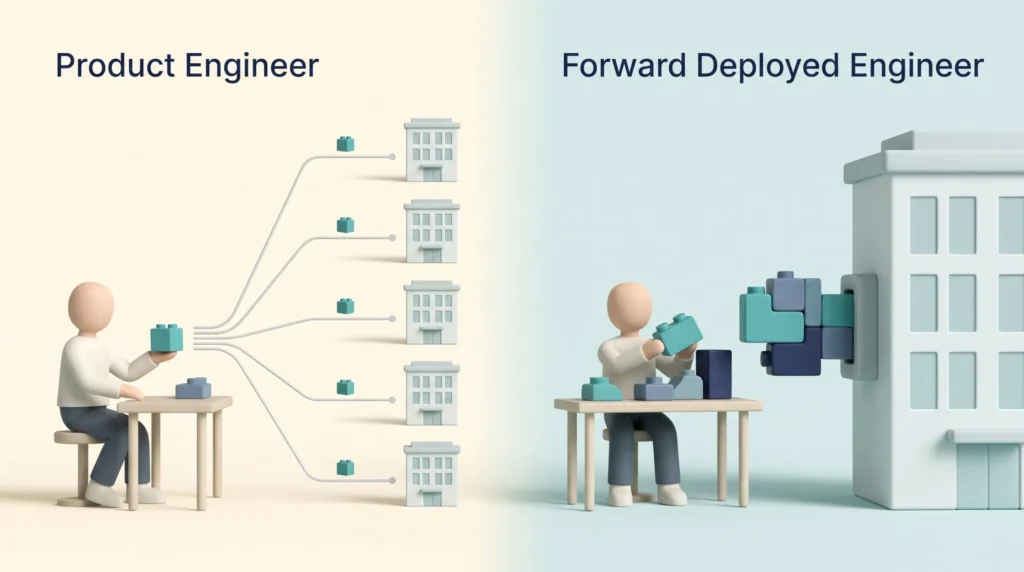
The data analytics company Palantir popularized the role. Internally, Palantir called these engineers “Deltas.” According to The Pragmatic Engineer, Palantir describes the difference like this:
- A regular product engineer builds one capability for many customers.
- A forward deployed engineer combines many capabilities for one customer.
In practice, the role sits between software engineering, solutions architecture (designing how systems fit together) and consulting. Palantir’s FDEs originally worked mostly with government and defense clients, then moved into sectors such as healthcare, manufacturing and aviation. The role was so central that, until 2016, Palantir reportedly employed more FDEs than traditional software engineers.
Why the Role Took Off in 2026
Two things came together. First, generative AI gave companies powerful new tools that are hard to wire into existing systems. Second, AI vendors realized that unused software gets cancelled. Getting customers to real results became a business necessity, much like the shift that made customer success tools standard in software.
That explains the wave of announcements:
- OpenAI (May 2026): launched the OpenAI Deployment Company with more than $4 billion in initial investment and agreed to acquire the consulting firm Tomoro, bringing about 150 experienced FDEs and deployment specialists on board (OpenAI).
- Anthropic (May and July 2026): announced a $1.5 billion enterprise AI services company with Blackstone, Hellman & Friedman and Goldman Sachs in May. The firm, aimed largely at companies owned by private equity investors, launched in July as Ode with Anthropic.
- AWS (June 30, 2026): committed $1 billion to a Forward Deployed Engineering organization that embeds thousands of engineers with customers. AWS says the goal is to cut deployment time “from months to days.” Named customers include the NFL, the NBA, Cox Automotive and Southwest Airlines (About Amazon).
- Microsoft (July 2, 2026): launched the Microsoft Frontier Company with $2.5 billion and more than 6,000 people, most of them moved from existing Microsoft teams.
The job market followed. LeadDev, citing Indeed data reported by Business Insider, notes that FDE job postings in April 2026 were up 729% compared with a year earlier. Google Cloud, ServiceNow, Accenture and many AI startups are hiring as well.
Why Vendors Accept the Cost
Embedding engineers is expensive. A software company that sends people to every customer earns lower margins than one that only sells licenses. So why do it?
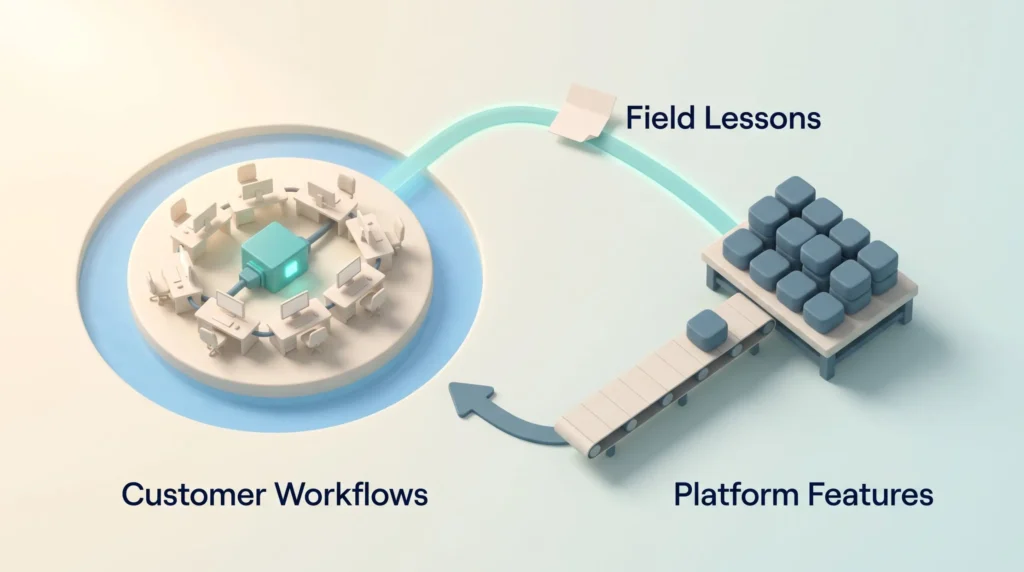
Andreessen Horowitz partner Joe Schmidt summed it up as “trading margin for moat.” A moat is a lasting competitive advantage. When an FDE builds a product deep into a customer’s workflows, the customer is far less likely to switch. The engineer also brings real-world lessons back to the product team. Palantir’s model depends on turning those field lessons into reusable platform features, instead of billing for the same custom work again and again like a classic consulting firm.
Schmidt points to history: Salesforce, ServiceNow and Workday all grew with heavy implementation work before their margins improved. AI vendors are betting on the same path. For a broader look at how this affects software business models, see our guide to AI in SaaS.
What a Forward Deployed Engineer Does Day to Day
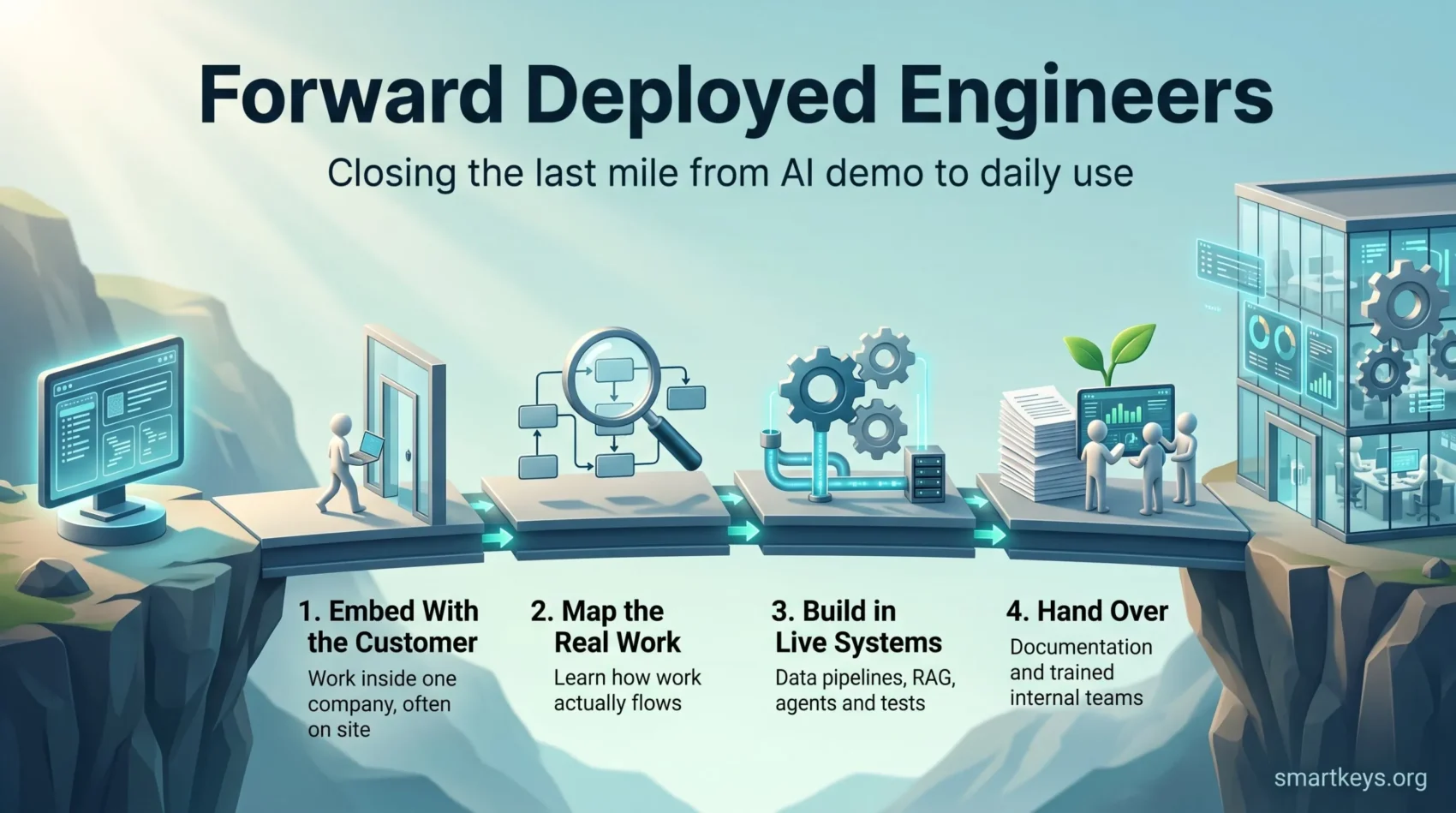
The work usually follows a pattern: understand the problem, build the solution in the customer’s systems, then hand it over.
Understanding the Customer
- Interviewing managers and frontline staff to find the problems a written specification misses.
- Mapping how work actually flows, for example how a support ticket travels from inbox to resolution.
- Spending real time on site. The Pragmatic Engineer reports that Palantir FDEs spend roughly 25% of their time at customer locations, while the health tech company Commure expects up to 50%.
Building in the Real Environment
FDEs write production code inside the customer’s infrastructure, not in a clean demo setup. Typical tasks include:
- Building data pipelines, the automated routes that move and clean data between systems.
- Setting up retrieval-augmented generation (RAG), a method that lets an AI model look up the company’s own documents before answering.
- Connecting AI agents to internal tools and approval workflows.
- Creating evaluations, which are repeatable tests that check whether the AI gives correct and safe answers.
A well-known example comes from OpenAI. One of its FDEs worked with John Deere on personalized guidance for farmers. The work included traveling to Iowa and meeting farmers directly, with a tight deadline before the growing season.
Handing Over
Good FDEs leave the customer more capable. AWS, for example, says its engagements deliver documentation and trained internal staff so customers can run the systems on their own afterwards. That handover depends on sound change management, because new tools only stick when people change how they work.
Skills You Need as a Forward Deployed Engineer
The role needs two skill sets at once: strong coding and strong communication.
Technical Skills
- Solid software engineering fundamentals, often across the full stack (front end, back end and databases).
- Data engineering and cloud deployment experience.
- Working knowledge of RAG, vector databases (databases built to search by meaning rather than exact words) and model fine-tuning.
- Familiarity with AI coding assistants and the Model Context Protocol (MCP), an open standard for connecting AI models to tools and data. Our AI glossary explains these and related terms in plain language.
- Security awareness, especially in regulated industries such as finance and healthcare. A clear AI governance model on the customer side makes this much easier.
If you work in or with operations teams, our guide to LLM Ops strategy explains how companies run large language models reliably after launch.
Human Skills
- Translating vague business wishes into clear technical plans.
- Explaining trade-offs to both engineers and executives.
- Building trust with people who may be skeptical of AI.
- Business sense: knowing which result actually matters to the customer, such as hours saved or errors avoided.
Research supports the value of this customer focus. Google Cloud’s 2023 DORA report found that teams with a strong user-centric focus had about 40% higher organizational performance. For more on why these abilities matter across roles, read our piece on soft skills for future work.
Forward Deployed Engineer Salary and Career Outlook
FDE pay generally sits above standard software engineering because the role combines technical delivery, customer trust and influence on revenue. Exact numbers vary widely by company and level, so treat any single figure as a rough guide.
- Benchmark for software engineers: the U.S. Bureau of Labor Statistics reports a median annual wage of $135,980 for software developers (May 2025).
- Average FDE base salary: Indeed data cited by LeadDev puts it at about $171,911 per year.
- Example ranges: The New Stack reported Google Cloud FDE base salaries from $127,000 to $183,000 for applied roles and $183,000 to $265,000 at a more senior level, plus bonus and equity.
The broader outlook for data and AI work is also strong. The BLS projects employment of data scientists to grow 35% from 2025 to 2035, much faster than average.
There are downsides too. Travel is heavy; some OpenAI FDE listings mention up to 50%. A former Palantir FDE told LeadDev that constant travel makes burnout come earlier than in other engineering jobs. Some observers also expect better tooling to reduce the need for embedded engineers over time. That does not make the skills worthless, in line with the broader pattern of AI augmenting rather than replacing jobs. It means the title may change while the ability to connect technology and business stays in demand. Our article on job descriptions in the AI era covers how titles like this keep shifting, and the story of what happened to prompt engineering jobs shows how fast a hot AI title can be absorbed into other roles.
Forward Deployed Engineer vs. Other Technical Roles
Several job titles overlap with the FDE role, and companies define them differently. The main differences come down to how close you sit to the customer and whether you write production code.
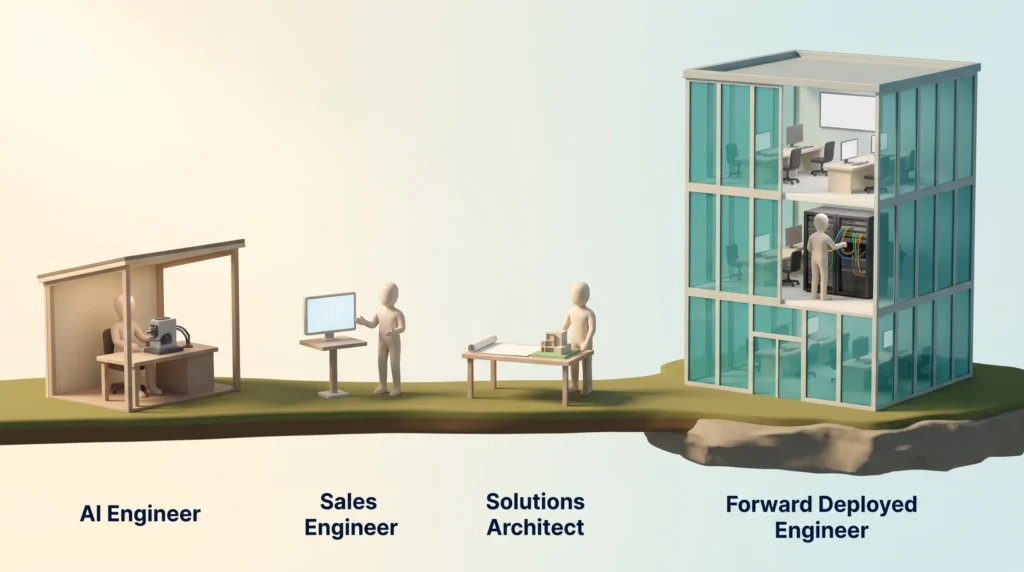
- Solutions architect: advises on system design and builds prototypes, often with sample data. Rarely writes production code inside customer systems.
- Sales engineer: supports the sales process with demos and technical answers before a deal closes. The FDE usually takes over after the contract is signed.
- AI engineer: builds and integrates machine learning systems, typically for the employer’s own product, without being embedded at one customer.
Palantir’s commercial leadership has warned that many companies simply relabel customer-facing staff as FDEs. When you read a job ad, check how much production coding and customer time it really involves. For context on how AI is reshaping roles like these, see hybrid jobs where humans and AI share the work.
How to Prepare for a Forward Deployed Engineer Role
There is no single degree for this job. Most FDEs start as software engineers, data engineers or technical consultants and add the missing half of the skill set.
- Build the technical base. Computer science, data science or software development is the usual starting point. Cloud platforms and security knowledge add a lot of value.
- Ship real projects. Build something that real users rely on, including deployment, monitoring, tests and documentation. A working system with measurable impact beats a polished demo, especially at employers that use skills-based hiring.
- Get close to customers. Volunteer for customer calls, support rotations or internal tool projects where you work directly with the people who use your code.
- Learn a domain. FDEs who understand healthcare billing, logistics or financial compliance are especially valuable, because they spot problems faster.
If you are planning a career move, our guides to future job skills, lateral career moves and mid-career retraining can help you map the path. Employers building these teams may find our digital skills gap analysis guide useful as well.
Conclusion
The forward deployed engineer is the answer to a simple problem: AI that looks great in a demo often fails in the messy reality of a real company. By placing engineers inside customer organizations, Palantir, AWS, Microsoft, OpenAI and Anthropic are trying to turn pilots into systems people actually use.
For professionals, the role rewards a rare combination of hands-on engineering, business understanding and good communication. The title may evolve as tools improve. The ability to connect technology with measurable results will stay valuable.
Found this useful?
Make SmartKeys a preferred source on Google, and our articles will surface more often in your Top Stories, AI Overviews, and AI Mode.
Add as Preferred SourceFAQ
What does a forward deployed engineer do?
A forward deployed engineer works inside a specific customer’s organization to make a product, usually an AI system, work in that customer’s real environment. That means interviewing staff to understand how work really happens, writing production code in the customer’s systems, connecting data sources and building tests that check the AI’s answers. The goal is to move a project from a promising pilot to a tool people use every day, and then hand it over so the customer’s own team can run it.
What skills are essential for this role?
You need strong software engineering skills and strong people skills at the same time. On the technical side, employers look for full-stack development, data engineering, cloud deployment and hands-on experience with AI methods such as retrieval-augmented generation and model evaluation. On the human side, you must turn vague business goals into clear technical plans, explain trade-offs to executives and build trust with skeptical users. Domain knowledge in a field like finance or healthcare is a major plus.
How does this role differ from traditional engineering positions?
A traditional product engineer builds one feature that many customers use. A forward deployed engineer combines many features and integrations for one customer. FDEs spend a large share of their time with that customer, sometimes on site, and write code directly in the customer’s infrastructure. They are also judged more on business results, such as time saved or errors avoided, than on shipping features for a general product roadmap.
How much do forward deployed engineers earn?
Forward deployed engineers usually earn more than standard software developers, though pay varies widely by company, level and location. Indeed data cited by LeadDev puts the average FDE base salary at about $171,911 a year in the US. Reported Google Cloud ranges run from $127,000 to $265,000 in base pay depending on seniority, plus bonus and equity. For comparison, the Bureau of Labor Statistics lists a median of $135,980 for software developers in May 2025.
What are the career prospects for forward deployed engineers?
Demand is strong in 2026. AWS, Microsoft, OpenAI, Anthropic and Google Cloud all expanded FDE teams this year, and Indeed data showed FDE postings up 729% year over year in April 2026. The skills also transfer well into product management, solutions architecture, engineering leadership or founding a company. The main caveat is that better tooling may reduce some demand over time, so the exact title could change even if the underlying skills stay valuable.
Do I need a computer science degree to become a forward deployed engineer?
A degree in computer science, engineering or a related field is common but not always required. Employers care most about proof that you can build and run real software and work well with customers. A portfolio of deployed projects, experience in customer-facing technical work and knowledge of a specific industry can carry as much weight as formal education.
How much travel does a forward deployed engineer job involve?
Travel is a core part of most FDE jobs, but the amount depends on the employer. Palantir FDEs reportedly spend about 25% of their time at customer sites, while Commure expects up to 50%, and some OpenAI listings mention up to 50% travel. Heavy travel helps engineers understand the customer, but it is also a common cause of burnout. Ask about the expected on-site share, typical project length and remote options before accepting an offer.