A works council is a group of elected employees that represents the staff inside a company. In Germany, the Netherlands and much of the European Union, it holds real legal rights: management must inform it, ask its advice, or in some cases get its formal consent before changing how people work. Artificial intelligence is now one of those changes.
That makes the works council a practical partner in automation decisions rather than a rubber stamp at the end of a rollout. When it is involved early, questions that later become disputes get settled first: what data the system reads, who checks its output, and what happens to the people whose tasks it takes over.
This guide covers what the law actually grants employee representatives in Germany and the Netherlands, which duties the EU AI Act adds and which were postponed in 2026, how unions in the United States handle the same problem through bargaining, and how to turn all of it into one framework agreement your company can live with.
Key Takeaways
- AI decisions belong in front of employee representatives before purchase, not after go-live.
- German and Dutch law give councils information, advice and consent rights that already cover AI.
- The EU AI Act obliges employers to inform staff and their representatives about high-risk AI at work.
- One framework agreement beats renegotiating every tool separately.
- Transparency and hands-on testing turn employee concerns into better systems.
Why AI Is Now a Works Council Issue
AI is no longer a future topic. It already runs in customer service, logistics, finance and human resources. A chatbot answers first-line questions, a robotics and automation stack moves goods through a warehouse, a routing system decides which driver gets which stop, a screening tool ranks job applicants, and a forecasting model sets next week’s staffing level.
Generative tools such as ChatGPT and Microsoft Copilot sit on top of that, drafting emails, summaries and reports. They still need someone to check the result, because a confident wrong answer looks exactly like a correct one.
Employees notice the effect long before anyone calls it a project. Their tasks change, their output is measured differently, and decisions that used to come from a person now arrive from a system nobody in the room can explain. Those are exactly the subjects a works council exists to handle, which is why giving employees a voice in decisions pays off faster with AI than with almost any other workplace change.
Handled well, automation raises quality and takes tedious work off people’s desks. Handled badly, it creates a monitoring system nobody agreed to and a workforce that quietly works around the tool.
What AI at Work Actually Looks Like
Strip away the marketing and AI is software that finds patterns in past data and turns them into predictions, recommendations or decisions. That definition is enough to have a useful conversation about any tool a vendor puts in front of you.
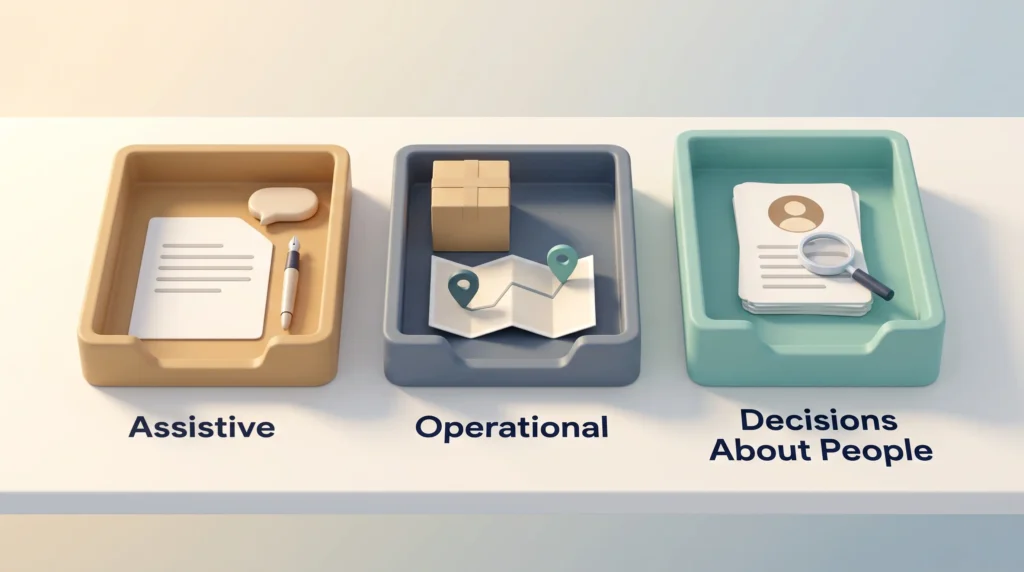
For negotiation purposes, workplace systems fall into three groups, and they do not deserve the same amount of attention:
- Assistive tools: drafting, translation, transcription, search. Low risk, as long as confidential material stays out of them.
- Operational tools: demand forecasting, route planning, stock management, quality inspection, and increasingly AI agent workflows that chain several steps together. These change how work is organised and how fast it has to happen.
- Decision tools about people: applicant screening, performance scoring, shift allocation, absence prediction. This is where employee rights bite hardest.
A shift-scheduling tool shows the difference in one example. As a planning aid it saves a manager two hours a week. Once it also records who accepts extra shifts and who declines them, it has quietly become a performance record, and a different set of rules applies. Systems that score people deserve the same scrutiny you would give any other form of predictive analytics in employee management. The same logic applies to any device that collects data about staff, which is why a wearable tech policy and an AI agreement tend to end up covering similar ground.
What a Works Council Does When AI Arrives
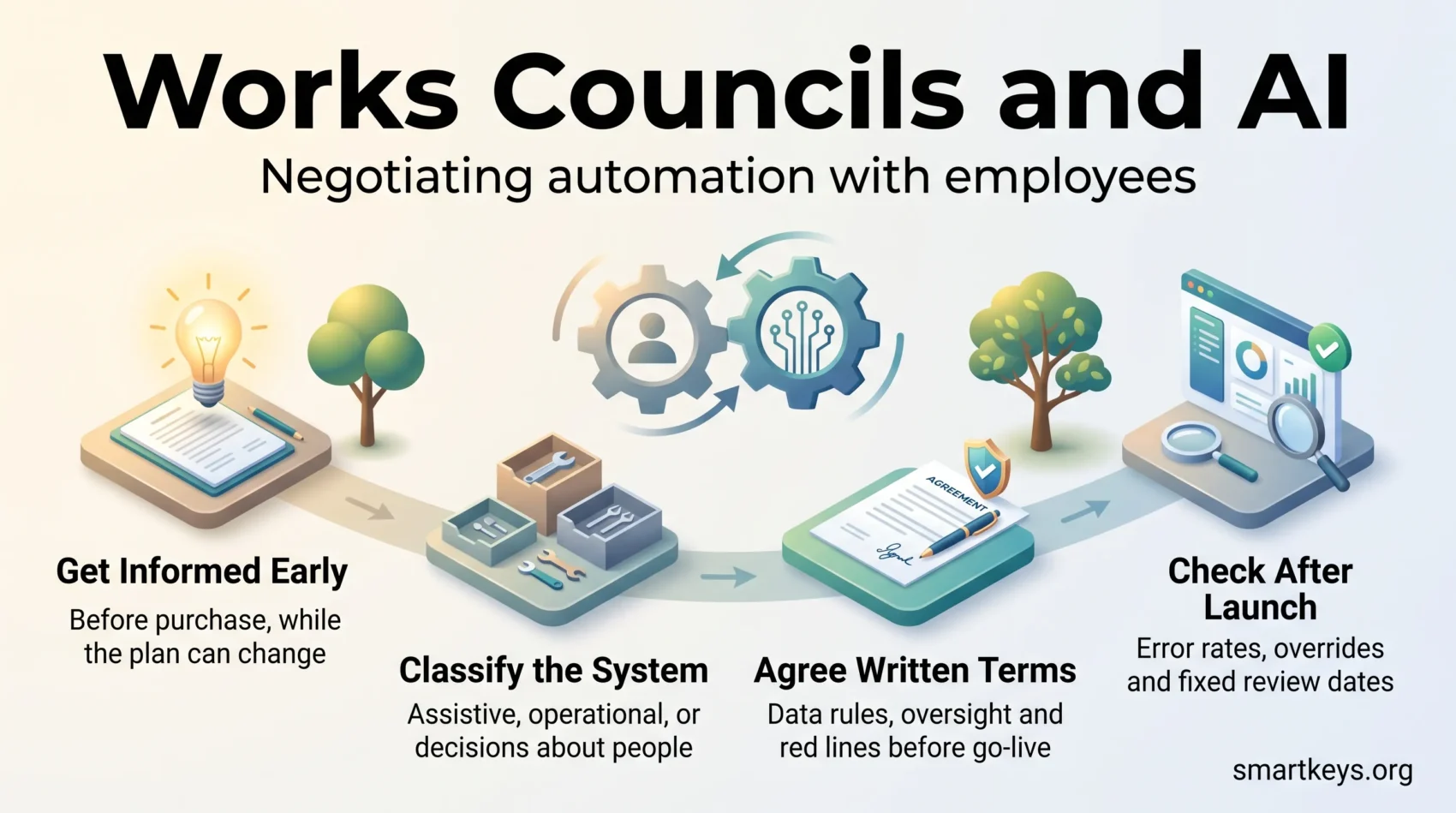
The council has four jobs, and they run in order. First, get informed early enough that the answer can still change. Second, classify the system, because a translation plugin and an applicant ranker are not the same negotiation. Third, agree written terms before go-live. Fourth, check after launch whether the system behaves the way the vendor promised.
Confidentiality runs alongside all four. Under Article 20 of the Dutch Works Councils Act, council members are bound to keep business secrets and personal data confidential, and equivalent duties apply in Germany. That obligation now has a practical edge: council members should not paste personnel files, complaint records or draft agreements into a public AI tool while preparing their own position.
Settle the internal rules before the first negotiation, not during it. Agree which tools council members may use for drafting and analysis, which material never goes into them, and who is allowed to bring in an external expert. Treating that as part of your wider privacy compliance framework keeps the council credible when it asks management for the same discipline.
Works Councils and AI: Best Practices for Negotiating Automation
These practices keep a negotiation short and useful. They assume the council wants the tool to work, not to stop it.
- Ask for the system’s purpose, data sources and output in writing before any contract is signed. A vendor who cannot describe those in one page has not thought them through.
- Separate advisory topics from consent topics early. Anything that can measure behaviour or performance sits in the consent category, whatever the vendor calls it.
- Insist on a named human owner for every automated decision that affects a person, so employees know who to challenge.
- Agree the evidence you will get after launch: error rates, override rates, complaints, and who reviews them.
- Write a review date into the agreement. Models get retrained, and a tool approved last year may behave differently now.
- Push for training as part of the rollout budget rather than a later nice-to-have, since an untrained user is the fastest route to a bad outcome.
An automation ethics board or a joint review group can carry this work between formal meetings, especially in companies deploying several tools at once.
Legal Frameworks and Worker Rights in AI Adoption
The rules differ by country, but the pattern is consistent: the more a system judges people, the stronger the employee voice.
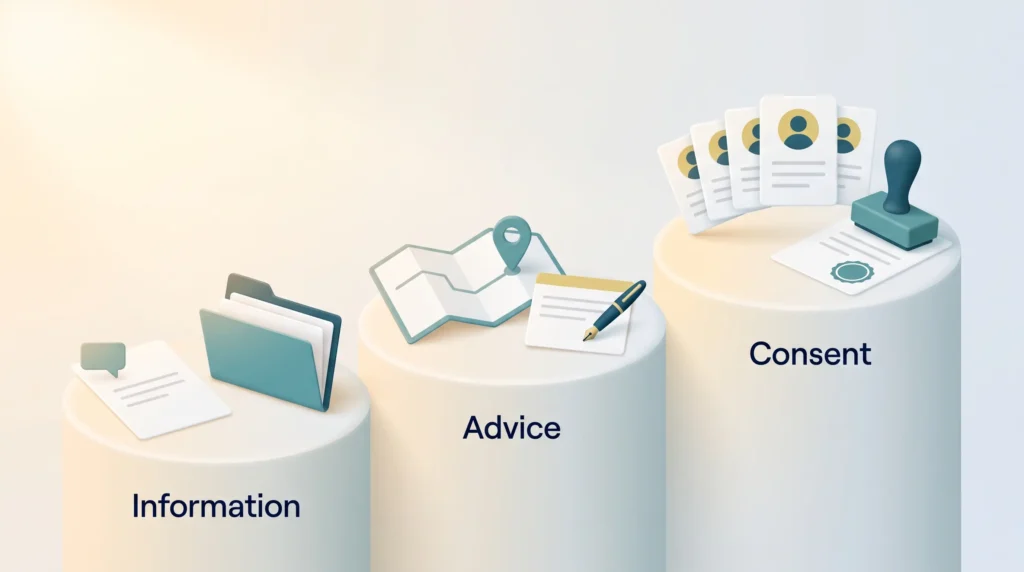
Germany: information, co-determination and a paid expert
Under the Works Constitution Act, employers must inform and consult the works council about planned changes to workplaces, processes and technology. Where a technical system is suited to monitoring behaviour or performance, section 87(1) no. 6 gives the council genuine co-determination, which means the employer needs its agreement rather than its opinion. Courts read “suited to monitoring” broadly, so many tools qualify even when surveillance was never the intent.
The 2021 Works Council Modernisation Act added a point that matters in practice. Under section 80(3), when a council has to assess the introduction or use of artificial intelligence, bringing in an expert counts as necessary, and the employer carries the cost once the person and the fee are agreed. Councils no longer have to argue about whether outside expertise is justified.
Netherlands: advice before, consent for monitoring
Dutch law splits the same problem in two. Article 25 of the Works Councils Act gives an advisory right over major decisions, including significant technological investments, and the employer has to seek that advice while it can still change the plan.
Article 27 goes further and requires consent. Paragraph 1(k) covers rules on the use of personnel data, and paragraph 1(l) covers rules for staff tracking systems, meaning any system able to monitor attendance, access or how work is handled. Without consent, the rule is not validly introduced.
The EU AI Act: what applies now and what was postponed
Article 26(7) is the provision every employee representative should know by heart. Before putting a high-risk AI system into service at the workplace, deployers who are employers must inform workers’ representatives and the affected workers that they will be subject to it. Notification is a duty, not a courtesy.
Two other duties already apply and have done since 2 February 2025. Article 4 requires employers to ensure a sufficient level of AI literacy among staff who use these systems. Article 5(1)(f) prohibits AI that infers emotions of employees in the workplace, apart from narrow medical and safety uses, which rules out sentiment scoring of support calls or video interviews in the EU.
The timetable for high-risk systems did move. The Digital Omnibus on AI was published in the Official Journal on 24 July 2026 and entered into force on 27 July 2026. It defers the obligations for stand-alone high-risk systems listed in Annex III to 2 December 2027, and for AI embedded in regulated products under Annex I to 2 August 2028. The transparency duties in Article 50, such as telling people they are interacting with an AI system, still apply from 2 August 2026. A delay is not a cancellation, and it is a poor argument for postponing an internal agreement. For the wider compliance picture, see our guide to AI regulation in 2026.
The United States: bargaining instead of statute
There is no US equivalent of a statutory works council, and the legislative attempts have not landed. California’s Workplace Technology Accountability Act (AB 1651) was introduced in 2022 and never enacted. New York’s Bossware and Oppressive Technologies Act was introduced in 2024 and has not become law either. Employee protection therefore comes from collective bargaining, from state privacy statutes, and from the patchwork tracked in our overview of future of work legislation. Platform work is the exception that proves the rule, since gig economy regulation has moved faster on automated decisions than employment law generally has.
Implementing a Framework Agreement for AI Integration
Negotiating every tool from scratch does not scale. One framework agreement sets the ground rules, and each new system is then slotted into a category rather than argued over from the beginning.
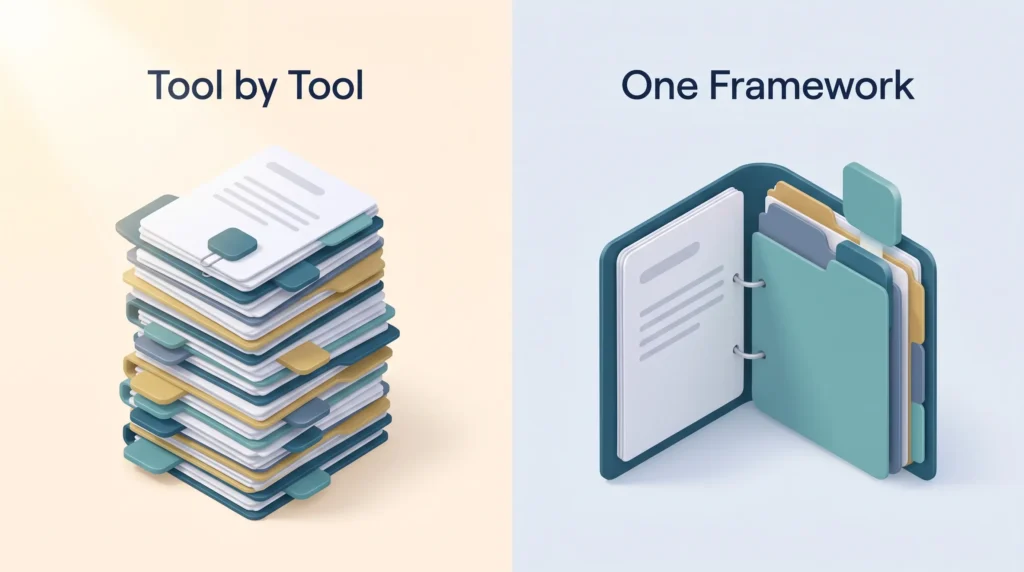
A workable agreement covers these points:
- Scope and definitions: what counts as an AI system for this agreement, written plainly enough that both sides read it the same way.
- Risk tiers: a light path for assistive tools, a full review for anything that measures or ranks people.
- Data rules: which data sources feed the system, how long records are kept, and what is never used for training.
- Human oversight: a named role that can override an output, plus the time and authority to actually do it. In larger companies this often sits with an AI ethics officer.
- Vendor disclosure: purpose, training data at a general level, known limitations, error rates and audit support, written into the purchase contract.
- Evidence and review: access to audit logs and role-based access controls, a fixed review cycle, and a defined route to pause a system.
- Red lines: the uses the company will not pursue, such as emotion inference or secret productivity scoring.
Borrow the structure from your existing risk management framework instead of inventing a parallel process. The same escalation paths, owners and review rhythms work here, and reusing them makes adoption far easier for management.
Building Trust Through Transparency and Employee Training
Trust is built with specifics. A plain-language notice should tell employees which system is in use, what data it processes, what its output means, and who is accountable for decisions based on it. Two paragraphs on the intranet beat a policy nobody opens.
Let people touch the tool. When council members and a few affected employees test a system on real cases, they find problems that no vendor demonstration reveals: the categories that do not fit the local process, the field that is always blank, the recommendation that is wrong every Friday.
Training should cover limits as well as features. What the system cannot do, where it is known to be weak, what confidential material must stay out of it, and how to escalate a wrong result. That is the substance behind the EU AI Act’s AI literacy duty, and it doubles as the practical work of AI augmentation: people work with the tool instead of around it.
Build a correction loop as well. When an employee flags a wrong output and someone acts on it, the system improves and the workforce sees that human judgement still counts. Companies that treat those corrections as free quality data get better results than those that treat them as complaints, which is the core idea behind collaborative intelligence.
Case Studies: What Companies and Unions Have Actually Agreed
Three concrete examples show what negotiated AI looks like in practice.
Deutsche Telekom published nine self-binding AI guidelines on 11 May 2018, among the first such commitments from a large European employer. One principle states plainly that the company maintains control, with continuous readiness to intervene in AI systems to prevent or reduce harm. Published principles are not the same as a works agreement, but they give employee representatives a documented standard to hold management to.
In the United States, the Writers Guild of America’s 2023 contract settled the question of status rather than usage. AI cannot be a writer, and material generated by AI does not count as literary material, so it cannot be used to reduce a writer’s credit or compensation. Companies must disclose when material handed to a writer was AI-generated, and no writer can be forced to use AI tools.
SAG-AFTRA’s 2023 television and theatrical agreement took the same approach to likeness, requiring informed consent and compensation before a performer’s digital replica is created or used. The lesson for a works council is transferable: the durable clauses are about consent, disclosure and status, not about which tool is currently popular. That pattern also shapes the debate around augmentation versus replacement in ordinary workplaces.
Strategies for Collaboration Between Management and Works Councils
Early involvement costs management a few meetings and saves months. Bring the council into the room before a system is selected, when requirements are still open, rather than after a contract makes every objection expensive.
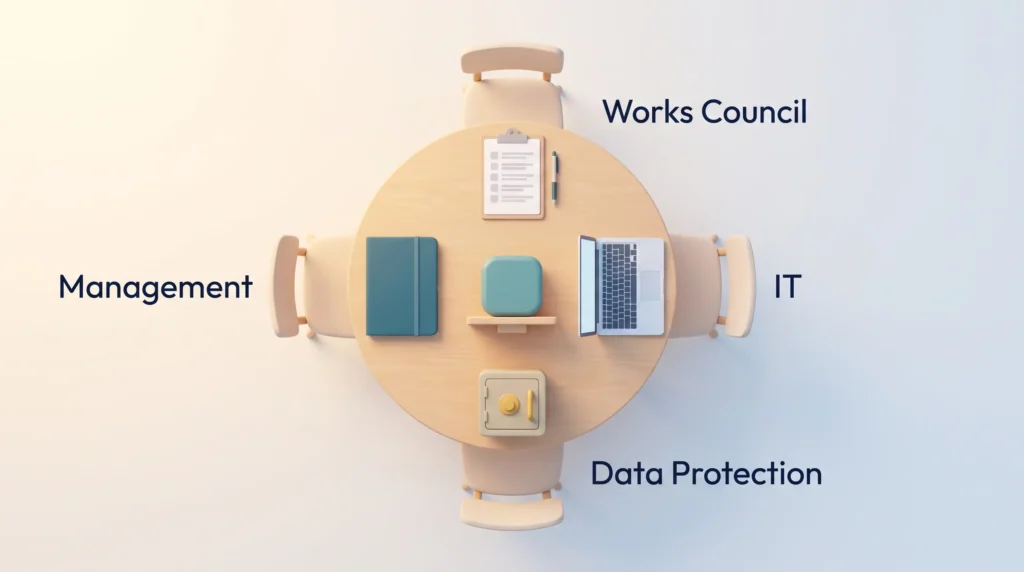
A joint AI group works well: a small standing team with people from management, the works council, IT and data protection that reviews proposed tools, sorts them into risk tiers and flags training needs. It keeps decisions moving between formal consultation rounds and prevents the council from seeing a tool for the first time a week before launch.
Agree shared principles and red lines once, in writing. Job security commitments, limits on monitoring, and rules on how automated savings are handled are far easier to settle in the abstract than in the middle of a specific rollout. Companies rethinking reporting lines at the same time will find the same discussion running through AI-driven organisational design.
Finally, treat employee objections as information. The people doing the work know where a model will fail, and a council that channels that knowledge into the project improves the outcome for both sides. Where several tools run at once, the same joint group can keep an eye on the wider effects, from workload shifts to the questions raised in the debate on automation and inequality.
Conclusion
A works council turns automation from something that happens to employees into something that is agreed with them. The legal tools already exist: information and co-determination rights in Germany, advice and consent rights in the Netherlands, and an explicit duty under the EU AI Act to tell workers and their representatives about high-risk systems at work.
Start with early information and clear data rules. Add risk tiers, named human oversight and real training, then write it once into a framework agreement so each new tool is a short conversation instead of a fresh dispute.
The companies that do this are not slower. They spend their time on the systems that actually carry risk, and they get honest feedback from the people using the tools every day. That is how automation improves productivity and quality without costing the workforce its rights.
Found this useful?
Make SmartKeys a preferred source on Google, and our articles will surface more often in your Top Stories, AI Overviews, and AI Mode.
Add as Preferred Source