You breathe roughly 20,000 times a day without thinking about it. That makes your breath the one part of your stress response you can take manual control of in seconds, at your desk, without anyone noticing.
This guide covers six patterns you can use during a workday, what the research does and does not support, and how to turn a few slow breaths into a habit that survives a busy week.
Key Takeaways
- Slow breathing with a long exhale is the fastest way to bring your heart rate down.
- The effect is real but modest. A randomised trial found five minutes a day was enough to shift mood over four weeks.
- Six patterns cover most work situations: box breathing, 4-7-8, cyclic sighing, coherent breathing, alternate nostril and pursed lips.
- Forceful holds and rapid patterns are not for everyone. Check with a clinician if you have heart, lung or blood pressure conditions, or if you are pregnant.
- Two minutes a day, anchored to a habit you already have, beats a long session you skip.
Why slow breathing calms you down
Your nervous system has two settings, and your breath is one of the few switches you can reach.
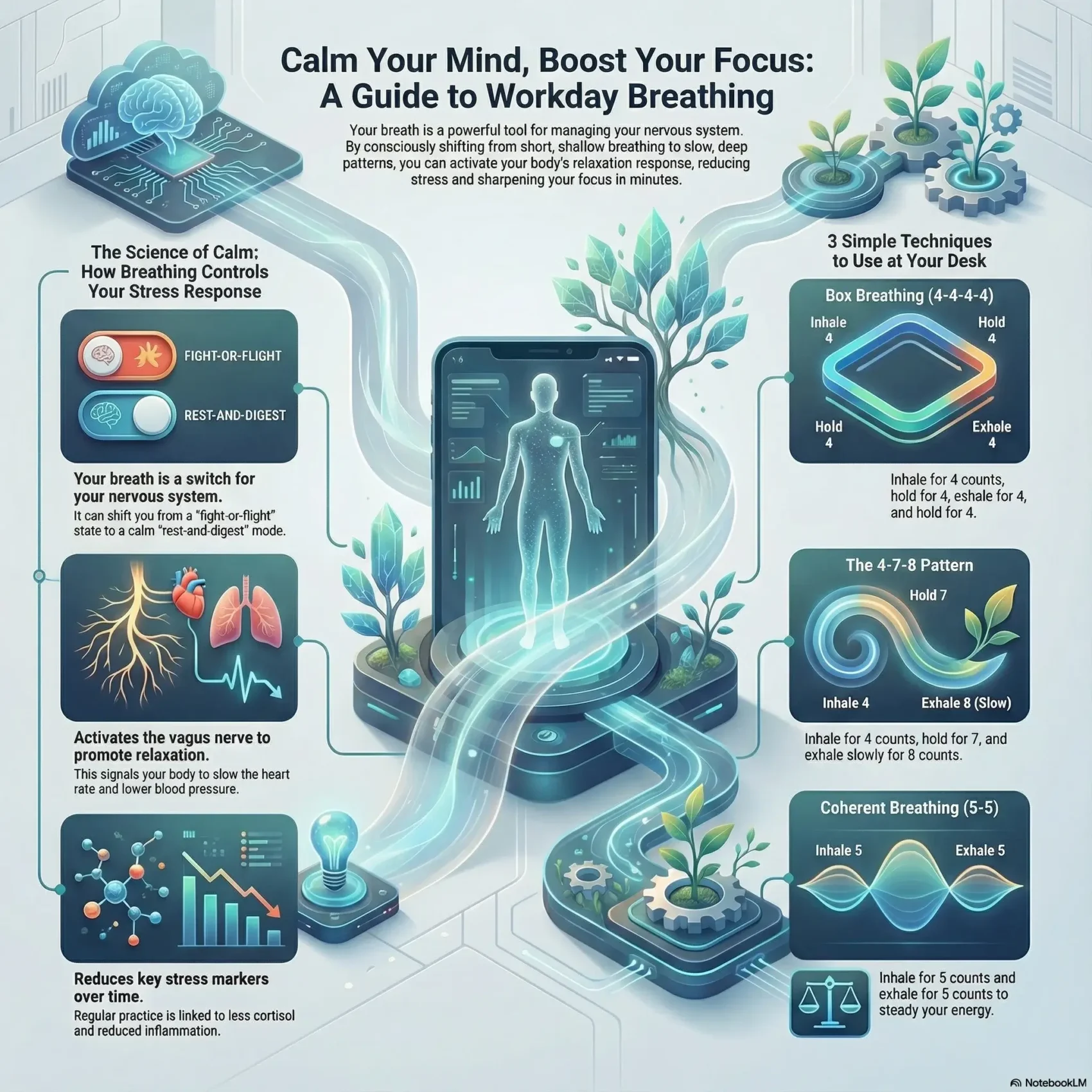
When a deadline lands or a meeting turns tense, your sympathetic nervous system takes over. That is the branch responsible for the fight-or-flight response: your heart rate climbs, your breathing gets fast and shallow, and your attention narrows. Useful if you need to run. Unhelpful if you need to write a careful email.
The opposing branch is the parasympathetic nervous system, sometimes called rest-and-digest. It slows the heart, relaxes muscles and lets attention widen again. You cannot switch it on by deciding to feel calm. You can switch it on by changing how you breathe.
The vagus nerve, in plain terms
The link between the two runs largely through the vagus nerve, the long nerve connecting your brain to your heart, lungs and gut. Slow, deep breaths stimulate it, and it responds by signalling the heart to slow down.
Mary Ella Blair Wood, DO, a physician at Northwestern Medicine, describes it directly: many breathwork techniques activate the vagus nerve, which sends signals to slow the heart rate and lower blood pressure.
Why the exhale matters more than the inhale
Here is the detail most guides skip. Your heart speeds up slightly when you inhale and slows when you exhale. A long exhale is therefore not just relaxing in a vague sense: it is the part of the cycle that actively brings your pulse down.
That one fact explains most of what follows. Every pattern below either lengthens the exhale or slows the whole cycle. If you remember nothing else, breathe out for longer than you breathe in.
What the evidence actually shows
Breathing exercises are often sold as a cure for everything. The research supports something narrower and more useful.
A 2023 meta-analysis in Scientific Reports by Fincham and colleagues pooled randomised controlled trials on breathwork. Across 12 trials with 785 adults, breathing practice produced a small to medium reduction in self-reported stress compared with control conditions (Hedges’ g = 0.35). Anxiety and depressive symptoms moved by similar amounts. The authors were careful about their own result: most of the included studies carried a moderate risk of bias, and they explicitly warned against overselling the findings.
How much practice is enough
A 2023 randomised trial published in Cell Reports Medicine gives a concrete answer. Balban and colleagues at Stanford asked 108 participants to do a five minute daily exercise for 28 days, comparing three breathing patterns against mindfulness meditation.
All groups improved. The largest gain in positive mood came from cyclic sighing, a pattern built around a double inhale and a long, slow exhale. It also produced the biggest drop in resting breathing rate, and the two changes tracked each other: the more someone’s breathing slowed, the better their mood tended to get.
The takeaway is modest and worth having. Five minutes a day, done consistently, is a reasonable dose. This is a support for handling ordinary work pressure, not a treatment for a mental health condition. If stress at work has tipped into something heavier, the habits that protect against burnout and a conversation with a professional matter far more than a breathing pattern.
Safety first: when to check with your doctor
Most of these patterns are gentle. A few are not.
Rapid or forceful methods, including Kapalabhati, Bhastrika and long breath retentions (Kumbhaka), are generally not recommended if you have cardiovascular disease, uncontrolled high blood pressure or a respiratory condition. If you are pregnant, avoid breath holds and patterns that raise pressure in the abdomen.
- Ask your clinician first if you have heart disease, lung disease, uncontrolled blood pressure, or a recent stroke.
- Start with short sessions and see how your body responds before extending them.
- Stop and seek help for chest pain, unusual shortness of breath, dizziness, or a pounding heart that feels out of the ordinary for you.
- When in doubt, pick the conservative option: calm nasal breathing with a slightly longer exhale. It carries very little risk and still helps.
If your heart is pounding and you feel dizzy or short of breath, stop the exercise and contact your physician.
Six breathing techniques you can use today
Each of these takes under five minutes. Try one for a week before adding another, so you learn what each one actually does for you.
1. Box breathing (4-4-4-4)
How: Sit tall. Inhale through your nose for 4 seconds, hold 4, exhale 4, hold 4. Repeat four rounds.
Best for: the two minutes before a presentation or a difficult call. The even rhythm gives your attention something simple to hold on to.
If the holds feel long, shorten every count evenly to 2 or 3 seconds. The ratio matters more than the length.
2. Cyclic sighing
How: Inhale through your nose, then take a second short sip of air on top of it to fully inflate your lungs. Let it out through your mouth in one long, slow, unforced exhale. Repeat for five minutes.
Best for: a daily five minute reset. This is the pattern that performed best in the Stanford trial described above.
3. The 4-7-8 pattern
How: Inhale quietly through your nose for 4, hold for 7, exhale through your mouth for 8 with a soft whoosh. Up to four rounds.
Best for: winding down at the end of the day, or before sleep. The long exhale makes it strongly calming, which is exactly why it is a poor choice right before you need to be sharp.
Beginners sometimes feel lightheaded. If that happens, stop and breathe normally. Pair it with a proper wind-down routine rather than treating it as a sleep fix on its own.
4. Coherent breathing (5-5)
How: Inhale for a count of 5, exhale for 5. That works out to about six breaths a minute, far slower than a typical resting rate.
Best for: a steady background pace during focused work. It is quiet, requires no holds, and you can keep it going while you read.
5. Alternate nostril breathing
How: With your right hand, close your right nostril with the thumb and inhale through the left. Then close the left with your ring finger and exhale through the right. Continue for a few minutes, keeping your hand light on your face.
Best for: a transition between very different kinds of work, when you need a clear break rather than just a pause. It is conspicuous, so save it for a private room.
6. Pursed-lips breathing
How: Inhale through your nose for 2, purse your lips as if cooling a spoonful of soup, and exhale for 4.
Best for: movement. Use it walking to a meeting or climbing stairs. It is best known as a technique for lung conditions, but the longer exhale eases tightness for anyone.
One note on mechanics: prefer nasal inhales, which warm and filter the air, and keep mouth exhales soft so your throat does not tighten. These patterns also slot neatly into the breaks in the Pomodoro technique.
Belly breathing, step by step
Diaphragmatic breathing, or belly breathing, is the foundation the other patterns are built on. The diaphragm is the dome-shaped muscle under your lungs. When it does the work, air reaches the lower part of the lungs where blood flow is greatest, so each breath moves more oxygen for less effort. When your chest and shoulders do the work instead, you breathe more often and more shallowly for the same result.
Set-up and posture
Lie on your back with your knees bent, or sit tall with your back supported. Put one hand on your chest and one on your belly.
Inhale slowly through your nose so the belly hand rises and the chest hand stays still. Exhale through pursed lips while gently drawing the abdominal muscles in. One inhale plus one exhale is one round.
Common mistakes and easy fixes
- Chest lifts first. Slow down and picture the diaphragm moving downward as you inhale. Speed is usually the cause.
- Shoulders creep up. Drop them deliberately, unclench your jaw, and keep your lower back in a neutral position.
- You cannot feel the movement. Move your hand lower on the abdomen, or lie down, where the cue is much clearer.
- Your mind wanders. Count the inhale and the exhale. Counting gives attention a job.
How long to practise
Start with 3 to 5 minutes, then build toward 5 to 10 minutes. One to three sessions a day is plenty. Use it before a meeting, or after a tense exchange, as a deliberate reset.
Posture makes a noticeable difference here. A seat that lets your ribcage open is easier to breathe into than a slumped one, which is one of the quieter arguments for getting your workstation ergonomics right and for setting up a home office properly.
Making it a workday habit
The gap between knowing these patterns and using them is where most people lose the benefit. Five minutes a day only works if the five minutes happen.
Anchor it to something you already do
Pick one fixed moment: after your first coffee, before your first meeting, or immediately after lunch. Attaching a new habit to an existing routine removes the decision, and the decision is what you skip when busy. The same principle underpins most durable morning routines.
Use micro-practices during the day
- Three rounds of box breathing before you unmute yourself.
- One minute of coherent breathing after an email that annoyed you.
- A few 4-7-8 rounds during the mid-afternoon energy dip, when reaching for more caffeine tends to backfire.
- Two slow cycles while a video call connects. Nobody can tell.
These pair well with other short recovery habits. Short breaks, movement breaks and structured downtime all work on the same principle: brief, deliberate recovery beats pushing through until you crash.
Combine breath with posture and release
Plant your feet, lengthen your spine, and let your shoulders drop so each inhale can reach the belly. On the exhale, let your jaw loosen and open your hands. You are teaching your body that the out-breath is where tension goes.
If your environment is working against you, fix that too. Noise in an open plan office and poor workspace lighting both keep low-level stress simmering, and no breathing pattern fully compensates for either.
Tracking whether it works
Keep the measurement lighter than the practice itself. A rating and a note are enough.
Score your stress and your focus from 1 to 10 before and after a session. Over a few weeks you will see whether the numbers move, and which pattern moves them most. If you wear a fitness tracker, compare heart rate variability on practice days against other days, but treat it as a hint rather than proof. Consumer devices are noisy.
- Log the technique, the length, and how you felt afterwards.
- Note how quickly you fall asleep and whether you wake rested.
- Watch for indirect signs: reacting less sharply to interruptions, settling into work faster.
- Pause and speak to your clinician if you notice palpitations, dizziness, or anything unusual.
Treat the log as motivation, not another obligation. If it starts to feel like a chore, drop it and keep the practice.
Conclusion
A few slow breaths will not fix an unmanageable workload, but they will change how your body responds to it, in about a minute.
The evidence points to something modest and dependable: regular short practice lowers self-reported stress, and roughly five minutes a day is enough to see it. Pick one pattern. Attach it to a moment that already exists in your day. Extend the exhale.
To build on it, meditation and mindfulness techniques for focus use the same mechanism over longer sessions, and regular exercise does more for baseline stress than any breathing pattern. See also our guides to managing stress for better productivity, building a digital detox routine, protecting time for deep work and using mindfulness at work.
Found this useful?
Make SmartKeys a preferred source on Google, and our articles will surface more often in your Top Stories, AI Overviews, and AI Mode.
Add as Preferred Source