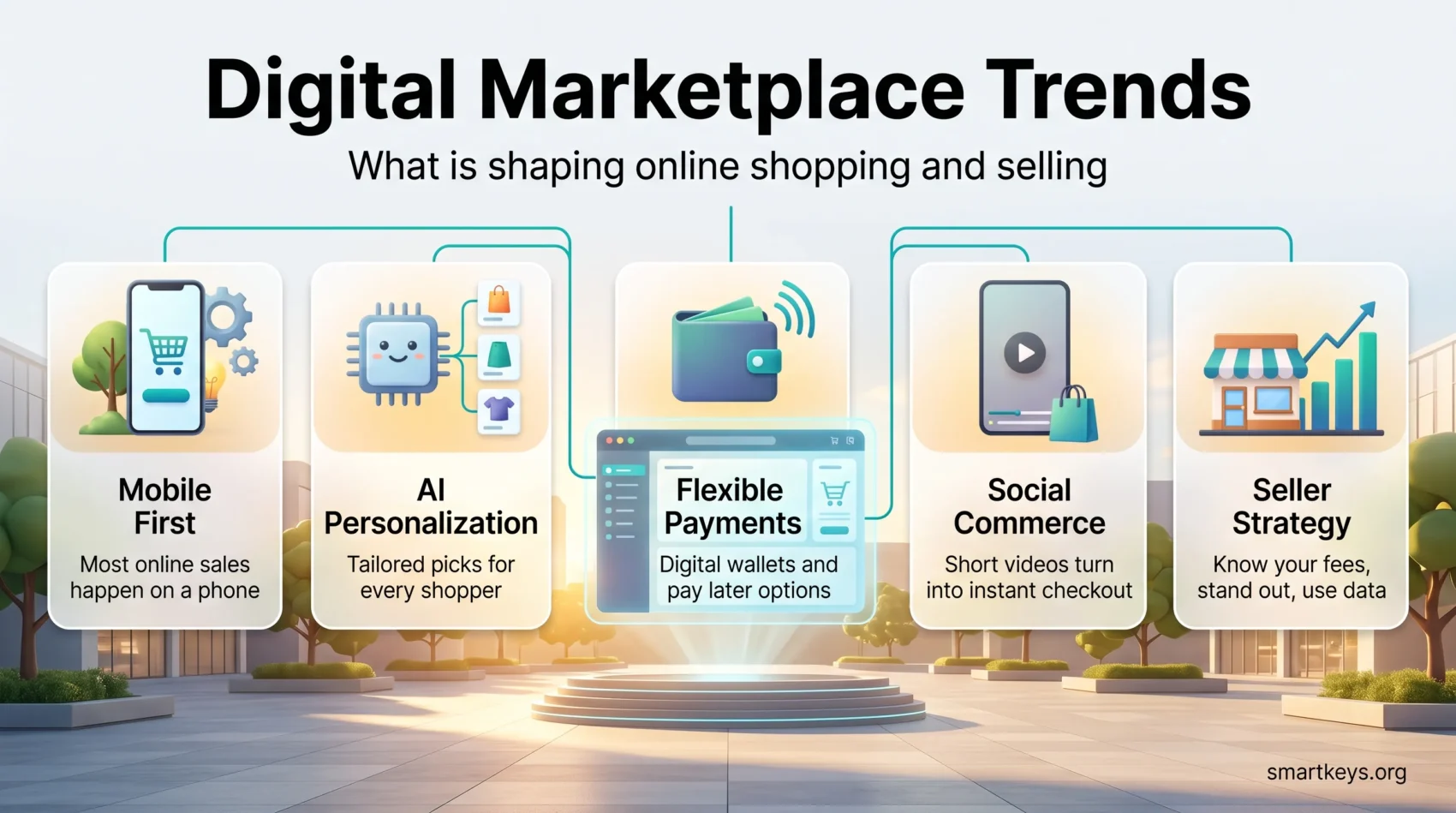
The rise of digital marketplaces continues to reshape online shopping. Platforms like Amazon, eBay, Alibaba and Shopify-powered storefronts connect millions of buyers and sellers every day. This guide explains the digital marketplace trends that matter in 2026, how technology and consumer habits are driving them, and what sellers can do to stay competitive.
Key Takeaways
- Digital marketplaces give small businesses global reach without the cost of building an audience from scratch.
- AI, mobile-first design and richer product experiences now shape how people discover and buy.
- Trust still depends on secure payments, clear policies and buyer protection.
- Flexible payment options, from digital wallets to buy-now-pay-later, widen access.
- Marketplaces command the majority of global online sales, so a marketplace strategy is no longer optional.
Introduction to Digital Marketplaces
Digital marketplaces have changed how business gets done online. They connect buyers and sellers inside a single ecosystem, handling discovery, payment and often fulfilment. Global e-commerce is expected to reach roughly $6.9 trillion in 2026, according to aggregated industry data, and marketplaces account for the largest share of that spending. For many shoppers, a marketplace is now the default starting point for a purchase.
The move from traditional retail to digital platforms means people can buy from almost anywhere, at any time. Newer experiences make this smoother: augmented reality lets shoppers preview products before buying, and AR shopping tools help reduce returns by setting clearer expectations. Live shopping, already a major channel in Asia, is spreading to Western markets as brands blend entertainment with instant checkout.
Understanding the core mechanics of these platforms matters. Sellers increasingly use personalization to build stronger customer ties, while data protection and clear privacy practices keep trust intact. The result is a shopping experience that feels more tailored and easier to navigate.
Adapting to this landscape is vital for buyers and sellers alike. With the right technology and strategy, the room to grow is wide. As you explore these platforms, keep an eye on the trends and openings in digital commerce.
Understanding the Rise of Digital Marketplaces
The marketplace boom is driven by social shifts and changing tastes. Smartphones and cheaper, faster internet have pushed millions of people to shop online every day. Platforms like Amazon, eBay and Alibaba have made it crucial for businesses to sell across borders to keep growing.
Fee structures and platform policies can make or break a seller’s margins, so it pays to understand them before listing. By studying competitors, you can spot gaps and opportunities. Clear product descriptions and competitive prices, set with fees in mind, sway buying decisions.
Careful inventory management helps avoid overselling and disappointed customers. Sponsored placements can lift visibility in a crowded catalogue. Positive reviews and active community engagement build the trust and loyalty that keep buyers coming back.
Improvement comes from listening to customer feedback and acting on it. Automation and AI in business make day-to-day operations more efficient, from pricing to support. As online spending keeps climbing, staying adaptable is what separates sellers who grow from those who stall.
Digital Marketplace Trends
Shopping is evolving fast. As you look across digital marketplaces, watch the marketplace trends reshaping the industry. The most visible shift is away from traditional retail, which has struggled to keep pace with changing expectations. That shift is not only changing how consumers shop; it is rewriting sales strategy across every sector.
The Shift from Traditional Retail
Traditional retail has been reshaped by digital platforms. Many retailers are rethinking strategy as online behaviour dominates. Physical stores now treat their online presence as essential, and the smartest ones blend the two channels seamlessly. Buy Online, Pick Up In Store (BOPIS) is a good example, bridging in-person and digital shopping. This kind of phygital retail has become a baseline expectation rather than a novelty.
- Physical stores adding online options alongside in-store sales
- Greater focus on convenience, especially through BOPIS and curbside pickup
- Merchants adopting marketplace models to widen their reach
How the Pandemic Reset Online Shopping
The pandemic accelerated a shift that was already under way, forcing retailers to move online quickly and permanently changing habits. Shoppers who were once hesitant now transact online without a second thought, and that behaviour has stuck. The migration to digital platforms was never a temporary fix; it reflected a lasting change in how people buy.
Several downstream shifts followed from that reset:
- Heavier reliance on digital wallets, now on track to handle more than half of global e-commerce payments in 2026 according to industry forecasts
- Wider acceptance of subscription models as shoppers commit to recurring purchases
- Steady growth in voice and conversational commerce as smart speakers and chat assistants spread
Advancements in Online Marketplaces
The online marketplace landscape keeps evolving, driven by technology. Businesses adopt new tools to meet rising expectations and improve the buying experience. These technologies are shaping the future of eCommerce.
Emergence of Innovative Technologies
Recent eCommerce technology has introduced tools that make online shopping faster and more engaging. Mobile apps, augmented reality and richer search all respond to changing consumer expectations. As more of the buying journey happens on a phone, these experiences increasingly decide who wins the sale.
Integration of Artificial Intelligence and Big Data
AI and big data analytics are now core to eCommerce strategy. Most large retailers use them to sharpen marketing and streamline operations. The payoff is personalized shopping, smarter inventory management and better demand forecasting. AI that reads shopping behaviour helps sellers match products to what each customer actually wants, which lifts satisfaction and loyalty.
Challenges Facing Traditional E-commerce Platforms
The eCommerce landscape is full of hurdles for traditional platforms, especially with growing competition. Smaller businesses struggle to stand out against high fees and giants like Amazon. Understanding these issues is the first step to a smoother path.
Fee Structures Impacting Small Businesses
Small sellers feel the weight of platform fee structures. Transaction fees, listing fees, referral fees and subscription costs all chip away at margins. On some marketplaces, a meaningful slice of a small retailer’s revenue can disappear into combined selling and fulfilment fees, which limits the cash left to grow or reinvest. Modelling total fees before committing to a platform, and using dynamic pricing to protect margins, makes a real difference.
Competition from Major Players like Amazon
Amazon’s scale is a serious challenge for smaller businesses. Large platforms offer aggressive pricing and fast, often free shipping, which is hard to match. That pressure forces smaller sellers to keep innovating on product, service or niche focus. In a crowded market, differentiation is not just helpful; it is how independent sellers survive.
Opportunities in Emerging Digital Markets
Fast-growing emerging markets offer real room for expansion. Southeast Asia stands out, powered by young, tech-savvy consumers who are eager to shop online. Shifting market dynamics create fertile ground for new and established players alike.
Growth in Southeast Asia
Southeast Asia has become a magnet for global investors and brands, and it is one of the fastest-growing e-commerce regions in the world. Mobile commerce leads the way, so platforms that load fast and check out smoothly on a phone have the edge. Scalable cloud infrastructure helps sellers manage traffic spikes without runaway costs.
Expanding into Untapped Markets in Africa and South America
Africa and South America also hold significant promise. Both regions are seeing rapid growth in mobile device usage, with many shoppers reaching the internet through a phone first. AI and machine learning support the localized, personalized experiences that win trust in newer markets, from local languages to region-specific payment methods.
Top Marketplace Trends to Watch
The retail landscape keeps shifting, and a few trends stand out. Staying on top of them can sharpen both the shopping and the selling experience. Personalization and mobile shopping are central to how people interact with digital platforms.
Personalization and Customer Experience
Personalization has reshaped online shopping. Sellers use data to serve relevant recommendations, and AI analyzes past behaviour to tailor offers in real time. Done well, it makes a sprawling catalogue feel curated for one person. Short-form video has also become one of the most effective ways to build product recognition and lift conversion, especially on mobile feeds. Predictive tools that anticipate what a shopper wants next make the experience feel closer to a helpful in-store assistant.
Mobile Commerce and Accessibility
Mobile shopping has transformed eCommerce. Mobile is expected to account for the majority of global e-commerce sales in 2026, so a mobile-friendly experience is no longer optional. Consumers browse and buy whenever the mood strikes, from a commute to a sofa.
Social platforms shape this behaviour heavily. TikTok, with well over a billion monthly users, has turned discovery into instant buying through social commerce features, and short clips routinely drive purchases. Brands that treat these feeds as storefronts, not just ad space, tend to win.
In short, personalization and mobile-first design now define how people shop. Sellers who follow these trends will navigate the market far more effectively.
Digital Transformation in Marketplaces
Digital transformation is central to success in today’s market. Adopting new technology changes how you operate and how you connect with customers. Studying successful marketplaces reveals patterns worth copying. By innovating steadily, you can keep pace with changing demand.
Importance of Adapting to New Technologies
The marketplace moves quickly. Businesses that take an ecosystem approach, layering services around a core platform, tend to extract more value from each customer. Digital platforms let small businesses reach a global audience without a physical footprint, which keeps pulling more commerce online.
Case Studies of Successful Transformations
Plenty of companies show the impact of digital transformation. AB InBev’s B2B platform BEES, for example, operates across dozens of markets and serves millions of small retailers, proving how a well-built platform can digitize an entire distribution channel.
- Super-apps like Grab bundle payments, delivery and services into one platform used by a large share of consumers in their regions.
- Platforms like BEES use order data to personalize offers and boost customer satisfaction.
- Payment systems such as Brazil’s PIX show how simple, instant transfers can bring underserved groups into digital commerce.
Exploring Open Commerce Platforms
Open commerce platforms give small businesses a flexible way into the digital marketplace with fewer hurdles. The perks are real: lower transaction fees can lift margins, and the freedom to customize helps build a distinct brand and lasting loyalty.
Benefits of Open Commerce for Small Businesses
Open commerce amplifies small business advantages. It hands you more control over your online presence, so your brand reflects your vision rather than a template. You can shape a customer experience that resonates with your audience, and the right engagement tools help turn browsers into buyers. For many independent sellers, this is the foundation of a strong direct-to-consumer strategy.
How Open Commerce Can Enhance Market Competitiveness
Open commerce can sharpen your market competitiveness. The model supports scalability, letting you grow while keeping a personal touch. With advanced technology and analytics, you gain insight into consumer behaviour and trends, which supports smarter decisions and faster adaptation. As the eCommerce landscape evolves, platforms built on open commerce are becoming pivotal to redefining success. For a deeper look, explore this resource on business analytics trends.
Marketplace Industry Trends
Recent shifts in how marketplaces operate reveal important industry trends. Two stand out: the spread of subscription models and the rise of collaborative selling. Together they show how businesses can adapt and thrive.
The Role of Subscription Models
Subscription eCommerce keeps gaining ground, giving businesses a predictable revenue stream while offering shoppers convenience. Recurring plans help capture loyal customers who value ongoing service over one-off transactions. Retail media, the advertising that marketplaces sell around their own traffic, has also become one of the fastest-growing ad channels, giving sellers new ways to reach buyers at the point of purchase.
As more brands lean on customer relationship tools to manage these ongoing relationships, subscription models grow even more valuable. They build a base of customers who keep coming back.
Collaborative Selling Approaches
Collaborative selling has emerged as a way for businesses to partner rather than only compete. It widens the product range and can improve service and satisfaction, while opening the door to shared marketing.
Shopper expectations are shifting too. Many younger buyers now factor sustainability into their choices and favour brands whose values match their own. As sustainability becomes a purchase criterion, collaborative selling can help brands meet it and create more engaging experiences.
Strategies for Success in Digital Marketplaces
To thrive in this landscape, a few success strategies stand out. Managing customer relationships well and leaning on data lets businesses make informed, data-driven decisions that lift engagement and loyalty.
Managing Customer Relationships
Strong customer relationship management is vital in digital commerce. Engaging buyers across touchpoints builds trust, and tools like AI chatbots enable instant, around-the-clock support. A few approaches that work:
- Using email campaigns to stay in touch and share relevant promotions.
- Engaging customers on social media to gather feedback and build community.
- Tracking satisfaction through surveys and reviews to find what to improve.
Leveraging Data Analytics for Decision Making
Data-driven decisions can transform operations and lift conversion. Watching key indicators, such as traffic, cart abandonment and customer acquisition cost, reveals what is really happening. Business intelligence tools turn that raw data into action. To get more from analytics:
- Measure the return on influencer and partner campaigns before scaling them.
- Analyze purchase patterns to fine-tune recommendations and inventory.
- Use personalized marketing that reflects individual preferences to improve retention.
Conclusion
The outlook for digital marketplaces is strong. Social channels keep pulling in new shoppers, and marketplaces command the majority of global online sales, so the room to grow is significant. To capture it, businesses need to keep pace with changing habits.
The subscription economy continues to expand, and demand for sustainable products keeps rising. Both trends reward businesses that innovate rather than stand still. Staying informed is how you keep up.
Winning in digital marketplaces comes down to watching technology, tracking shifting preferences and reading market signals. Embrace those changes, lean on your marketplace advantages, and you can secure a lasting place in a competitive landscape.
Found this useful?
Make SmartKeys a preferred source on Google, and our articles will surface more often in your Top Stories, AI Overviews, and AI Mode.
Add as Preferred Source