Cash flow is simply the money moving in and out of your business over a period of time. It is not the same as profit. A company can be profitable on paper and still miss payroll, because an invoice sent in March may not be paid until May while wages are due every month.
That gap is what cash flow management closes. You track what comes in, you plan what goes out, and you make sure the two line up. Do it well and you can hire, restock, and take on a bigger client without lying awake about it.
The pressure is real. In the Federal Reserve’s 2026 Report on Employer Firms, based on its 2025 Small Business Credit Survey, 77% of small employer firms reported rising costs, tariff-related costs, or both, and 56% of firms that sought financing did so simply to meet operating expenses. Money management is not a back-office chore. It decides what you can do next.
Key Takeaways
- Cash flow measures money in and out over time. Profit does not tell you whether you can pay next week’s bills.
- A rolling 13-week forecast is the single most useful habit: it shows the gap early enough to fix it.
- Getting paid faster usually beats cutting costs, because late invoices are the most common source of pressure.
- Automation of invoicing and approvals removes delay and error from the parts of the cycle you control.
- Arrange credit before you need it. Borrowing under pressure costs more and takes longer.
What this guide covers
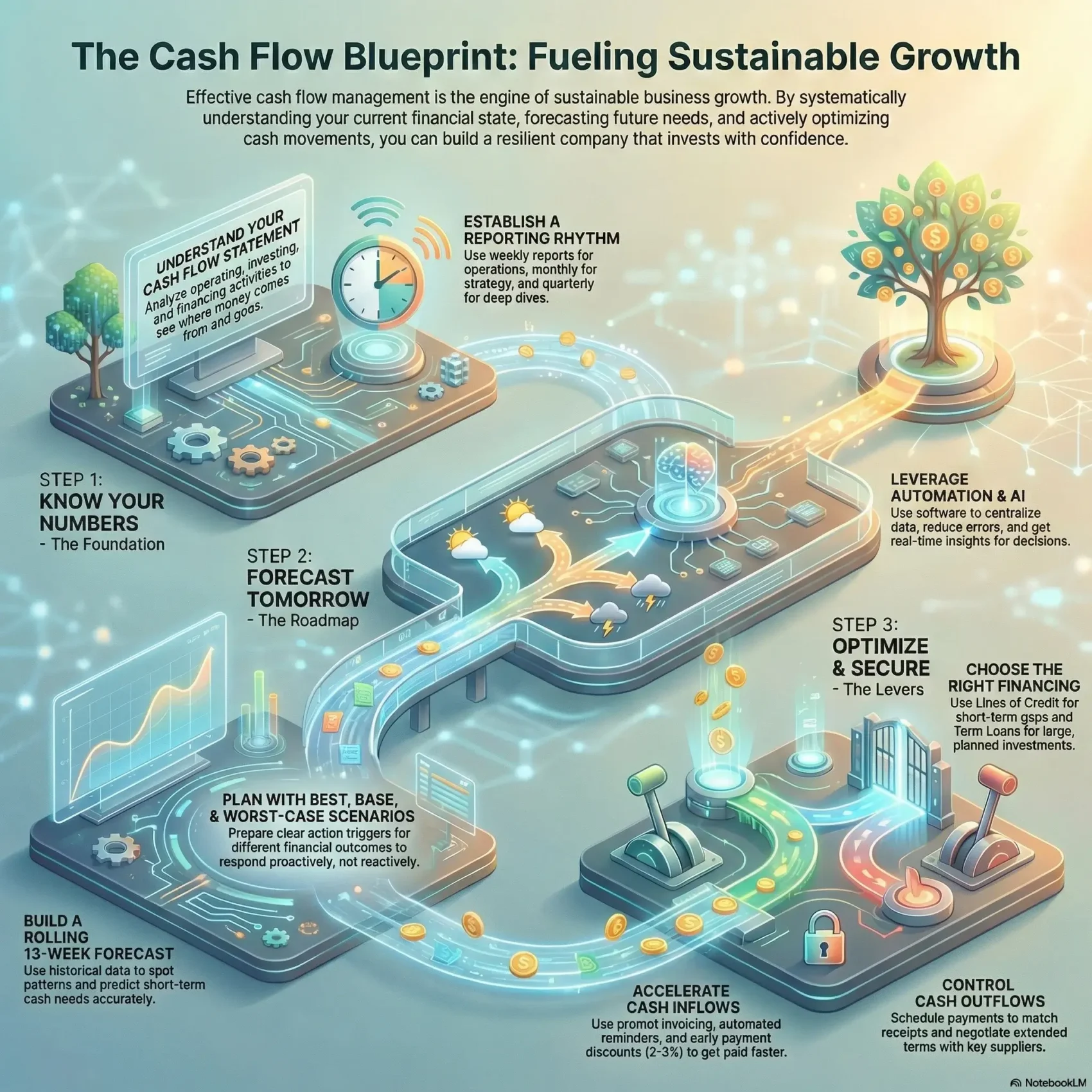
You will get a working routine: understand where you stand today, forecast the next quarter, and close the gaps you find.
We start with the vocabulary, because the terms get used loosely. Then we move to reporting, forecasting, collections, payables, expense control, software, and financing, in that order. Each section ends with something you can apply this week.
If you are scaling quickly, read this alongside our guide to scaling strategies for startups, since growth itself consumes cash before it produces any.
- A three-step plan: know today, forecast tomorrow, close the gap.
- The handful of numbers that warn you early, and the thresholds worth setting.
- A checklist for collections, payables, expense control, and forecasting.
Cash flow fundamentals, in plain terms
Your cash flow statement splits every movement of money into three buckets. Reading them separately tells you where the money is really coming from.
Operating, investing, and financing activities explained
Operating activities are the day-to-day money: customer payments in, supplier bills and wages out. This is the most important section. If operating cash is positive, the business funds itself. If it is negative month after month, something in the model is broken, and no amount of borrowing fixes it permanently.
Investing activities cover long-term purchases such as machines, vehicles, or property. Accountants call this capital expenditure, or capex. It usually shows a negative number during a growth phase, which is normal.
Financing activities track money moving between you and lenders or investors: new loans, repayments, equity raised, dividends paid.
Positive and negative cash flow, and your runway
Positive cash flow means more came in than went out in the period. Your runway, meaning the number of months you can keep operating on the cash you hold, gets longer. You can hire or buy stock without urgent borrowing.
Negative cash flow shortens the runway and needs a response within weeks, not quarters. The usual levers: postpone non-essential purchases, chase overdue invoices harder, and move payment dates where suppliers agree.
- Where to look: compare operating results by month, check seasonal swings, and test your assumptions against money actually received, not invoices issued.
- Fast levers: delay capex, invoice sooner, renegotiate supplier terms.
- When to get help: if operating cash stays negative for two or three months, arrange short-term credit before the gap becomes a crisis. Forecasting tools can flag this earlier than a spreadsheet does: see predictive analytics in finance.
Why cash flow management drives sustainable growth
Steady cash converts a bumpy year into a predictable one, and predictability is what lets you commit to anything long-term.
Paying suppliers reliably has a direct price benefit. Many vendors offer a discount of a few percent for early settlement, and reliable payers tend to get priority when stock is tight. Both effects show up in your margin.
Lenders respond to the same signal. A business with clean, consistent reporting looks lower risk, which usually means faster decisions and better terms when you do need capital. That matters in a market where access has narrowed for smaller firms, as our look at startup funding trends sets out.
Stability, resilience, and a lower cost of capital
- Disciplined oversight turns volatility into something you can plan around, so you can invest while still covering daily commitments.
- Proven reliability strengthens your hand in vendor negotiations and protects supply during shortages.
- A reserve sized to your own cost base lets you absorb a bad quarter without pausing strategic work.
- On-time commitments build trust with partners and staff, which is hard to rebuild once lost.
This is also why many founders have shifted their emphasis, a change we cover in the move away from growth at all costs.
Turn your numbers into insight: statements and reporting
Treat the cash flow statement as a dashboard you act on, not a document you file.
How to read the three sections together
Start with operating cash to see whether normal trading supports the business. Then check investing items, which tell you how much capacity you are buying and at what cost to your reserves. Finally, read financing to see how much of your position depends on borrowed money.
Pair it with working capital, which is current assets minus current liabilities. In plain terms: what you expect to receive within a year, minus what you owe within a year. A shrinking figure is an early warning even when the bank balance still looks healthy.
Weekly, monthly, and quarterly rhythms
Run a short weekly review covering money received, invoices outstanding, and payments due in the next fortnight. This is the review that lets you act in time.
Use the monthly close to clean the data and check assumptions. Save the quarterly session for seasonality, customer concentration, and pricing, which connects directly to your pricing strategy framework.
Five numbers worth watching weekly
- Bank balance available today, excluding money already committed.
- Receivables ageing: how much is overdue, and by how long.
- Payables due in the next 14 days.
- Days sales outstanding (DSO): the average number of days between issuing an invoice and being paid.
- Net burn: how much cash the business consumes in a typical week.
Standardise the definitions once and write them down. Teams stop trusting the numbers the moment two reports define the same term differently.
How to forecast cash
A forecast turns past receipts and signed contracts into a plan you can act on this week.
History, trends, and scenario planning
Pull twelve months of actual receipts and payments to find the repeating patterns. Then build a rolling 13-week forecast: one quarter ahead, updated every week so it never goes stale. Thirteen weeks is the standard window because it is long enough to see a problem coming and short enough to predict with reasonable confidence.
Run three versions: best case, expected case, and worst case. The point is not the numbers themselves but the triggers attached to them. For example: if the worst case becomes likely, freeze discretionary spend and draw on the credit line. Deciding that in advance removes panic from the decision. Our risk management framework guide covers how to structure those triggers.
- Compare the forecast with what actually happened, every week.
- When a line is repeatedly wrong, change the assumption rather than the total.
- Give one named person responsibility for updating the model.
Using software and AI for real-time modelling
Software that pulls transactions straight from your bank and accounting system removes the re-keying that causes most forecast errors. Tools that connect to your ERP, the central system holding finance, inventory, and orders, keep the model current without a manual export.
AI features in this category mainly do pattern work: flagging customers whose payment behaviour has changed, estimating when an invoice will actually be paid, and re-running scenarios quickly. They are useful. They do not replace judgement about a contract you know is at risk.
Translating forecasts into hiring, inventory, and capex
Tie each planned commitment to the week the money is expected. A hire approved in principle becomes a hire approved for a start date once the forecast supports the salary plus onboarding costs.
- Convert scenarios into explicit go or no-go rules for hiring.
- Match inventory purchases to projected receipts, not to projected sales.
- Refresh the plan weekly so priorities stay current.
Speed up receivables to accelerate inflows
Late payment is the most common cash flow problem, and the one you have most control over. The Atradius Payment Practices Barometer for North America, published in September 2025, found that around 43% of the value of US B2B sales made on credit was overdue, with roughly 5% written off as bad debt.
Invoice timing, clear terms, and automated reminders
Send the invoice the day the work is delivered or the milestone is hit, and reference that milestone on the invoice. Most payment disputes start as simple ambiguity about what was delivered and when.
State the payment terms on every invoice in plain words, including the due date as a calendar date rather than “net 30”. Then automate the reminders: one before the due date, one on it, and a defined escalation afterwards. Automated follow-up is not aggressive, it is consistent, and consistency is what shortens DSO.
There is also a compliance reason to modernise invoicing now. Under the French mandate, every business operating in France must be able to receive structured electronic invoices from 1 September 2026, with large and mid-sized companies also required to issue them from that date and smaller firms following in September 2027. If you trade with French customers or suppliers, the receiving capability is no longer optional.
Early payment discounts and reducing DSO
An early payment discount trades margin for speed. Before offering one, do the arithmetic. The common “2/10 net 30” structure means a 2% discount for paying 20 days early. Giving up 2% to be paid 20 days sooner works out at an annualised cost of roughly 37%, which is far more expensive than most credit lines. Use it selectively, for a genuinely tight period or a customer whose payment behaviour you want to change.
- Use deposits or milestone billing on long projects so inflows arrive during the work, not after it.
- Offer several payment methods such as bank transfer, card, and direct debit, so paying takes a minute rather than a meeting.
- Review the ageing report weekly and escalate on a fixed schedule, so chasing never feels personal.
For consumer-facing businesses, deferred payment options change the timing of your own receipts too, which we examine in our piece on what buy now, pay later does to sales and margins. A practical starting point for invoicing software is our QuickBooks Online review, with Xero and FreshBooks as the main alternatives.
Manage payables without damaging supplier relationships
A payment schedule that matches your receipts protects working capital. Stretching payments without telling anyone does the opposite: it costs you goodwill, and goodwill is what you need when stock is short.
Scheduling, approvals, and vendor negotiation
Schedule payments so due dates fall after the receipts that fund them. That avoids late fees while keeping your cash as long as the agreed terms allow.
Automate the approval flow so invoices are coded, checked against budget, and routed without sitting in someone’s inbox. Approval delay, not deliberate stretching, is what causes most accidental late payments.
Negotiate openly. If you need longer terms, ask for them and offer something in return: predictable payment dates, a larger committed volume, or partial early settlement. A negotiated 45-day term is worth more than an unannounced 45-day delay. Procurement software helps once you are past a handful of suppliers, as our guide to digital procurement explains.
When to take a discount and when to extend terms
Take an early payment discount when the effective annual return beats the cost of your own financing. Skip it when cash is tight, because a discount paid for with an overdraft is not a saving.
- Align payment runs to due dates and actual cash availability.
- Keep an approval trail so every bill has a reviewer and a date.
- Extend terms selectively and always by agreement.
- Centralise invoices and purchase orders to catch duplicate charges.
- Choose the payment rail deliberately, weighing fees, speed, and any card rebates.
Concentrating spend with fewer suppliers improves terms but raises dependency risk, a trade-off covered in supply chain resilience.
Practical levers to control expenses and working capital
Run a line-by-line audit of monthly outgoings. Unused software seats, duplicate tools, and subscriptions nobody owns are the easiest money you will ever find. Cancel them and redirect the budget.
Set a spend threshold above which purchases need pre-approval. It removes surprises without turning every small purchase into paperwork.
- Audit recurring costs quarterly and stop anything with no clear owner. For cloud spend specifically, see FinOps best practices.
- Right-size inventory and update reorder points so cash is not sitting on shelves.
- Automate a transfer into a reserve account so the cushion builds without a decision each month.
- Flex staffing and marketing with your season rather than holding both flat all year.
- Review pricing. Raising prices improves cash faster than most cost cuts, which is the argument in value-based pricing.
Technology that streamlines the work
Accounts payable automation, usually shortened to AP automation, takes an incoming supplier invoice and handles capture, coding, approval routing, and payment scheduling with minimal manual entry. Your team then reviews exceptions instead of typing.
From invoice capture to a faster close
The practical gain is time. Invoices arrive as email attachments or structured files, get read automatically, and land in the right account code. Month-end close shortens because the data was already clean, and you stop losing discounts to invoices found too late.
Integrations, real-time data, and spend controls
Connecting the software to your accounting system or ERP means transactions post once and reconcile themselves. That is where the reporting accuracy comes from. Expense capture is a related piece, compared in Expensify vs QuickBooks.
- Fewer errors: automated capture and coding cut both rework and the mistakes that survive into reports.
- Enforced policy: approval limits are applied before payment, not discovered afterwards.
- Deliberate payment choices: route by cost and timing across the rails available to you.
- Visible commitments: dashboards show what is due and what is stuck.
Where this fits into a wider automation plan is covered in finance automation and business automation trends.
Financing tools for gaps and for growth
The right credit facility turns a timing gap into a decision rather than an emergency. The distinction that matters is between money you might need briefly and money you are committing for years.
Lines of credit versus term loans
A line of credit is a pre-approved limit you can draw on and repay repeatedly, paying interest only on what you have drawn. It suits payroll timing, seasonal stock, and short gaps.
A term loan is a fixed amount repaid over a set period. It suits equipment, fit-outs, and anything with a useful life you can match to the repayment schedule.
Newer options sit alongside these. Invoice financing advances money against unpaid invoices, and payment platforms increasingly offer credit inside the tools you already use, a shift described in embedded finance.
Choosing the right instrument
- Use a line for timing gaps, seasonal stock, and payroll smoothing.
- Use a term loan for large purchases, matching repayments to the asset’s life.
- Compare the cost of borrowing against the discounts or growth it unlocks.
- Arrange credit while your numbers look strong. Applying under pressure is slower and more expensive.
- Build the repayments into your forecast so they never arrive as a surprise.
- Write down any covenants and reporting duties, and diarise them.
“Securing a credit line before you need it preserves your operating runway and keeps options open.”
Common problems and how to solve them
Small shortfalls compound quickly unless you have a standing response for each of them.
Late payments and overdue invoices
Automate invoicing and reminders first, since consistency does more than escalation. Offer a payment plan to a customer in genuine difficulty rather than losing the whole balance, and set a fixed point at which an account moves to formal collection.
Seasonality, unexpected costs, and downturns
Map your seasonal pattern from actual history, then plan the lean months while the good ones are still running. Build a reserve sized to your own fixed costs, keep a credit line available, and spread revenue across enough customers that losing one is survivable.
Weak budgeting, weak forecasting, weak collections
Review budgets monthly and track the variance, not just the total. Use the ageing report to prioritise collections and give each overdue account a named owner.
Communicate early. A supplier told in advance that a payment will be three days late is a supplier who stays a supplier.
- Automate follow-ups and escalate on a published schedule.
- Use deposits, milestones, and multiple payment methods to steady receipts.
- Keep reserves, maintenance, and insurance in place so surprises stay small.
Conclusion
A repeatable routine of forecasting, reporting, collections, and approvals turns uncertainty into steady progress.
Forecast weekly. Compare the forecast with reality. Collect faster. Schedule payables deliberately. Use software where it removes manual steps, and arrange financing before you are under pressure.
None of this is complicated. It is a habit, and the businesses that keep it are the ones that can say yes to an opportunity without checking the bank balance first.
Found this useful?
Make SmartKeys a preferred source on Google, and our articles will surface more often in your Top Stories, AI Overviews, and AI Mode.
Add as Preferred Source