Tools
Tools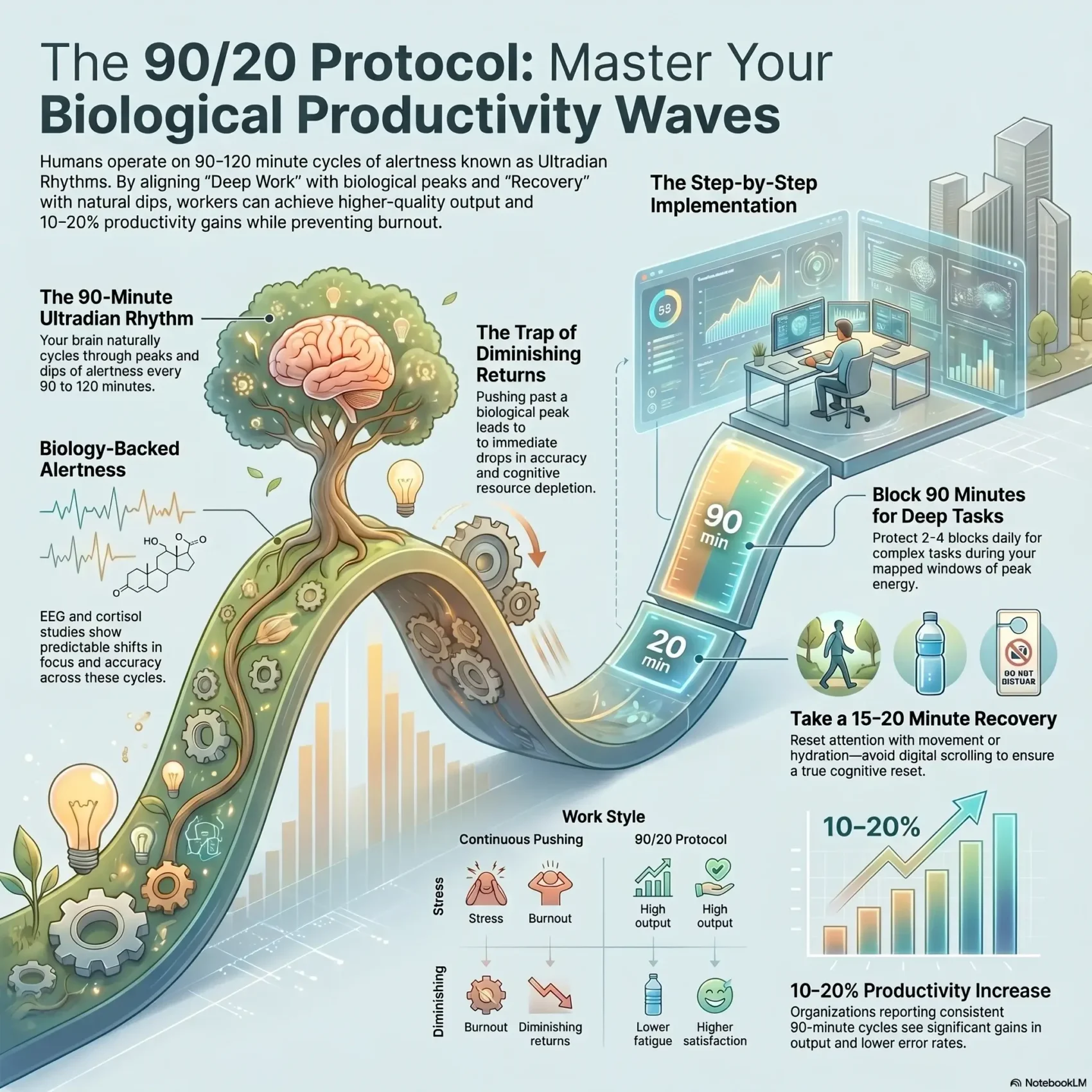
Last Updated on June 17, 2026
You can shape your day by matching tasks to natural 90–120 minute cycles. Scientists identified these patterns as the Basic Rest-Activity Cycle, and EEG studies show the brain moves through clear peaks and dips in alertness.
When you align focus blocks with these periods, your energy and performance tend to improve without adding hours. Hormones like cortisol shift across cycles, and attention research shows pushing past a peak reduces returns.
This guide shows how to map your personal patterns, build 90-minute blocks, and add short recovery breaks so your productivity and health both rise. Companies such as Shyft report fewer errors, better satisfaction, and lower turnover when schedules respect these biological signals.
Key Takeaways
- You’ll learn why 90-minute cycles reflect real brain and hormonal patterns.
- Plan focus-heavy tasks during peaks to protect attention and accuracy.
- Short breaks after each block restore energy and sustain performance.
- Aligning schedules to biology can boost productivity and employee health.
- This introduction previews a practical, science-backed plan you can try today.
Ultradian rhythms explained: how your 90-minute cycles drive daily energy
Short, repeating cycles of roughly 90 minutes shape when you feel sharp and when you need a pause. These 90–120 minute periods repeat across the day, producing rises and falls in alertness and energy.
Ultradian vs. circadian rhythms: what’s the difference and why it matters
The 24‑hour clock of circadian rhythms sets your broad sleep and wake schedule. In contrast, ultradian rhythms are the shorter loops that control moment‑to‑moment focus.
The present-day edge: aligning work with your body’s natural rhythm
EEG studies show clear shifts in brain state across these periods. Cortisol and other hormones track with those shifts, so your levels of alertness rise then dip in predictable ways.
“You’ll notice waves of clarity followed by a brief drop—that pattern is normal and useful.”
- Use 90‑minute blocks for deep tasks.
- Take short recoveries when you hit a dip.
- Map your body to spot personal peak times.
The science behind focus cycles: from brain waves to diminishing returns
Your attention runs in built-in waves, and that pattern has a firm scientific base. Kleitman’s research identified a Basic Rest-Activity Cycle of roughly 90–120 minutes that repeats through the day and during sleep. That period helps explain why your best focus comes in bursts.
Kleitman’s Basic Rest-Activity Cycle
Early research measured awake and sleep patterns and found a near-90-minute period that persists across states. This cycle shows why you naturally hit peaks and dips in attention every few minutes.
EEG and brain-state shifts
EEG studies reveal clear brain transitions. Peaks of focused alertness last about 90 minutes, then give way to lower arousal. That change affects your accuracy and overall performance.
Hormones, attention restoration, and sleep links
Hormonal levels like cortisol track these cycles and help drive shifts in alertness. Attention Restoration Theory shows cognitive resources deplete within a cycle. Push past your natural point and you face immediate diminishing returns.
“Respecting these biological rhythms is less about willpower and more about syncing with what your body already does.”
- Scientific findings connect sleep stages to daytime cycles.
- EEG and hormone data explain peaks of focus.
- Time-boxing to these periods preserves performance.
Why working with your rhythm boosts performance and wellbeing
Matching tasks to personal energy highs helps you deliver higher-quality output faster. Plan focus blocks for peak alertness and insert short recoveries to keep your mind sharp. This approach raises productivity while protecting your health.
More high-quality output in less time: productivity and focus gains
When you schedule high-focus tasks for peak periods, you get more done in fewer hours. Targeting those windows increases accuracy and output quality.
Use 90-minute blocks and add a 15–20 minute recovery break. That pattern restores attention and sustains productivity across the day.
Health, energy, and satisfaction: reducing stress and burnout
Short, deliberate rest protects your body and keeps energy steadier. Regular recovery reduces stress and helps motivation stay high.
People who follow this pattern report better sleep, lower fatigue, and higher job satisfaction.
Fewer errors and lower turnover: real business impact
Organizations that respect natural periods see fewer mistakes and improved performance metrics. Less error means lower costs and safer teams.
- You’ll leave the day with stronger output and more reliable results.
- Honoring periodic rest keeps your energy steadier and motivation higher.
- Fewer errors reduce risk, and happier people lower turnover.
- Well-timed recovery is essential—your brain needs it to protect attention.
Ultradian rhythm work: your step-by-step plan
Begin by recording short notes about alertness and task ease at regular intervals so patterns emerge fast.
Map your energy: track peaks, dips, and patterns across your day
Log a quick entry every 60–90 minutes about how sharp you feel. Note what task you were doing and the perceived effort.
After a week you’ll see clear patterns that guide when to schedule deep focus and lighter items.
Block your time: 90-minute deep focus periods with intent
Protect two to four focus blocks per day. Start each block with a short ritual so your mind knows the time to focus.
Design real recovery: 15–20 minute breaks that restore your brain
Use a true break: move, hydrate, or breathe—no endless scrolling. A short recovery resets attention in minutes.
Match tasks and use smart inputs
- Reserve complex tasks for peak blocks and admin for dips.
- Use bright light, brief movement, and early coffee to boost alertness at the start of a block.
- Iterate weekly so the plan respects your body and keeps your mind aligned to patterns.
“Small, consistent changes to how you schedule hours will raise both output and wellbeing.”
Tools and practices that make rhythm-based work stick
The right apps and simple spaces make it easy to protect focused minutes and quick recovery.

Smart scheduling and AI that respect your cycles
Advanced platforms (including Shyft) let you build custom cycles, automate start and end times, and test different lengths. AI can suggest optimal slots for your hardest tasks and adapt as your patterns change.
Reminders and break management to prevent overrun
Use break apps that ping individuals and teams to prevent fatigue. Timed alerts stop overruns and protect attention so your energy stays steady across the day.
Create recovery zones and simple norms
Set aside quiet corners, stretching areas, or outdoor access for real recovery. Make rules: no screens, short walks, or breathing drills during a break so the body gets a true reset.
Train managers and teach practical skills
Coach leaders to spot fatigue and to rotate tasks when needed. Run workshops that teach quick recovery techniques—brief walks, breathing, or light snacks—that fit inside the minutes you save for breaks.
- Choose scheduling platforms with customizable cycles and automated reminders.
- Deploy break and overrun alerts that protect attention.
- Create recovery zones that make rest natural and supported.
- Train managers to coach teams on sustainable patterns and energy habits.
- Track adherence and tune cycle lengths as tasks shift.
“Small systems and clear norms make it simple to keep energy high and errors low.”
Measure what matters: proving ROI from 90-minute cycles
Start by measuring baseline output and error rates so you can prove any gains clearly.
Gather simple metrics for a week: units produced, task completion time, error and safety incidents, and quality checks. Add people data like satisfaction, absenteeism, and turnover so the picture is complete.
Set your baseline: output, quality, and error rates before change
You’ll capture a baseline of output and quality that makes later improvements obvious.
Record errors and incidents by shift and by time of day to tie problems to specific periods.
Track productivity and performance across cycles and times of day
Log productivity by slot and compare performance levels across the day. Use simple dashboards so trends jump out.
People metrics: satisfaction, absenteeism, and turnover trends
Survey your team on satisfaction and track absenteeism and turnover. These human signals often move with changes in schedule and recovery.
Review cadence: evaluate results after 3-6 months and iterate
Set a clear review point at 3–6 months. Compare numbers and calculate ROI: many organizations report 10–20% productivity gains and fewer mistakes after adopting 90‑minute cycles.
“Measure what you change and share results in plain language so teams see the link between better schedules and real business and human wins.”
- You’ll prove gains in output and quality with baseline data.
- You’ll log results by time of day and across periods to spot peak points.
- You’ll track satisfaction and turnover to show effects on team health.
- You’ll review after 3–6 months and use dashboards to guide decisions.
Adapt your cycles: people, tasks, night work, and continuous coverage
When shifts span day and night, small tweaks to block length and recovery keep alertness and safety steady.

Chronotypes and timing
First, map who’s a lark and who’s an owl. Place demanding tasks at each person’s natural peak times.
Doing this aligns your team with their body clock and raises overall energy.
Night shifts and shorter blocks
At night, shorten focus blocks to 75–85 minutes and lengthen recovery periods.
Use bright lighting during active periods and time coffee early in the shift to boost alertness without a late crash.
Continuous operations and coverage
Stagger breaks so someone always covers essential duties. Cross-train teammates so rotating recovery doesn’t stop production.
Different tasks, tailored minutes
Cognitive roles work well with classic 90-minute peaks and true rest. Physical roles benefit from frequent rotation. Creative periods can extend to 120 minutes with looser recovery.
Fatigue management
Watch for slower reactions, mood changes, and rising error rates — early signs of fatigue.
“Intervene early with a real break to prevent diminishing returns.”
- Align cycles with chronotype so people hit peaks at the right times.
- Adjust night shifts with 75–85 minute blocks, bright light, and timed coffee.
- Stagger coverage and cross-train to keep operations moving during recovery.
- Tailor periods to task type and monitor fatigue levels continuously.
Industry playbooks: applying ultradian rhythms across sectors
Practical playbooks help you apply 90‑minute periods across different fields so teams stay safe and efficient.
Healthcare
Place critical tasks during biological prime times to reduce fatigue-related errors.
Rotate staff through clinical duties so no one stays at high-intensity stations for long.
Manufacturing
Use structured work-rest cycles and rotate workstations to boost safety and quality.
Short, scheduled breaks cut lapses and keep error rates down across long hours.
Retail
Match customer-facing shifts to peak foot traffic and move back-of-house tasks into natural dips.
This alignment keeps floor energy high while preserving team recovery windows.
Technology
Block deep coding into focused periods and insist on genuine recovery between sprints.
That approach stabilizes energy and improves overall performance on complex tasks.
Hospitality
Rotate staff between high-intensity service and prep/reset periods so quality stays consistent.
Staggered breaks and cross-training keep operations running without sacrificing rest.
- You’ll see how healthcare can cut errors by scheduling peaks and guaranteeing recovery.
- You’ll learn why manufacturing gains safety by rotating stations through the hours.
- Retail aligns customer surges with floor coverage and shifts back tasks to dips in the day.
- Technology benefits from deep focus blocks with true recovery to protect energy and performance.
- Hospitality sustains quality by alternating intense service with prep and reset periods.
- Cross-training and staggered breaks keep continuous operations without compromising natural periods your body needs.
Conclusion
Small, repeatable time habits can keep your alertness higher and reduce costly errors across the day. Evidence shows ~90‑minute ultradian cycles match sleep architecture at night. Use 90‑minute focus blocks and 15–20 minute recovery breaks to protect energy and lift productivity.
You’ll get better output without adding hours by focusing when your body is ready and resting when it isn’t. Train teams, stagger coverage, and adapt for night shifts and chronotypes so people can do the right task at the right period.
Start simple: one task per cycle, a timed break, and a brief activity reset. Try short focus sprints and measure results so you can tune times and avoid diminishing returns.
Honor patterns, protect breaks, and iterate. When you do, the mind, the body, and your productivity all improve.