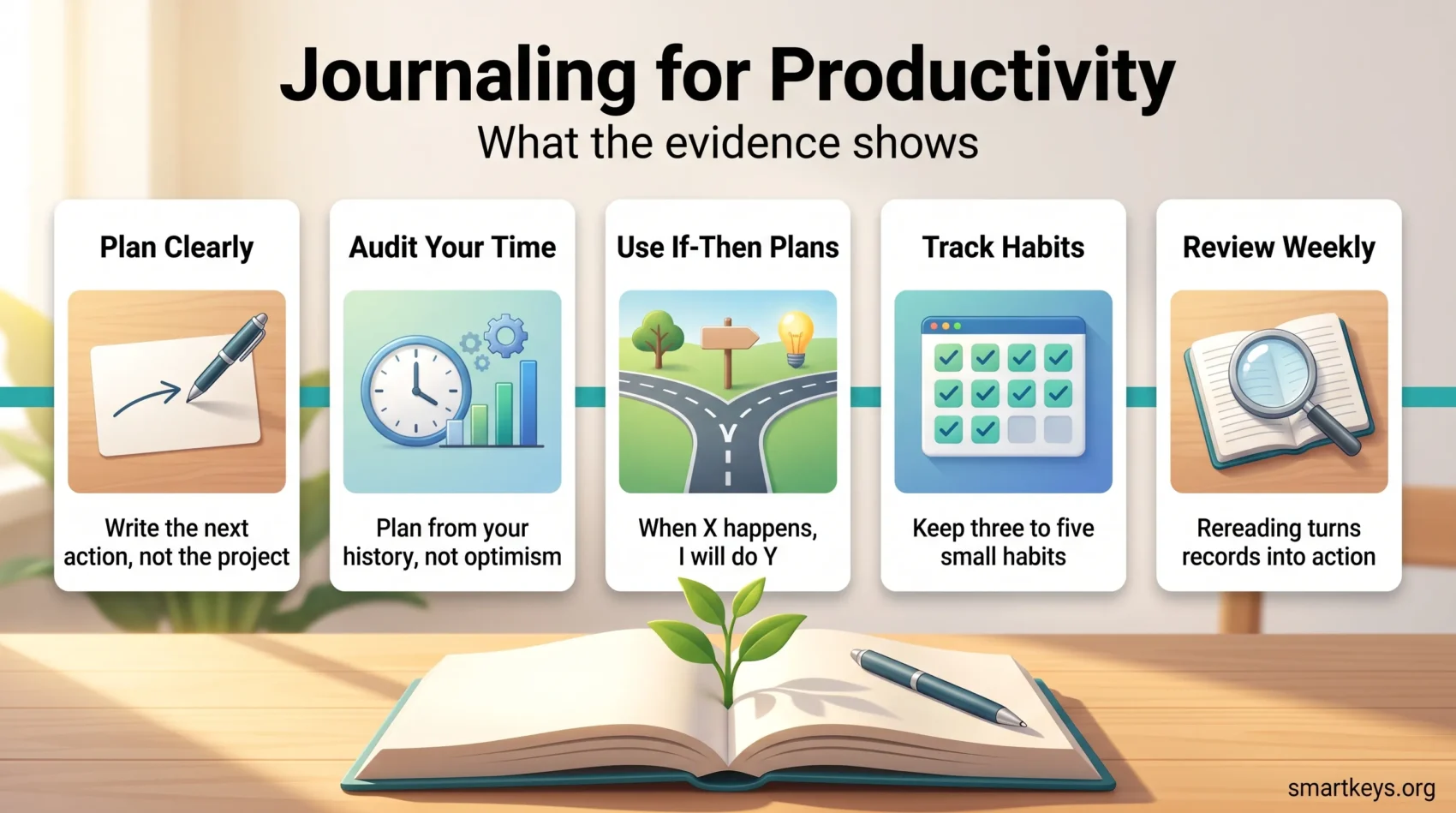
Journaling is one of the few productivity habits that costs nothing, needs no software and still has a genuine research base behind it. Writing things down clarifies what you are actually trying to do, leaves a record you can look back on, and turns vague intentions into steps you can act on.
The evidence is narrower than the internet suggests. Journaling will not double your output, and most of the dramatic percentages you see quoted trace back to studies that were never published. What controlled research does support is more modest and more useful: structured writing helps people process stress, notice patterns in their own behaviour, and follow through on plans they have committed to on paper. This guide covers what journaling genuinely does well, which formats are worth trying, and how to keep the habit alive past week two.
Key Takeaways
- Productivity journaling combines planning, tracking and reflection in one place, so decisions stop living only in your head.
- Written if-then plans are among the best-evidenced ways to close the gap between intending to do something and actually doing it.
- Journaling is a reliable outlet for stress and rumination, with randomised trial evidence behind structured formats.
- Reviewing entries matters more than writing them. Without a weekly or monthly read-back, a journal is just an archive.
- Five focused minutes a day beats an elaborate spread you abandon in February.
Understanding the Concept of Productivity Journaling
Productivity journaling is the practice of writing down what you plan to do, what you actually did, and what you noticed along the way. It sits between a to-do list and a diary: more reflective than the first, more purposeful than the second. The point is not to produce good prose. It is to externalise decisions so you can look at them instead of carrying them around.

Most people get one or more of the following out of it:
- Clearer planning, because writing a plan forces you to be specific about the next action.
- Less mental clutter, since a written brain dump stops you rehearsing the same open loops.
- A record you can audit, which is the only honest way to find out where your time actually goes.
- A calmer relationship with work, because worries put on paper tend to shrink to their real size.
There is no single correct format. Four approaches cover most needs:
- Today and tomorrow: a short review of what happened, then three priorities for the next day.
- Self-evaluation: a weekly look at what worked, what stalled and what you would change.
- Stream of consciousness: unstructured writing to clear your head before focused work.
- Goal journal: a running record of a small number of objectives and the progress against them.
A few things make the habit stick. Pick one format rather than combining all four. Attach it to an existing anchor, such as the end of your workday. Accept messy entries. And pair the journal with wherever you already capture tasks, so the two systems do not compete for the same job.
How Journaling Enhances Time Management
You cannot fix a schedule you cannot see. Writing down what you worked on, in rough blocks, gives you the raw material for a time audit — and the results usually surprise people. Meetings, context switching and small administrative tasks tend to occupy far more of the week than anyone estimates.
That gap between estimate and reality has a name. The planning fallacy describes our reliable tendency to underestimate how long our own tasks will take, even when we have done the same task many times before. A journal is the cheapest available correction: once you have a few weeks of recorded durations, you can plan against your history instead of your optimism.
Journaling also exposes the cost of switching. If your log shows a day chopped into fifteen-minute fragments, the problem is not motivation, it is structure. That is a different fix from working harder, and it is one reason a written record beats a vague sense that the week went badly. Readers who want the broader picture can start with our guide to time management techniques and the evidence on why multitasking hurts productivity, then use the journal to see which of those problems is actually yours.
A short daily log also feeds naturally into weekly planning. Instead of starting each Monday from a blank page, you start from evidence about the week that just ended.
Improving Goal Setting Through Journaling
Writing goals down does help, but not for the reason usually given. The popular claim that written goals make you “42% more likely” to succeed comes from a small unpublished study and should not be treated as a fact. The better-supported mechanism is more specific.
In a meta-analysis of 94 independent studies, Peter Gollwitzer and Paschal Sheeran found that implementation intentions — plans written in the form “when situation X arises, I will do Y” — had a medium-to-large effect on goal attainment (d ≈ 0.65). The benefit came from the format, not from the act of writing as such. A goal journal works because it is a natural place to write if-then plans and then check whether the trigger actually fired.
That suggests a practical structure. For each goal, record the outcome you want, the specific next action, the cue that will start it, and the obstacle most likely to derail it. Then revisit those entries on a schedule rather than when you happen to think of it. Regular goal tracking is what converts a list of ambitions into something you can steer, and a monthly review is usually the right cadence for anything longer than a few weeks.
Journalling goals also helps you retire them. Most people’s lists grow faster than they shrink; a written record makes it obvious which objectives you have quietly stopped caring about, so you can drop them deliberately instead of carrying them as background guilt.
Overcoming Procrastination with Productivity Tools
Procrastination is usually an emotional problem wearing a scheduling costume. People avoid tasks that feel ambiguous, unpleasant or threatening to their self-image, and the delay provides short-term relief that reinforces the pattern.
A journal is useful here because it makes the avoidance legible. Asking “what am I actually afraid will happen if I start this?” and writing the answer down often reveals something small and manageable: an unclear brief, a decision you do not have authority to make, a first step you cannot picture. Once named, the blocker can be addressed directly.
Two follow-ups make the reflection practical. First, write the next physical action rather than the project — “draft the three headline options”, not “work on the campaign”. Second, cap the daily commitment. Three high-impact actions is a workload you can finish, and finishing is what rebuilds momentum. For a fuller treatment of triggers and countermeasures, see our guide to overcoming procrastination.
It is also worth noting what a journal cannot do. If the underlying issue is chronic overload rather than avoidance, more reflection will not help; the honest entry is the one that says the workload does not fit the week.
Using Habit Trackers to Boost Efficiency
A habit tracker is a grid: behaviours down one side, days across the top, a mark for each day you follow through. It works because it makes an invisible pattern visible.
Habits deserve that attention because so much of the day runs on them. In two studies of everyday behaviour, Wendy Wood and colleagues found that roughly 35% to 43% of what participants did was performed almost daily and in the same location — the practical definition of a habit. Changing that layer of behaviour has more leverage than optimising the handful of decisions you consciously make.
Trackers earn their keep in three ways: they raise awareness of what you are actually doing, they provide a small immediate reward for consistency, and they build a record that shows progress over months rather than days. The “don’t break the chain” method leans on the third of these — you mark each successful day and become reluctant to interrupt the streak.
Keep the list short. Three to five habits is enough, and they should be behaviours you can complete in a bad week, not an ideal one. Habits tied to a fixed point in the day, such as an evening routine or a set of daily intentions written each morning, survive far better than ones you fit in whenever there is time.
Combining a Journal with a Daily Planner
A journal records what happened; a planner commits you to what comes next. Used together they cover both halves of task management: the planner holds appointments, deadlines and the day’s shortlist, while the journal holds the reasoning and the review.
There is a reasonable case for doing at least part of this by hand. In a high-density EEG study published in Frontiers in Psychology, Van der Meer and Van der Weel found that handwriting produced widespread connectivity across brain regions associated with memory and encoding, while typing did not — a pattern the authors link to better learning conditions. That is an argument for writing plans and reflections by hand, not for abandoning digital tools.
In practice, most people end up with a hybrid. Shared calendars and team boards stay digital because other people depend on them. The daily shortlist and the reflection work well on paper, where there is nothing to click away to. If you prefer to keep everything in one place, our comparisons of productivity apps and of Evernote and OneNote are a reasonable starting point, and the same principles apply to digital note-taking generally.
One caution worth adding in 2026: AI-assisted journaling apps that summarise your entries or generate prompts are now common. They can be genuinely useful for spotting themes across months of writing, but a journal is among the most sensitive text you will ever produce. Check what a tool stores, where it stores it, and whether your entries are used for training before you move years of private reflection into it.

Promoting Self-Improvement through Reflective Writing
Reflective writing is the part of journaling that looks backwards. You describe an event, what you did, how it went and what you would change — and over time the entries start to show patterns that no single day would reveal.
Systematic reviews of expressive and positive writing interventions report small but reasonably consistent benefits for wellbeing, with effects that vary by population and by how the writing is structured. The honest summary is that reflective writing is a low-cost practice with modest, real returns, not a transformation.
To get those returns, the review step is not optional. Writing entries and never rereading them is the most common way the habit fails. A few prompts that hold up:
- What went better than expected this week, and what made the difference?
- Where did I spend time that did not move anything forward?
- Which decision would I make differently with what I now know?
- What did I avoid, and what was I avoiding about it?
Reflection also compounds with quieter practices. People who pair journaling with meditation or another deliberate pause often find the writing sharper, because they arrive at the page having already slowed down.

How Bullet Journaling Can Streamline Your Tasks
Bullet journaling, the method developed by Ryder Carroll, is a rapid-logging system built on short entries and simple symbols. A dot marks a task, a circle an event, a dash a note; completed tasks get crossed through and unfinished ones are deliberately migrated forward. That migration step is the clever part, because rewriting a task by hand every week makes it obvious when you do not actually intend to do it.
The system is built from a few standard components:
- Daily log: tasks, events and notes as they happen.
- Monthly log: the month at a glance, plus the tasks that belong to it.
- Future log: anything scheduled beyond the current month.
- Index: page numbers so you can find things again.
- Collections: custom pages for a project, a reading list or a habit grid.
Two warnings. The elaborate spreads that dominate social media are a hobby, not the method — the original system is deliberately plain and fast. And the method assumes you will sit down weekly to migrate; skip that and it degrades into a notebook full of stale lists. The Bullet Journal Method rewards consistency far more than artistry.
The Impact of Journaling on Mental Health and Stress Reduction
The mental health evidence for journaling is stronger than the productivity evidence, and it is worth separating the two.
In a randomised controlled trial published in JMIR Mental Health, Joshua Smyth and colleagues assigned 70 adults with medical conditions and elevated anxiety to either usual care or 15-minute web-based positive affect journaling sessions three times a week for twelve weeks. Compared with the control group, the journaling group reported fewer depressive symptoms and less anxiety after one month, along with greater resilience in the first two months. It is a small preliminary trial rather than definitive proof, but it is real evidence for a specific, structured format.
Two mechanisms are usually offered. Writing about a stressor forces it into language, which tends to make it more bounded and less overwhelming than the version circling in your head. And writing about what went well shifts attention toward evidence you would otherwise skip past.
There are limits worth respecting. Repeatedly writing about a distressing event without any shift in perspective can reinforce rumination rather than relieve it, and journaling is not a substitute for treatment.

If low mood or anxiety is persistent, a notebook is a supplement to professional support, not an alternative. For the workplace side of the same problem, our guide to managing stress for better productivity covers the structural fixes that no amount of reflection will replace.
Conclusion
Journaling earns its place through accumulation rather than any single session. The planning is marginally better because it is specific. The goals stay visible. The stress has somewhere to go. None of that is dramatic on any given Tuesday, and all of it adds up over a quarter.
Start smaller than feels worthwhile: three lines at the end of the day, one weekly read-back, one habit tracked. Choose the format that matches how you already think — a plain daily log, a bullet journal, or a notes app you already have open. Then protect the review, because that is where a journal stops being a record and starts changing what you do. If you want to see how the habit fits alongside everything else, our overview of current productivity trends puts it in context.
Found this useful?
Make SmartKeys a preferred source on Google, and our articles will surface more often in your Top Stories, AI Overviews, and AI Mode.
Add as Preferred Source