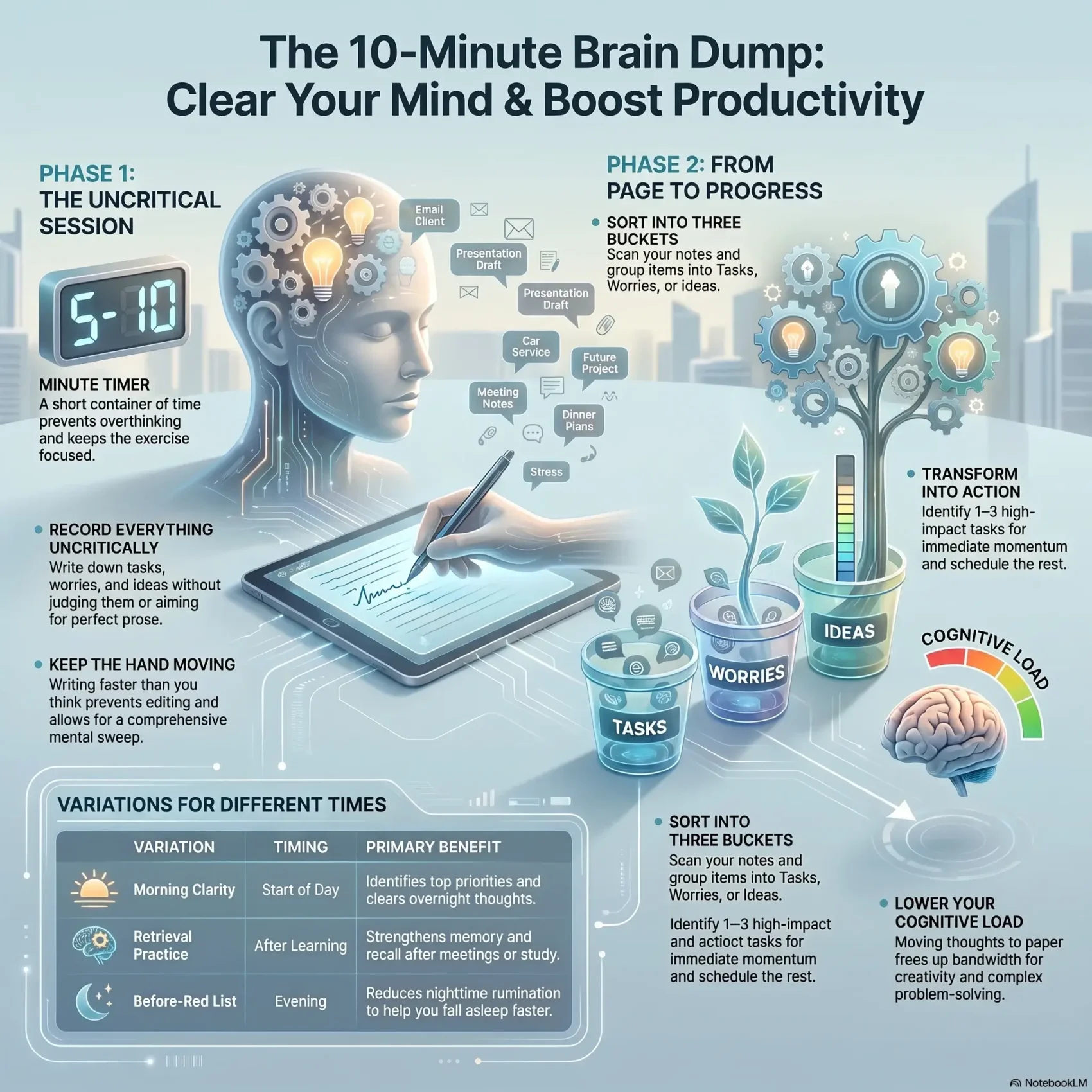
You can clear your head in about five minutes. A brain dump is a short, timed exercise where you move every task, worry and half-formed idea out of your head and onto a page. No editing, no ranking, no polish.
The need for it has grown. Microsoft published a Work Trend Index report on the “infinite workday” in June 2025. It found that people working in Microsoft 365 are interrupted roughly every two minutes during core hours, about 275 times a day. The average worker also receives 117 emails and 153 Teams messages a day, and nearly half say their work feels chaotic and fragmented.
Your working memory (the small mental scratchpad that holds what you are thinking about right now) was never built to buffer that queue. A brain dump gives the queue somewhere else to live.
Key Takeaways
- Five to ten minutes of unfiltered writing clears most of the mental backlog.
- The relief shows up in lab data. In a Baylor University sleep study, students who wrote a to-do list before bed fell asleep about nine minutes faster.
- Specific beats vague. “Email Sarah about the Q3 budget” works better than “work stuff.”
- The dump is only half the job. Sort the page into tasks, worries and ideas, then commit to one or two next actions.
- Offload storage, keep judgment. Letting an AI decide your priorities skips the part that creates clarity.
- It is a tool, not therapy. Persistent anxiety or low mood deserves professional support.
What a Brain Dump Is and Why It Works
A brain dump means writing down everything on your mind, completely and without judging it. You set a timer, usually for five to ten minutes. Then you record everything competing for your attention: tasks, worries, ideas and half-remembered obligations. You do not sort and you do not edit.
It sounds too simple to matter, but three lines of research suggest otherwise.
1. Unfinished tasks keep tapping you on the shoulder
Psychologists call this the Zeigarnik effect: goals you have started but not finished stay active in memory. They pop up while you are trying to do something else. Researchers E. J. Masicampo and Roy Baumeister showed that unfinished goals caused intrusive thoughts during a reading task and hurt performance on unrelated puzzles.
The interesting part came next. When people wrote a specific plan for the unfinished goal, the interference disappeared, even though the task itself was still undone.
That is the mechanism behind a brain dump. Your mind is not demanding that you finish everything. It wants proof that nothing will be forgotten. If the same three items circle your head all day, our guide to open loops and how they sabotage focus explains the pattern in more depth.
2. Writing a to-do list before bed can speed up sleep
Michael Scullin and colleagues at Baylor University tested 57 university students in an overnight sleep lab. They measured sleep with polysomnography, which records brain activity through electrodes and is the most accurate way to tell when someone actually falls asleep.
Half the students spent five minutes writing a to-do list for the coming days. The other half wrote about tasks they had already completed. The to-do list group fell asleep about nine minutes faster. The longer and more specific the list, the faster they fell asleep.
Two caveats keep this honest. The sample was small and made up of young students, and it measured falling asleep, not total sleep quality. Still, a nine-minute gain from a five-minute exercise is a good trade. If nighttime rumination is your bottleneck, pair this with a deliberate evening routine and the basics in our guide to sleep and productivity.
3. Offload storage, but keep the thinking
Cognitive offloading means handing mental work to an outside tool, whether that is a notebook, a calendar or an AI assistant. Writing things down is the classic, healthy version. Newer research adds a warning about how far to take it.
A 2025 study by Michael Gerlich in the journal Societies found that heavier AI users tended to score lower on critical thinking. Offloading explained much of that link. The study shows a correlation, not proof that AI causes weaker thinking. It still suggests where to draw the line.
Offload storage, keep judgment. Writing “renegotiate the vendor contract” moves the reminder out of your head while you still do the thinking. Asking an assistant to read your notes and hand you a ranked priority list skips the exact step that produces clarity. The same distinction applies when you organize digital notes or build a second brain system.
How to Do a Brain Dump in Five Steps
The method takes less time to run than to read.
- Pick one surface and stick to it. Use a notebook, a single note in your app, or a voice memo. Splitting the dump across three places recreates the problem you are trying to solve.
- Set a timer for five to ten minutes. A fixed limit stops the session from turning into rumination. Ten minutes is the ceiling, not the target.
- Write without filtering. Include tasks, worries, feelings, people to contact and the subscription you keep meaning to cancel. Keep your hand or voice moving faster than your inner editor.
- Stop when the pressure drops. Relief is the goal, not a full page. If you feel lighter at minute four, stop at minute four.
- Mark one or two next actions. Circle the smallest concrete step you can take today. This is where a next action mindset turns raw writing into momentum.
Run this two or three times a week and it soon becomes automatic. It also pairs well with time-based methods. The dump clears the queue, then focus sprints or a timeboxing routine protect the block of time you just freed up.
Five Brain Dump Variations for Different Moments
The same five minutes does different work depending on when you spend it.
Morning clarity dump
Clear the overnight residue and pick one to three priorities before the first message arrives. For most people this is the most useful version, and it fits neatly into a productive morning routine.
After-learning recall dump
Straight after a meeting, course or long call, write down everything you remember without looking at your notes. Learning researchers call this retrieval practice: pulling information out of memory strengthens it far more than rereading does.
Project dump
When one project has taken over your head, dump only that project. List every open question, dependency, name and deadline. This often reveals that two items are blocking the other fifteen.
Gratitude dump
When your mood is the problem rather than your workload, list specific people, moments or small wins. Our piece on gratitude journaling and focus explains why specificity matters here too.
Bedtime dump
Write tomorrow’s tasks for five minutes, as concretely as you can. This is the version with the strongest evidence behind it. If you want to turn it into a longer reflective habit, see our guide to journaling for productivity.
Turn the Page into a Plan
A raw dump that you never revisit is just a longer list of things you are not doing. Give it a two-minute sweep and sort every line into three buckets:
- Tasks: anything with a concrete action. Pull one to three into today and schedule the rest. Our guide to to-do lists that actually work covers how to phrase them so you act on them.
- Worries: circle what you can influence and name one tiny step for each. Park the rest on purpose so they stop replaying.
- Ideas: move them somewhere you will actually look again. This is where a trusted capture system earns its keep.
If something takes less than two minutes, do it now instead of filing it. That is the two-minute rule in practice. For everything else, run it through the Eisenhower Matrix, a simple grid that separates urgent work from important work, so urgency does not quietly outrank importance. A recurring weekly review catches whatever slipped through.
Paper, App or Voice: Choosing Where to Capture
There is no universally correct answer, only trade-offs.
| Surface | Best for | Watch out for |
|---|---|---|
| Paper | Bedtime dumps, emotional clearing, zero-distraction sessions | Nothing is searchable; items get stranded unless you transfer them |
| Notes app | Work dumps that feed straight into your task system | The device that holds your notes also holds your notifications |
| Voice | Commutes, walks, anyone who talks faster than they type | Transcripts are messy, so budget two minutes to clean them up |
Voice capture has improved the most. Phone and desktop dictation is now accurate enough that a brain dump on a walk is practical. Our guide to voice dictation for faster work covers the setup.
Whichever surface you choose, silence notifications first. A dump interrupted by a chat ping is not a dump, and our piece on instant messaging boundaries shows how to make that stick.
Four Mistakes That Make Brain Dumps Useless
- Editing while you write. The moment you start phrasing things well, you are drafting instead of emptying your head.
- Skipping the sort. Ten unsorted dumps in a notebook create more anxiety than they relieve.
- Turning it into a planning session. Dumping and prioritizing are different jobs. Do them in that order, with a short break between.
- Dumping instead of doing. If capturing is becoming the work, read our take on managing information overload. The system should serve your output, not replace it.
Where a Brain Dump Stops Being Enough
Brain dumping is a low-cost way to reduce everyday pressure, and it fits alongside broader stress management habits. It is not a clinical treatment.
Some signs call for more. The same worries return week after week, writing brings no relief, or low mood and anxiety affect your work or relationships. In those cases, talk to a licensed professional. Writing faster will not fix that. For everyday use, end each session with one win or one thing that went well. That keeps the page from becoming a catalogue of everything wrong.
Conclusion
A brain dump is one of the cheapest productivity moves available. Five minutes, one surface, no editing, and the queue that was eating your attention sits on a page instead of in your head.
The research points in the same direction from several angles. Unfinished tasks keep intruding until you make a plan for them, and writing that plan before bed helped people in a sleep lab fall asleep faster. The newer work on cognitive offloading adds a boundary: move the storage out of your head, but keep the judgment.
Start tonight. Spend five minutes on tomorrow’s tasks, as specific as you can make them. Then close the notebook and let your brain stop rehearsing.
Found this useful?
Make SmartKeys a preferred source on Google, and our articles will surface more often in your Top Stories, AI Overviews, and AI Mode.
Add as Preferred Source