ADHD productivity starts with understanding your brain, not blaming yourself. A delayed start or an unfinished task does not mean you are lazy. It usually means your mind needs a clearer path into the work.
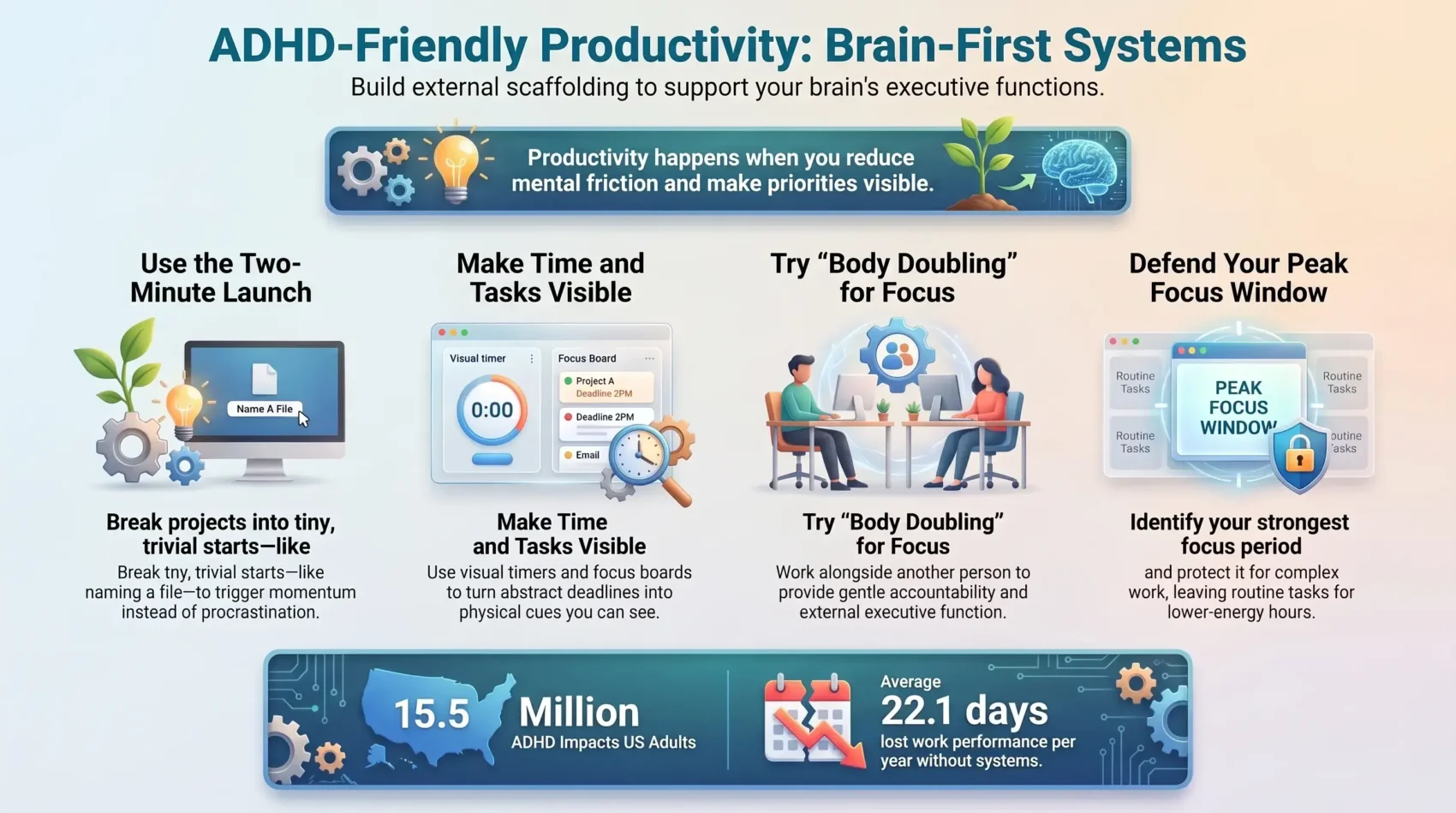
Executive function is your brain’s management system. It handles planning, organization, task initiation, and follow-through. ADHD is common: when the CDC surveyed US households in late 2023, an estimated 6.0% of adults, about 15.5 million people, had a current ADHD diagnosis. You are far from alone.
This guide focuses on creating the right conditions for attention instead of forcing yourself into rigid routines. You will find practical strategies: body doubling, visual cues, timers, rewards, flexible planning, and environmental design, each meant to help you begin, sustain, and finish work that matters.
None of it replaces clinical care. Treatment decisions belong with a qualified clinician, and the systems below are the scaffolding around whatever care you already have.
Key Takeaways
- Your brain may need support, not more self-criticism.
- Executive function guides planning and follow-through.
- Flexible routines can make important tasks easier to start.
- Visual cues and timers can reduce mental friction.
- Body doubling and rewards can help you stay engaged.
- Systems complement treatment. They do not replace it.
Why ADHD Productivity Requires Brain-Friendly Systems
Starting work depends on more than knowing what to do. Your brain has to plan, organize, begin, and finish each step, and when one part of that chain is unclear, a simple task feels surprisingly hard.
Brain-friendly systems reduce friction instead of relying on shame. They give you visible cues, fewer choices, and support you can actually see.
How Executive Function Affects Task Initiation and Follow-Through
Executive function supports planning, organization, task initiation, and follow-through. An ADHD brain may understand the goal perfectly yet struggle to convert it into a first action. That gap does not reflect a lack of care or ability.
Switching between activities costs something too. Every transition asks your brain to rebuild the picture of what you were doing. A vague next step makes that rebuild slower. Fewer transitions and clearer priorities protect your focus. If you routinely misjudge how long that rebuild takes, time blindness is worth reading about, because it explains why an estimate and a stopwatch so often disagree.
The same gap often shows up as busy avoidance: you tidy the desk, clear the inbox, and never open the file. That pattern is productive procrastination, and naming it makes it easier to interrupt.
Why Motivation, Novelty, and Urgency Matter
Routine alone may not create enough interest. Novelty, urgency, connection, and reward make a task feel more compelling. A short deadline, a person waiting, or a finish line you can see may supply the spark.
Brian Tracy’s Eat That Frog suggests doing the hardest task first. The eat the frog method works well if your sharpest hours arrive early, and it backfires if they do not. Choose the order that matches your energy, then build flexible strategies around it.
Build a Simple Planning System for Your Day
A useful plan gives your day a shape without filling every minute. Reserve 15 minutes each morning to decide what matters most, which keeps your to-do list from turning into a wall of text. A daily routine template can carry the parts you should not have to decide twice.
Choose Your Most Important Tasks
Try the Rule of Three: no more than three important tasks for the day. One goal that needs your best focus, then two smaller wins. David Allen’s two-minute rule handles the quick actions, though it turns into a trap when every two-minute job keeps interrupting the one that matters.
Fewer choices also means fewer chances to stall. Decision fatigue tends to bite late in the day, which is a good argument for choosing tomorrow’s first task tonight.
Use Time Blocking With Flexible Buffers
Give each task more time than your first estimate suggests. If work looks like 30 minutes, reserve a 45-minute block. The extra space absorbs transitions, emails, and slow starts, which keeps the schedule honest.
Create Morning and Evening Routines
A 10-minute morning routine can be as small as coffee, calendar, and three priorities. At night, spend five minutes noting wins, capturing loose ends, and setting up tomorrow, then close the laptop so your brain gets permission to stop. A short weekly review catches what a daily pass misses.
Make Starting Tasks Easier With Tiny Actions
A blank screen can feel bigger than the work itself. Your ADHD brain may need a clear entry point before focus shows up. Start with one small action, not the entire project.

Break Overwhelming Projects Into First Steps
Use a two-minute launch. Work briefly instead of trying to finish. Open the report, name the file, write one sentence. That first move lowers the pressure and lets motivation arrive through action rather than before it.
If the project is loud in your head, empty it first. A five-minute brain dump gets every loose thread onto paper, and a habit of capturing tasks in a trusted system keeps them from circling back mid-sentence.
Parkinson’s Law explains why open-ended work can expand without limit:
“Work expands so as to fill the time available for its completion.”
Set a 15-minute boundary for one task. A smaller window limits overthinking and gives your brain a finish line it can see.
Use Timers to Build Momentum
Try a flexible version of the Pomodoro technique, which pairs a timed work sprint with a short break. Use fifteen-minute sprints for tedious work and 45-minute blocks for work that pulls you in. Stop for five minutes, then decide whether to continue. Each finished chunk creates visible progress.
- Pick one clear action.
- Set a timer.
- Adjust the length to your energy, not to a rule.
A countdown you can see beats one you have to imagine. Visual timers turn an abstract 25 minutes into a shrinking wedge of colour, exactly the kind of external cue an ADHD brain can use. Stretching those blocks is its own project, and building your attention span works better as a gradient than a switch.
Use Body Doubling and Accountability to Stay on Track
Some tasks get easier when another person shares the moment. Body doubling uses quiet company to add structure and reduce isolation. The other person does not teach, edit, or solve anything. They work alongside you.
How Body Doubling Supports Focus
Cleveland Clinic describes body doubling as a form of external executive function. Someone else’s focused behaviour models the state you are trying to reach, and their presence supplies gentle accountability. Its clinicians suggest sessions of roughly 20 to 90 minutes. Be clear about the evidence: body doubling rests on clinical experience and design research, not large randomized trials. Treat it as a technique to test on yourself.
Try it with a friend, coworker, or family member. Agree on what each of you will do, then check in when the timer ends. A silent session still counts.
Find an ADHD Buddy or Virtual Coworking Partner
Services such as Focusmate, Flown, and Flow Club pair you with someone for a scheduled session, so the commitment exists before your motivation does. A “Study With Me” video is a lighter alternative when nobody is available.
- Name one task and define what “done” means.
- Set the timer for 25 minutes.
- Say what you finished before starting another round.
If daily tasks stay difficult despite good systems, that is information worth taking to a clinician or an ADHD coach rather than a signal to try harder. Workplace support matters too, and neurodiversity in the workplace covers what adjustments to ask for.
Design Visual Task and Organization Systems
Your workspace can act as external memory. A visible system helps your ADHD brain notice priorities before they vanish behind browser tabs or a crowded digital list.
Keep Priorities Visible With Boards and Sticky Notes
Use sticky notes, a whiteboard, or a small focus board within reach. Assign colours to urgent, creative, and low-energy work so the next action is obvious at a glance. One yellow note for the invoice that is due, one blue for the draft, one green for filing receipts: you pick by colour before you finish reading.
Keep the display small and clear. Today’s goals only, not every idea you may handle someday. A short list guides attention. A long one becomes wallpaper.
Manage Projects Instead of Maintaining Endless To-Do Lists
Replace the endless list with a project view. Keep no more than seven active projects and define one next step for each. Notion, Todoist, or a plain document all work, because the structure matters more than the app. Your calendar then reserves the time the work actually needs.
For reference material rather than actions, a second brain keeps notes findable without cluttering the task list. Ideas that arrive as voice memos need the same treatment, and organizing voice notes describes a workflow that survives the week.
Match Tasks to Your Energy and Focus Patterns
Your energy changes across the day, so your schedule should change with it. For a week, note at three fixed times whether your mind feels sharp, restless, or ready to recover. The pattern that shows up tells you when to write and when to answer email.

Work During Your Personal Peak Focus Period
Find the part of the day when your brain handles demanding work best, then defend it for writing, planning, or problem-solving. The restless hours suit calls, errands, and short interactive tasks that benefit from movement rather than stillness.
Use Movement and Recovery Breaks to Reset Your Brain
When energy drops, stop pushing. Ten to 15 minutes of walking or stretching gives your mind room to come back, and the post-lunch dip is predictable enough to plan around. See afternoon slump cures for what actually helps.
- Note your strongest focus period for one week.
- Match hard work to that window.
- Protect sleep, since short sleep worsens attention, impulse control, and mood.
Caffeine has a long half-life, so an afternoon cup can still be working at bedtime and quietly cost you the next morning.
Create an Environment That Reduces Distractions
Your surroundings either invite focus or pull it away. Name your own triggers first: phone alerts, news sites, a wall of open tabs, the inbox. Your environment should fit your attention patterns, not generic advice.
Identify and Block Your Biggest Distraction Triggers
Forest discourages phone checking during demanding work. StayFocusd limits distracting sites for a set period. Your operating system’s focus mode silences the rest. These barriers help most when willpower is lowest. There are more options in focus tools, and the habits behind them in focus management techniques.
At night, spend five minutes resetting the desk: put things away, close unused tabs, leave only tomorrow’s work in view. That habit removes a morning search you would otherwise pay for in momentum.
Use Sound, Lighting, and Novelty Strategically
Match sound to the work. Instrumental music suits repetitive tasks. Silence or brown noise, a low steady rumble similar to heavy rain, suits complex thinking. Moving to a café, a library, or another room restores novelty when a familiar desk stops working, and rotating lighting or layout helps when attention fades.
Capture matters as much as blocking. A voice memo or note app keeps a thought from evaporating mid-task, so you can park it and return to the work.
Boost ADHD Motivation With Rewards and Support
Meaning turns a chore into a step toward something you want. Sorting your finances is dull; saving for a trip is not. A clear goal gives each small action a reason when interest fades.
Connect Routine Tasks to Meaningful Goals
Chunk large goals into pieces small enough to finish in one sitting, then mark each one with a checkmark or a struck-through line. Visible feedback tells your brain the effort registered, which makes the next piece feel closer.
Use Dopamine-Friendly Rewards Without Losing Momentum
Put the reward after the focused work, not before it. Coffee, a snack, a walk, a short scroll. Set a timer for anything on a screen so it does not quietly become the afternoon. Pairing something you enjoy with something you avoid, known as temptation bundling, makes the trade easier to keep.
Short check-ins add gentle accountability. Ask someone to look at your plan, book a body doubling session, or bring it to a therapist or coach. A standing weekly slot holds better than a one-off promise, which is why accountability partners outlast good intentions. Support should build confidence, not guilt.
Conclusion
Build a system that meets your brain where it is. ADHD productivity is not about copying neurotypical routines. Start with one or two strategies, such as visual planning or a timer, and keep whatever survives a bad week.
Try body doubling when work feels lonely or hard to begin. Keep the daily list short, choose one goal, define the next step, and let small wins carry you.
Progress matters more than perfection, and your output will vary from day to day. The stakes are real: a WHO World Mental Health Survey analysis of more than 7,000 workers across ten countries found that employees with ADHD lost an average of 22.1 more days of work performance per year than their colleagues (de Graaf et al., Occupational and Environmental Medicine, 2008). Better systems will not close that gap on their own, but they make the days you do have easier to use.
If everyday tasks stay unmanageable despite honest effort, a clinical assessment is the next step, not another app. Systems and treatment work best together.
Found this useful?
Make SmartKeys a preferred source on Google, and our articles will surface more often in your Top Stories, AI Overviews, and AI Mode.
Add as Preferred Source