Almost every company now uses AI. Far fewer can show what it earned them. That gap, not access to models, is the defining problem of 2026.
The numbers make the point. Roughly nine in ten organizations report regular AI use, yet in a survey of 2,400 executives published this year, only about 29% saw significant returns from generative AI and just 23% from AI agents. PwC’s 2026 performance study found the concentration even starker: around a fifth of companies capture close to three quarters of AI’s economic gains.
The companies in that top fifth are rarely the ones with the best models. They are the ones that were precise about which work a machine should finish and which work a person should finish.
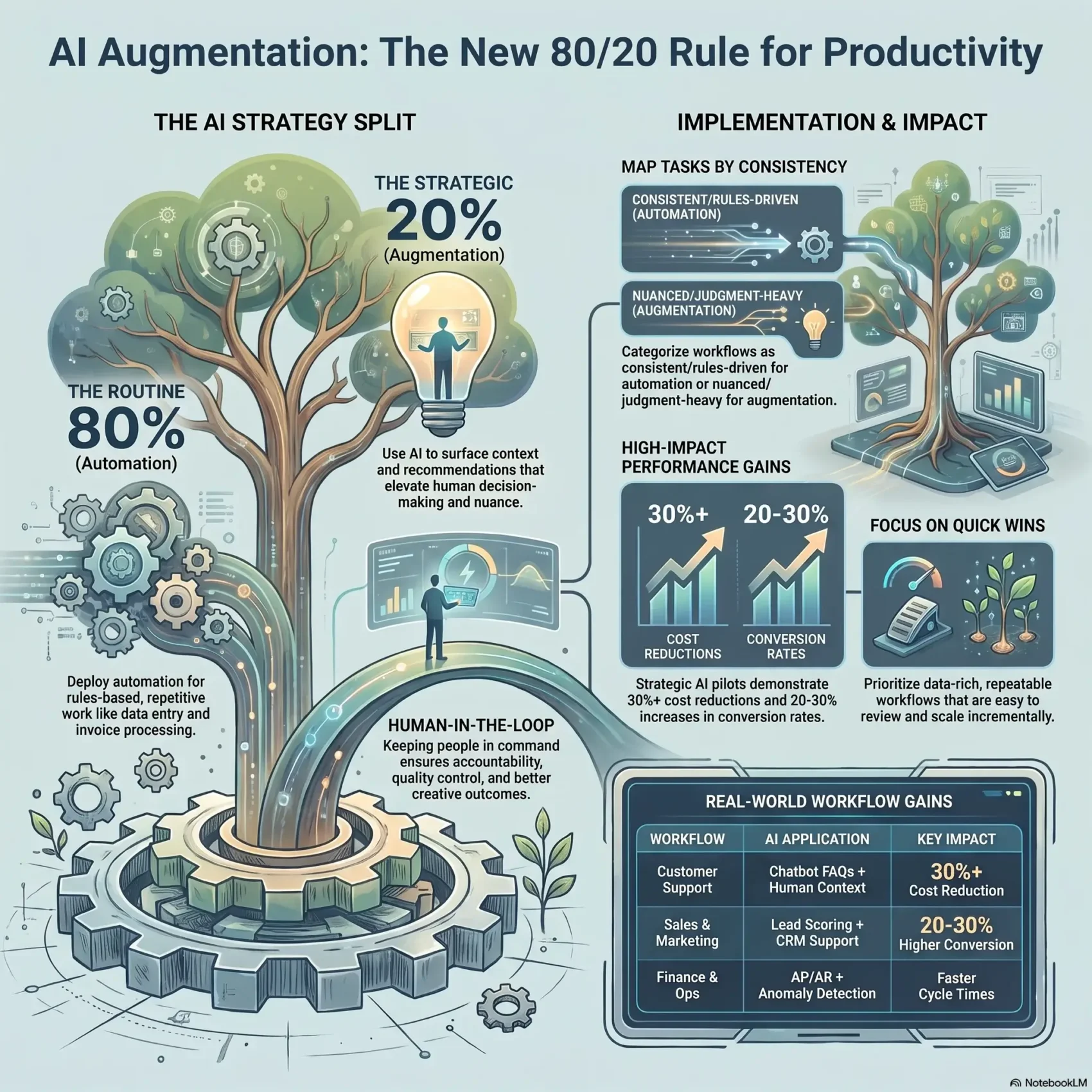
That is the distinction this guide is built on. Automation completes rules-based work end to end. Augmentation puts a machine in front of a person so the person decides better and faster. Most durable value in 2026 comes from combining them deliberately rather than picking a side.
Key Takeaways
- Adoption is no longer the differentiator. Only a minority of firms convert AI use into measurable business value.
- Automate consistent, rules-based work. Augment work that needs judgment, context or accountability.
- Agents changed the middle ground: they now act, not just suggest, which raises the bar on oversight design.
- Plan against production numbers, not vendor benchmarks. The gap is routinely 20 points or more.
- EU high-risk deadlines moved to December 2027, but transparency and AI literacy duties did not.
Why AI augmentation matters in 2026
Mid-market leaders are squeezed from three directions at once: thinner margins, stretched teams, and customers who now expect same-day answers because someone else gave them one.
Augmentation is attractive precisely because it relieves that pressure without adding headcount and without betting the operation on a system running unsupervised.
There is a second reason it matters more this year than last. Worker confidence has not kept pace with worker usage. ManpowerGroup’s 2026 Global Talent Barometer found regular AI use jumped 13 points to reach 45% of workers, while confidence in using the technology fell sharply. People are using tools they do not fully trust. Design that ignores this produces quiet non-adoption, not productivity.
Deloitte’s 2026 Global Human Capital Trends research points at the fix: 57% of leaders say their job is now to teach people how to think with machines, not merely operate them. That is a training and workflow problem, not a licensing one. Our guide to upskilling and reskilling covers how to structure that shift, and a data literacy program gives non-technical staff the vocabulary to challenge a model’s output instead of accepting it.
The question to ask for every use case
Before any pilot, answer one question in a single sentence: are you cutting cost and errors, or are you unlocking speed and better decisions?
Those two goals need different metrics, different owners and different risk tolerances. Teams that skip this end up measuring an augmentation project with automation metrics and concluding, wrongly, that it failed.
What AI augmentation is and how it differs from automation
Think of augmentation as a collaborator that surfaces context, drafts options and flags what you might have missed. It raises the ceiling on what a person can do rather than removing the person.
Three modes, clearly separated:
- Automation executes narrow, rules-based work at machine speed. Invoice matching, ticket routing, anomaly monitoring. No judgment required, so none is offered.
- Augmentation supports human judgment with recommendations, summaries and drafts. The person still signs off.
- Agentic systems plan a sequence of steps and act across tools. They sit between the other two and are the reason oversight design matters more in 2026 than it did in 2024.
That third category is no longer niche. Gartner expects roughly 40% of enterprise applications to embed task-specific agents by the end of 2026, up from under 5% in 2025. Around 31% of enterprises already run at least one agent in production, led by banking and insurance at roughly 47%, with healthcare and government trailing near 18% and 14%.
The same forecast carries a warning: Gartner expects more than 40% of agentic AI projects to be cancelled by 2027, mostly over unclear ROI and weak risk controls. Speed of deployment is not the constraint. Knowing which workflow justifies the operating overhead is.
Why keeping people in the loop still pays
Human review preserves accountability, and accountability is what makes the output usable in a regulated or client-facing context.
There is a subtler benefit. MIT’s Work of the Future group has argued that generative tools create a moral hazard: a worker can produce something that looks authoritative while masking a gap in their own understanding. Their suggested counterweight is structural, not cultural. Build in audits, sample the output, and reward people for catching errors rather than for volume.
That design principle is the core of collaborative intelligence, and it is what separates a team that gets faster from a team that gets faster and wrong.
The technologies doing the work
Natural language processing lets your team ask questions in plain English and get a usable draft back. Predictive models turn historical data into scored recommendations. Retrieval systems ground answers in your own documents instead of the open web.
For examples of copilots and assistants that fit this role, see our overview of AI assistants in future workplaces and the strategic view in AI job augmentation vs replacement. Where the model needs to explain why it recommended something, explainable AI is the relevant discipline.
Decide what to automate and what to augment
Start by mapping what your team actually does, at task level rather than job-title level. Titles are bundles of a dozen tasks with wildly different characteristics.
Task consistency is the first filter. If the steps are the same every time and the inputs are structured, lean toward automation: accounts payable matching, workflow routing, security anomaly monitoring. If the steps vary with context, favour augmentation: lead qualification, forecast review, drafting a client summary before a call.
Outcome goals are the second filter. Reducing manual workload and improving decision quality are different investments with different payback profiles. Across functions, median payback on agent deployments has been measured at roughly five months, but that average hides enormous variance by ticket mix and data quality.
A four-question test before any pilot
- Is the task rules-based or judgment-based? Rules point to automation, judgment to augmentation.
- What does a wrong answer cost, and who finds out? High cost with slow detection means mandatory human review.
- Is the underlying data clean enough that a person would trust it? If not, fix that first.
- Who owns the outcome by name? An unowned pilot produces a demo, not a result.
For the broader landscape of where automation is heading across the stack, our analysis of business automation trends and hyperautomation covers what connects these individual decisions into a programme. If you are starting from a purely manual baseline, the task automation playbook is the faster first step.
How to implement AI augmentation step by step
Lay a simple plan first: match the problems you must solve to the people and data you already have. Business-first, tooling second.
1. Start with strategy, not a tool trial
Map goals, pain points and capacity. Identify which processes carry the most cost or delay and which team will own each one.
Tie every use case to one measurable outcome and one named owner. If you cannot write both on a single line, the use case is not ready.
2. Select high-impact workflows
Prioritise workflows that are data-rich, repeatable and easy to review. Reviewability matters as much as volume, because you cannot improve what you cannot check.
- Shortlist cases that clearly reduce errors or save time.
- Document explicitly which steps are automated and which stay under human review.
- Write down what “good” looks like numerically before the pilot starts, not after.
3. Pilot, measure and iterate
Run small pilots against clear metrics: accuracy, time saved, escalation rate and customer impact. Embed review checkpoints so feedback flows back into prompts, retrieval sources and process design.
Then act on the result. Expand what works, retire what does not, and coach the team so the change survives contact with a busy week. Where models move into regular production, an LLM ops strategy keeps versions, evaluations and costs under control.
Practical playbooks for everyday workflows
Turn common workflows into predictable wins by pairing a capable assistant with human oversight at the point where mistakes get expensive.
Customer support. This is the most mature use case and the one with the widest gap between marketing and reality. Vendors advertise resolution rates in the 67% to 86% range; published case studies from the same vendors cluster nearer 42% to 50%, and independent small-business tests have landed below 40%. B2B deployments typically run well under vendor benchmarks because the tickets are harder. Plan for 40% to 70% and let your knowledge-base quality, not the model, set your expectation. Pricing has moved to outcomes too, roughly a dollar per resolution at Intercom’s Fin and somewhat higher at Zendesk, which makes repeat contacts the hidden cost multiplier. Klarna’s widely cited deployment is the cautionary case: it automated two thirds of chats and cut resolution time dramatically, then committed to an always-available human option after satisfaction dropped on emotional and edge-case tickets. See our deeper look at AI chatbots in customer support and the wider customer service trends for 2026.
Sales and marketing. Use models to score leads, recommend next-best actions and keep CRM records current so reps spend their hours on conversations rather than data entry. The augmentation framing matters here: a score that a rep can interrogate beats a score that simply reorders their list. Predictive analytics is the underlying capability.
Finance and operations. Automate the matching and reconciliation, then layer anomaly detection to flag duplicate payments and suspicious patterns for a human to judge. Forecast review is a good augmentation candidate because the model surfaces the variance and the controller decides what it means. Our guide to finance automation maps the sequence.
Engineering, legal and healthcare. Code assistants cut boilerplate and speed debugging; clinical and legal drafting tools produce a first pass that a professional corrects and signs. In all three, the professional carries the liability, so the interface has to make disagreement easy rather than burying the model’s reasoning. Industry-specific tooling has matured considerably here, as covered in vertical AI solutions.
Make augmentation safe, measurable and scalable
Treat scaling as a safety exercise. Protect the data, monitor performance, and formalise the process before you widen access.
What the EU AI Act now requires, and when
The compliance calendar changed this summer, and a lot of internal roadmaps are still wrong. The Digital Omnibus on AI, Regulation (EU) 2026/1744, was published in the Official Journal on 24 July 2026 and entered into force on 27 July, days before the original deadline.
What moved: obligations for standalone high-risk systems under Annex III, which include AI used in recruitment and employee management, shifted from 2 August 2026 to 2 December 2027. High-risk AI embedded in regulated products under Annex I moved to 2 August 2028.
What did not move: the Article 50 transparency duties, telling people they are talking to a machine and labelling synthetic content, still apply from 2 August 2026, with a short extension to December 2026 for watermarking on systems already on the market. The Article 4 AI literacy obligation has applied since February 2025 and is unaffected.
The practical reading is that the heavy conformity work has breathing room while the everyday obligations are already live. Spend the extra sixteen months on documentation and human-oversight design rather than treating it as a pause. Our guides to EU AI Act compliance and the broader AI regulation landscape for 2026 go into the detail, and if recruitment is in scope, AI hiring bias is the risk to address first.
Data, security and governance
Set clear roles, retention rules and access controls so sensitive data stays protected by design rather than by policy memo. A written AI governance policy and clear generative AI usage guidelines prevent the most common failure mode, which is staff pasting confidential material into consumer tools because nobody told them where the approved one lives. Underneath both sits a functioning data governance strategy.
Performance metrics that hold up
Define a small set of numbers you will actually review: accuracy, time saved, error and escalation rates, and the customer outcome you care about. Track them on a dashboard so drift shows up as a trend rather than a complaint.
Measure what matters: accuracy and customer impact beat vanity metrics every time.
- Standardise human review wherever a model proposes an action with financial or reputational consequences.
- Agree risk thresholds and escalation paths in advance so nobody improvises during an incident.
- Build documentation, training and vendor checks before you widen access, not after.
- Re-baseline quarterly. A model that performed in March may not perform on July’s data.
Conclusion
The durable gains come from linking strategy to small, measurable pilots and then being honest about the results. Protect current operations while you test what actually creates value.
Start with use cases tied to a clear outcome and a named owner. Automate the repeatable steps to cut cost and error. Use augmentation to lift the final decision, where judgment, context and accountability still belong to a person.
The organizations pulling ahead in 2026 are not the ones with the most licences. They are the ones that redesigned the work around the handoff between machine and human, and then trained people to use that handoff well. For the workforce side of that equation, see how companies are redeploying workers for the AI era.
In short: start small, measure impact, scale what proves its worth, and keep people at the centre of the decisions that matter.
Found this useful?
Make SmartKeys a preferred source on Google, and our articles will surface more often in your Top Stories, AI Overviews, and AI Mode.
Add as Preferred Source